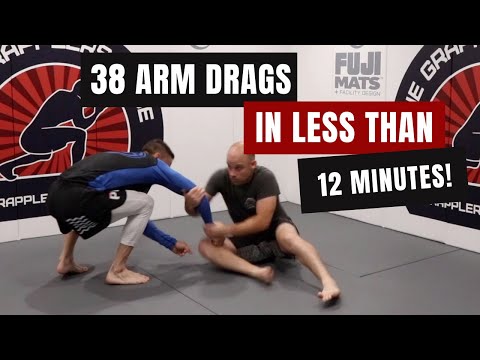
38 Arm Drag Techniques In Less Than 12 Minutes by Jason Scully
0
Arm-Drag·Jiu Jitsu In Minutes by Jason Scully
The arm drag is one of the true "ninja" moves of grappling. It is fast, effective, and catches many opponents off guard.…
Translation: arm drag
The arm-drag wrist lock applies wrist flexion — bending the wrist toward the inner forearm — using an arm-drag grip as the controlling mechanism. [1],[2] The attacker uses a standard arm-drag motion to isolate the opponent's arm, then repositions the grip to fold the wrist inward while controlling the elbow. [1] The arm-drag entry is effective because it simultaneously disrupts the opponent's balance and exposes the wrist for the lock. [1],[3] This technique bridges the gap between wrestling-style arm drags and submission-oriented wrist manipulation. [1]
Arm drags originated in wrestling and were refined for BJJ guard work by Marcelo Garcia, who made them central to his competitive system. [1]
No images yet for this technique.
Sign in to suggest an image.
The arm drag is one of the true "ninja" moves of grappling. It is fast, effective, and catches many opponents off guard.…
BJJ Techniques: ARM DRAG TO BACK TAKE BY GORDON RYAN // In this BJJ Techniques video, Gordon Ryan demonstrates the Arm …
Armdrag TAKEDOWNS | Grappling BJJ Back on our feet today to share you some more takedowns! This time we take a step by s…
The arm drag is a fundamental grappling technique valued for its speed, timing, and effectiveness in both standing and ground positions. All three instructors—Jason Scully (Jiu Jitsu In Minutes), Gordon Ryan (BJJ Fanatics), and Turman Vart (Energia Martial Arts)—emphasize that the arm drag functions as a control mechanism to manipulate an opponent's posture and transition to dominant positions, primarily the back take. Scully provides the most comprehensive catalog of entry points, detailing initiations from hand-fighting, collar ties, overhooks, 2-on-1 grips, and guard positions (closed, butterfly, reverse de la riva, Z half guard), plus top-position arm drags from side control and north-south. Ryan focuses on grip dominance as foundational, arguing that winning initial gripping exchanges determines match control, and emphasizes weight distribution and chest positioning to prevent posture escape. Vart prioritizes practical execution details: wrist-deep grip penetration into the armpit rather than shallow elbow control, chest-to-chest positioning with minimal circling, and simultaneous foot blocking to prevent defensive escape. Where Scully catalogs techniques broadly, Ryan and Vart stress realistic grip-fighting chains and defensive counters. All three agree the arm drag leverages an opponent's reaching or exposed arm, but Vart uniquely addresses judo trips and wrestling-based takedowns (double leg, single leg, slide-in variations) as intermediate attacks before back control, distinguishing the arm drag as not merely a back-take setup but a gateway to diverse finishing options.
Synthesized from 3 instructors
No instructional courses yet for this technique.
Sign in to suggest a course.
Risk of injury to the person this technique is applied to
Wrist lock variant targeting carpal and radioulnar joints through forced deviation or torsion
Skill level needed to execute this technique reliably
Whether this technique is allowed under major competition rule sets
Judo kumi-kata; Shooto / Japanese wrestling
Japanese terminology sourced from Judo kumi-kata; Shooto / Japanese wrestling
Japanese MMA pioneer organization — technique terminology
Standard katakana transliteration of Western martial arts terminology (外来語) — used in Japanese MMA, boxing, and BJJ communities
Japanese terminology sourced from Judo kumi-kata; Shooto / Japanese wrestling
fine motor control, grip sensitivity, quick hand transitions
dexterous hands with strong fingers
forearm flexors and extensors, intrinsic hand muscles
Every move, in any martial art, shares a few universal traits. Mix and match below to pinpoint the right tool — or compare equivalents across styles.
The arm drag from clinch tie-ups is a wrist flexion technique applied during the standing clinch by gripping the opponent's wrist and bending it into flexion while simultaneously dragging the arm across the body to off-balance. [1,2] In the clinch, the wrist becomes vulnerable when the opponent pushes or posts with an extended arm, and the arm drag motion amplifies the wrist lock by adding lateral pulling force to the flexion pressure. [1] The technique combines positional disruption with joint attack, serving both as a takedown setup and a submission threat. [1,2]
The arm drag from seated guard applies a wrist flexion lock while the bottom player uses an arm drag to off-balance the top player from the guard position. [1,2] The guard player grips the opponent's wrist with one hand and the triceps or elbow with the other, pulling the arm across the body while bending the wrist into flexion. [1] The seated guard provides the hip angle and leg control needed to prevent the opponent from simply stepping back to relieve the wrist pressure, trapping them in range for the submission. [1,2]
The arm drag from standing with wrist flexion is applied by gripping the opponent's wrist and dragging the arm across the body while simultaneously bending the wrist into a flexion lock. [1,2] The standing position allows the attacker to use footwork and body rotation to amplify the drag and the wrist bend, creating both positional advantage and joint stress. [1] The technique can produce a submission through wrist pain or serve as a setup for a takedown, back-take, or transition to a more dominant position. [1,2]
The arm drag with gi-specific grip uses the lapel, sleeve, or cuff of the gi uniform to secure the controlling grip for both the drag and the wrist lock, creating friction-based control that is impossible to replicate without the gi. [1,2] The gi fabric allows the attacker to maintain the wrist in flexion even against resistance, as the sleeve grip prevents the opponent from rotating the hand free. [1] The combination of cloth friction and wrist flexion makes this a particularly effective variant in gi grappling competition. [1,2]
Catch your opponent's wrist and grab behind their tricep, then pull them past you to get behind them. Jason Scully emphasizes that you should get your head to the other side, feed their arm to your dragging arm, and drag them through to take their back.
One of the most important skills is to learn how to arm drag off of hand fighting—when you're fighting for your opponent's wrist and they work to get their wrist back, look for arm drag opportunities. Getting an overhook and angle will expose your opponent's arm and make them reach out, which is when you can execute the arm drag.
Re-drag your opponent by grabbing their tricep and pulling it even harder than them, doing it quicker so you can reverse the situation and take their back instead. Gordon Ryan notes that when executing an arm drag, ensure your chest points down toward the floor and put weight over your partner's arm to prevent them from posting up.
Yes—the arm drag is a great way to hit double leg shots because when your opponent reaches out, the arm drag exposes their legs, allowing you to go for your takedown. A baseball slide style arm drag is described as a very high percentage way to get your opponent to the ground.
Grab wrist-deep into your opponent's armpit rather than just behind the elbow or tricep, as this provides better control and reduces the chance of slippage when your opponent is moving. Grabbing too low with only your fingers increases the risk of them slipping away during live training.
The arm-drag wrist lock applies wrist flexion — bending the wrist toward the inner forearm — using an arm-drag grip as the controlling mechanism. The attacker uses a standard arm-drag motion to isolate the opponent's arm, then repositions the grip to fold the wrist inward while controlling the elbow.
Arm-drag techniques are fundamental in wrestling for off-balancing opponents. The combination of the arm drag with a wrist lock submission developed in BJJ and submission grappling where practitioners recognized the wrist vulnerability created during the drag motion.
IBJJF: legal — Legal at all belt levels; IJF: banned — Only elbow joint locks (kansetsu-waza) permitted in judo — all other joint lo…; ADCC: legal — Legal — all submissions legal in ADCC; Unified MMA: legal — Legal submission technique; FIAS Sport Sambo: legal — Legal; FIAS Combat Sambo: legal — Legal
Danger rating 5/10. Wrist lock variant targeting carpal and radioulnar joints through forced deviation or torsion
The standard setup chain: Control the Arm → Position the Hips → Pinch Knees → Extend for the Finish.
Standard counters include: Clasp Hands — grip own wrist to prevent arm extension / Stack — drive forward to compress the attacker and relieve elbow pressure / Hitchhiker Escape — rotate the thumb toward the mat and roll to extract the arm.
Common variants: Standard wrist lock (kote gaeshi) (two-handed rotational lock on the wrist); Gooseneck wrist lock (flexion lock bending the wrist down toward the forearm); Standing wrist lock (applied during grip fighting or a standing exchange); Ground wrist lock (catching the opponent's posted hand from mount, side cont…).
Marcelo Garcia used the arm drag to win multiple ADCC and IBJJF World Championship titles, making it one of the most proven techniques in competition grappling.
Top errors to watch for: Pulling the arm without moving your body — the drag requires you to move past the opponent, not just pull their arm; … / Using only arm strength — the drag uses body weight and hip movement; arm-only drags are slow and easily resisted / Dragging without securing a grip on the tricep — the controlling hand grips the opponent's tricep or upper arm to com… / Not following up immediately — the drag creates a brief window of advantage; failing to move to the back or take a sh….
The Arm-Drag is also known as Āmu Doraggu, Arm Drag Wrist Lock, Arm-Drag Grip Break, Te-otoshi.