Armdrag TAKEDOWNS | Grappling BJJ
0
Arm Drag From Standing·Energia Martial Arts
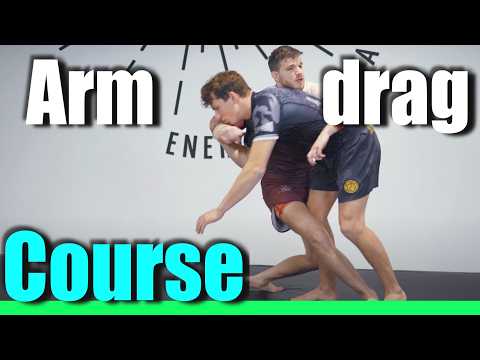
Armdrag TAKEDOWNS | Grappling BJJ Back on our feet today to share you some more takedowns! This time we take a step by s…
Translation: arm drag from standing
The arm drag from standing with wrist flexion is applied by gripping the opponent's wrist and dragging the arm across the body while simultaneously bending the wrist into a flexion lock. [1],[2] The standing position allows the attacker to use footwork and body rotation to amplify the drag and the wrist bend, creating both positional advantage and joint stress. [1] The technique can produce a submission through wrist pain or serve as a setup for a takedown, back-take, or transition to a more dominant position. [1],[2]
Standing arm drags with wrist manipulation are found across multiple martial arts traditions including jujutsu, aikido, and chin na, where standing joint locks are primary techniques. [1],[2] In wrestling, the arm drag is used purely for positional advantage, but martial arts traditions that include joint locks naturally added wrist manipulation to the dragging motion. [1] The standing application is widely taught in self-defense and traditional martial arts curricula. [1],[2]
The standing arm drag creates an angular advantage from the feet, pulling the opponent past to expose the back or set up a takedown. [1]
Standing arm drags are a fundamental wrestling technique adopted into BJJ and MMA. [1]
Standing arm drags are commonly used in wrestling and MMA competition to set up takedowns. [1]
No images yet for this technique.
Sign in to suggest an image.
Armdrag TAKEDOWNS | Grappling BJJ Back on our feet today to share you some more takedowns! This time we take a step by s…
The arm drag is one of the true "ninja" moves of grappling. It is fast, effective, and catches many opponents off guard.…
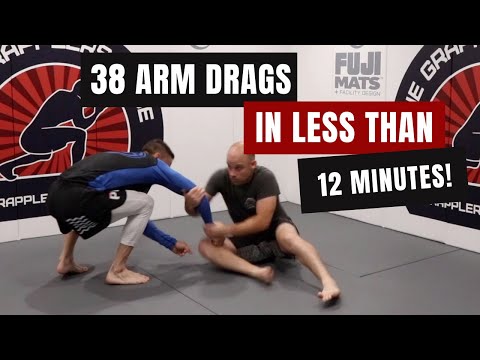
The arm drag from standing is a fundamental grappling technique that both Energia Martial Arts and Jiu Jitsu In Minutes emphasize as a high-percentage setup for takedowns and back control. Both instructors stress proper grip depth and body positioning as critical to success. Energia Martial Arts prioritizes going "wrist deep" into the opponent's armpit rather than grabbing the tricep alone, arguing this controls the torso through the arm rather than isolating limb movement. The instructor emphasizes close-range footwork—stepping chest-to-chest on the inside rather than circling outward—and blocking the opponent's foot simultaneously with the wrist drag to prevent their counter-circling. From this position, Energia Martial Arts details multiple takedown chains including double legs, single legs (especially a slide-in variation requiring proper hand basing), and judo trips. Jiu Jitsu In Minutes casts a wider net, cataloging 38 distinct entry points and contexts for the arm drag: from standing hand-fighting, collar ties, overbooks, and 2-on-1 positions, as well as from guard positions (closed guard, butterfly guard, reverse de la riva, half guard, and sitting guard). Both instructors agree the arm drag is triggered when opponents reach, expose their arms, or post defensively. Jiu Jitsu In Minutes emphasizes speed, timing, and quick switching between arm drag targets when initial attempts are defended. A notable difference: Energia Martial Arts focuses primarily on standing-to-back-control chains with wrestling details, while Jiu Jitsu In Minutes provides comprehensive guard-based arm drag applications and defensive counters, including re-dragging an opponent's attempted arm drag.
Synthesized from 2 instructors
No instructional courses yet for this technique.
Sign in to suggest a course.
Risk of injury to the person this technique is applied to
Wrist lock variant targeting carpal and radioulnar joints through forced deviation or torsion
Skill level needed to execute this technique reliably
Whether this technique is allowed under major competition rule sets
Japanese wrestling/BJJ standard terminology; widely used in Japanese competition
Japanese wrestling/BJJ standard terminology; widely used in Japanese competition
Mixed Japanese-Western terminology — combines traditional Japanese terms with katakana loanwords
Japanese terminology sourced from Japanese wrestling/BJJ standard terminology; widely used in Japanese competition
fine motor control, grip sensitivity, quick hand transitions
dexterous hands with strong fingers
forearm flexors and extensors, intrinsic hand muscles
According to Jason Scully, catch your opponent's wrist and grab behind their tricep, then pull them past you to get behind them. Head positioning is critical—get your head to the other side and feed their arm to your dragging arm so you can drag them back and take their back.
Yes. Jason Scully explains that the arm drag exposes your opponent's legs, allowing you to transition into a double leg takedown. The baseball slide style arm drag is also described as a high-percentage way to bring your opponent to the ground.
According to Energia Martial Arts, grab deep inside the armpit rather than just behind the elbow or tricep—go wrist-deep so your hand cups behind the shoulder. This allows you to control your opponent's torso through their arm, and if they step back, you'll still maintain contact.
Jason Scully recommends quickly grabbing their tricep and pulling harder and faster than they are, executing a re-drag to reverse the situation and take their back instead.
Energia Martial Arts explains that you should look for arm drag opportunities during hand fighting, or work from positions like a collar tie where your opponent is forced to reach or post. You can also drop your head level to encourage them to post on your shoulder, creating the setup.
The arm drag from standing with wrist flexion is applied by gripping the opponent's wrist and dragging the arm across the body while simultaneously bending the wrist into a flexion lock. The standing position allows the attacker to use footwork and body rotation to amplify the drag and the wrist bend, creating both positional advantage and joint stress.
Standing arm drags with wrist manipulation are found across multiple martial arts traditions including jujutsu, aikido, and chin na, where standing joint locks are primary techniques. In wrestling, the arm drag is used purely for positional advantage, but martial arts traditions that include joint locks naturally added wrist manipulation to the dragging motion.
IBJJF: legal — Legal at all belt levels; IJF: banned — Only elbow joint locks (kansetsu-waza) permitted in judo — all other joint lo…; ADCC: legal — Legal — all submissions legal in ADCC; Unified MMA: legal — Legal submission technique; FIAS Sport Sambo: legal — Legal; FIAS Combat Sambo: legal — Legal
Danger rating 5/10. Wrist lock variant targeting carpal and radioulnar joints through forced deviation or torsion
The standard setup chain: Establish Position → Create the Threat → Secure the Hold → Finish.
Standard counters include: Early Recognition — identify the submission attempt early and begin defence immediately / Posture and Base — maintain strong posture and base to prevent submission setups / Grip Fight — deny the attacker their preferred gripping configuration.
Common variants: Standard wrist lock (kote gaeshi) (two-handed rotational lock on the wrist); Gooseneck wrist lock (flexion lock bending the wrist down toward the forearm); Standing wrist lock (applied during grip fighting or a standing exchange); Ground wrist lock (catching the opponent's posted hand from mount, side cont…).
Standing arm drags are commonly used in wrestling and MMA competition to set up takedowns.
Top errors to watch for: Standing still during the drag — your feet must move laterally; dragging without footwork leaves you in front of the … / Pulling with arm strength only — step and drag simultaneously; the body's lateral movement provides the primary force / Not securing the tricep grip — the second hand on the tricep completes the control; without it, the opponent recovers / Dragging too slowly — the arm drag must be explosive; a slow pull allows the opponent to re-centre.
The Arm Drag From Standing is also known as Tachi kara no Āmu Doraggu, Standing Arm Drag, Tachi-waza Arm Drag.