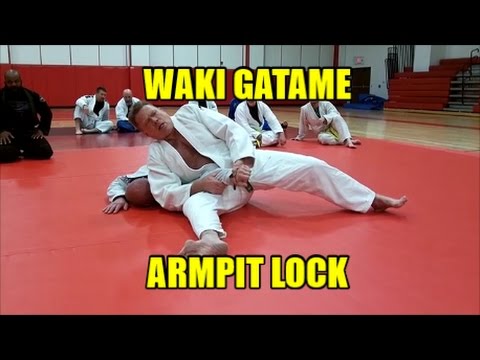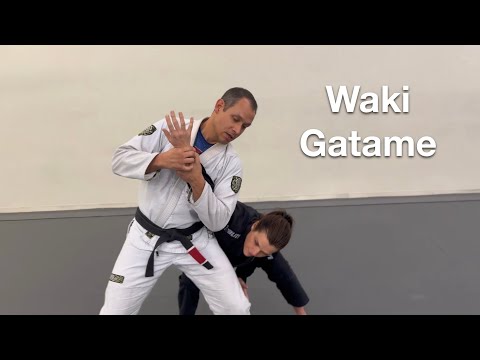
Waki Gatame - when and how to use it.
0
Waki-Gatame From Standing·Robert Silas (Aiki_and_Jiu)
Waki Gatame - when and how to use it. There are a lot of traditional judo example videos on waki gatame, and I’m sure @…
Translation: armpit hold from standing
Waki-gatame from standing is a standing armbar where the attacker traps the opponent's arm under their own armpit and applies downward pressure to hyperextend the elbow joint, using the armpit as the fulcrum. [1],[2] The attacker secures the wrist with both hands, clamps the upper arm under the armpit, and drops their body weight or turns to generate the extension force. [1] Waki-gatame is one of the fastest standing arm locks to apply, often catching opponents during transitions or when they extend an arm to post or push. [1],[2]
Waki-gatame (腋固, armpit hold) is one of the original Kodokan judo kansetsu-waza and is also a core technique in aikido's nikyo and sankyo series. [1],[2] In judo competition, waki-gatame was restricted in some rulesets due to the speed at which it can be applied and the injury risk involved, particularly when executed as a standing sacrifice technique. [1] The technique remains widely taught in self-defense, law enforcement, and traditional martial arts. [1],[2]
Standing waki-gatame applies the armpit lock from an upright position, often catching the arm during a failed grab. [1]
Standing waki-gatame was part of judo's tachi-waza before being restricted due to injury risk. [1]
Standing waki-gatame is banned in IJF competition but appears in MMA and catch wrestling events. [1]
No images yet for this technique.
Sign in to suggest an image.
Waki Gatame - when and how to use it. There are a lot of traditional judo example videos on waki gatame, and I’m sure @…
Waki Gatame (Armpit Lock) is an effective armlock used in many fighting sports. In this video, Coach John Saylor teaches…
Waki-gatame from standing is a traditional jiu-jitsu and judo technique that capitalizes on transitional moments when an opponent is turning or changing position. According to welcomematstevescott, the technique involves positioning the upper chest on the opponent's tricep to eliminate movement, then pulling the lower arm toward one's chest. When the opponent resists by bending their arm, the practitioner can transition to an uchi-garami (underhook shoulder lock) by placing the wrist in the crook of the elbow and applying a gable grip, using body rotation rather than arm strength to create pressure. Robert Silas (Aiki_and_Jiu) emphasizes that waki-gatame is banned in judo tournaments as a standing joint lock but demonstrates its application from self-defense scenarios and its relationship to standing sacrifice throws and ground pins. Silas notes that against trained opponents, the standing lock alone is difficult to achieve; instead, practitioners can exploit the opponent's defensive pull using kuzushi principles to execute throws or transitions to ground control. Both instructors stress precise arm isolation and angle adjustment as critical to effectiveness. Welcomematstevescott prioritizes partner safety, advocating gradual pressure application to avoid injury during repeated drilling, while Silas explores the technique's versatility across standing, transitional, and ground positions, particularly from turtle guard positions.
Synthesized from 2 instructors
No instructional courses yet for this technique.
Sign in to suggest a course.
Risk of injury to the person this technique is applied to
Waki-gatame (armpit armlock) applies sudden force and is considered one of the most dangerous armlocks in judo
Skill level needed to execute this technique reliably
Whether this technique is allowed under major competition rule sets
Kodokan Judo — Official Katame-waza Classification
Kodokan waki-gatame + positional modifier
Standard Japanese martial arts terminology (kanji/hiragana)
Established Japanese martial arts naming convention — native Japanese term (和語/漢語)
Kodokan waki-gatame + positional modifier
hip flexibility, hip bridge power, leg clamping strength
long legs for controlling the opponent's torso
hip extensors (glutes), adductors, quadriceps, hamstrings
Standing waki gatame is one of the few standing arm locks in the Kodokan system — the attacker catches an extended arm and locks it under the armpit while standing. Quick to apply but requires precise timing to catch the arm in extension. (Kano, Kodokan Judo)
You need to lean forward with your ribs on top of your opponent's tricep to eliminate movement, then control their wrist with minimal force. John Saylor emphasizes that this rib pressure is key to keeping the elbow locked in place.
The technique will cause discomfort but you should avoid taking it to full extension. John Saylor notes that doing too many repetitions in training can sideline your partner for weeks, so control the intensity and limit reps in practice.
Robert Silas recommends using kuzushi (off-balancing) by pulling your opponent forward, which naturally makes them sit back and creates the opening for the technique. If a trained opponent keeps their arm tight, you can use that pull to transition to a seated position behind them instead.
Block their face with one hand while dropping your shoulder and scooting your foot out to isolate the arm completely. Robert Silas also emphasizes taking a large step with your leg while maintaining shoulder pressure to prevent them from turning or escaping the lock.
Waki-gatame from standing is a standing armbar where the attacker traps the opponent's arm under their own armpit and applies downward pressure to hyperextend the elbow joint, using the armpit as the fulcrum. The attacker secures the wrist with both hands, clamps the upper arm under the armpit, and drops their body weight or turns to generate the extension force.
Waki-gatame (腋固, armpit hold) is one of the original Kodokan judo kansetsu-waza and is also a core technique in aikido's nikyo and sankyo series. In judo competition, waki-gatame was restricted in some rulesets due to the speed at which it can be applied and the injury risk involved, particularly when executed as a standing sacrifice technique.
IBJJF: legal — Legal at all belt levels; IJF: banned — Only elbow joint locks (kansetsu-waza) permitted in judo — all other joint lo…; ADCC: legal — Legal — all submissions legal in ADCC; Unified MMA: legal — Legal submission technique; FIAS Sport Sambo: legal — Legal; FIAS Combat Sambo: legal — Legal
Danger rating 8/10. Waki-gatame (armpit armlock) applies sudden force and is considered one of the most dangerous armlocks in judo
The standard setup chain: Control the Arm → Position the Hips → Pinch Knees → Extend for the Finish.
Standard counters include: Clasp Hands — grip own wrist to prevent arm extension / Stack — drive forward to compress the attacker and relieve elbow pressure / Hitchhiker Escape — rotate the thumb toward the mat and roll to extract the arm.
Common variants: Standard armbar (hips drive upward against the extended arm with legs clam…); Belly-down armbar (rolling to face the mat to prevent the opponent from stac…); S-mount armbar (transitioned from S-mount position for tighter control be…); Spinning armbar (rapid pivot from guard or side to catch the arm during tr…).
Standing waki-gatame is banned in IJF competition but appears in MMA and catch wrestling events.
Top errors to watch for: Turning too slowly — the 180-degree rotation must be fast; a slow turn gives the opponent time to retract the arm / Not controlling the wrist during the turn — the wrist must stay secured throughout the rotation; losing it releases t… / Over-rotating and losing the arm — turn exactly 180 degrees; over-rotation changes the angle and the arm may escape / Not dropping weight to finish — the standing position alone may not finish; sitting or kneeling adds the decisive force.
The Waki-Gatame From Standing is also known as Waki-gatame (Tachi kara), Standing Waki-Gatame, Standing Side Arm Lock.