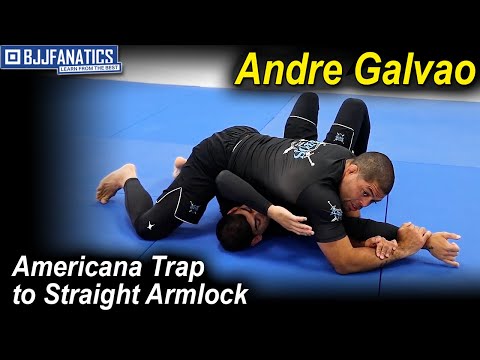
Americana Trap to Straight Armlock Submission Combo by Andre Galvao
0
Straight Armlock·BJJ Fanatics
AMERICANA TRAP TO STRAIGHT ARMLOCK SUBMISSION COMBO https://bjjfanatics.com This BJJ Moves video teaches the Americana …
Translation: arm crush (straight)
The straight armlock hyperextends the elbow by controlling the wrist and applying force against the back of the fully extended arm. [1],[2] Unlike the armbar which uses hip elevation from a perpendicular position, the straight armlock can be applied from various angles using the hands, forearms, or body to press against the elbow while the wrist is pulled. [1] Common entries include from side control (Americana position with the arm straightened), from mount, or as a standing arm lock in self-defense contexts. [1],[3]
Straight arm locks appear across virtually every grappling tradition, from Japanese jujutsu to catch wrestling to European folk wrestling. [1],[2] In judo's kansetsu-waza, the straight extension of the elbow is the foundational principle underlying all arm locks. [2],[3] The technique is also widely used in law enforcement and military restraint methods. [1]
Juji-gatame is the foundational armlock in judo, dating to the Kodokan's original kansetsu-waza curriculum. [1]
No images yet for this technique.
Sign in to suggest an image.
AMERICANA TRAP TO STRAIGHT ARMLOCK SUBMISSION COMBO https://bjjfanatics.com This BJJ Moves video teaches the Americana …
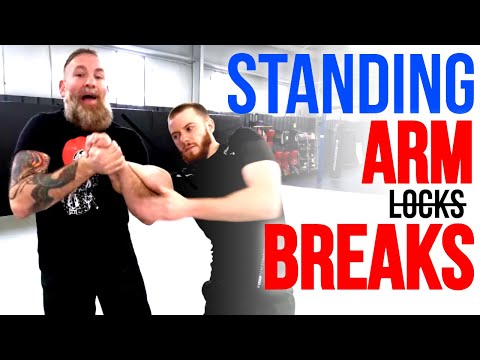
Standing arm locks, or should we call arm breaks are a cornerstone of Japanese Jujitsu Techniques. In the video coach Ma…
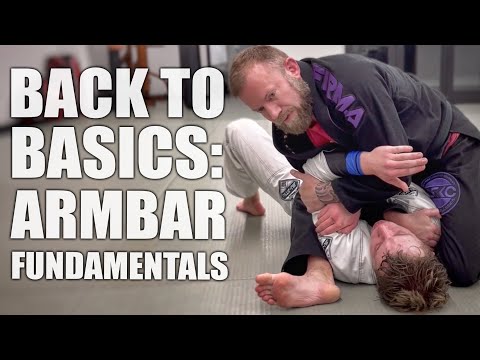
I was made aware the other day how many requests I get for just thorough explanations of fundamentals and basics. So I t…
The straight armlock is a fundamental elbow joint-lock submission that isolates and hyperextends the opponent's arm by controlling the elbow fulcrum while pinning the wrist. BJJ Fanatics' Andre Galvao emphasizes the technique's utility as a transition from the Americana grip, detailing precise hand positioning where the attacker turns the opponent's thumb upward, presses the wrist toward the mat, and lifts the elbow while maintaining frame control—noting that leg placement is critical to prevent the opponent from rotating away. Knight Jiu-Jitsu's Eli provides comprehensive mounted armbar fundamentals, stressing the S-mount position as the optimal setup, with particular attention to the compression component where leg squeeze combines with leverage, and emphasizing that hip thrust should occur only after secure leg compression is established. Both instructors agree on the importance of preventing escape through positional control and compression, though Galvao focuses on side-control variations with leg-frame techniques while Eli details the mounted transition sequence. TRITAC Martial Arts introduces standing straight armlock variations (udi gatami and related techniques), presenting these as breaking techniques in self-defense contexts where violence and speed are essential to snap the elbow quickly, contrasting with sport jiu-jitsu's submission approach. All three instructors converge on the principle that proper elbow positioning and forearm blade contact at the elbow joint create the mechanical advantage necessary for effective submission.
Synthesized from 3 instructors
No instructional courses yet for this technique.
Sign in to suggest a course.
Risk of injury to the person this technique is applied to
Armbars hyperextend the elbow; the most common joint lock submission in grappling and MMA
Skill level needed to execute this technique reliably
Whether this technique is allowed under major competition rule sets
Kodokan Judo — Official Katame-waza Classification
Kodokan — Ude-hishigi (腕挫) straight arm lock
Standard Japanese martial arts terminology (kanji/hiragana)
Established Japanese martial arts naming convention — native Japanese term (和語/漢語)
Kodokan — Ude-hishigi (腕挫) straight arm lock
hip flexibility, hip bridge power, leg clamping strength
long legs for controlling the opponent's torso
hip extensors (glutes), adductors, quadriceps, hamstrings
The straight armlock (ude-hishigi in aikido) appears in 28 passages across 3 books. The Principles and Practice of Aikido (Yamada & Macintosh) describes it as 'the first of the four basic elbow techniques, hiji-waza, applied in the form of a straight armlock, ude-hishigi.' Applied by straightening the arm against a fulcrum. (3 books; Yamada & Macintosh, Principles and Practice of Aikido)
Andre Galvao teaches that when your opponent tries to escape the Americana by turning, you can follow their arm and transition to the straight armlock by stapling their arm in place and attacking from that position.
TRITAC Martial Arts emphasizes that when using a blade or forearm, you should always connect to the inside of the elbow and focus on pushing the elbow forward to create the breaking sensation.
Knight Jiu-Jitsu teaches that the S-mount position is the typical way to catch a straight armlock effectively, where your legs are curved tight and you hug the opponent's arm using body weight rather than arm strength.
Knight Jiu-Jitsu points out that you should cover the opponent's head before your hips hit the ground, and avoid thrusting your hips through the elbow too early—instead, establish compression first to prevent them from escaping via hitchhiker or other methods.
The straight armlock hyperextends the elbow by controlling the wrist and applying force against the back of the fully extended arm. Unlike the armbar which uses hip elevation from a perpendicular position, the straight armlock can be applied from various angles using the hands, forearms, or body to press against the elbow while the wrist is pulled.
Straight arm locks appear across virtually every grappling tradition, from Japanese jujutsu to catch wrestling to European folk wrestling. In judo's kansetsu-waza, the straight extension of the elbow is the foundational principle underlying all arm locks.
IBJJF: legal — Legal at all belt levels, gi and no-gi; IJF: legal — Legal — elbow joint lock (kansetsu-waza), one of the permitted submission cat…; ADCC: legal — Legal — all submissions legal in ADCC; Unified MMA: legal — Legal submission technique; FIAS Sport Sambo: legal — Legal; FIAS Combat Sambo: legal — Legal
Danger rating 7/10. Armbars hyperextend the elbow; the most common joint lock submission in grappling and MMA
The standard setup chain: Control the Arm → Position the Hips → Pinch Knees → Extend for the Finish.
Standard counters include: Clasp Hands — grip own wrist to prevent arm extension / Stack — drive forward to compress the attacker and relieve elbow pressure / Hitchhiker Escape — rotate the thumb toward the mat and roll to extract the arm.
Common variants: Standard armbar (hips drive upward against the extended arm with legs clam…); Belly-down armbar (rolling to face the mat to prevent the opponent from stac…); S-mount armbar (transitioned from S-mount position for tighter control be…); Spinning armbar (rapid pivot from guard or side to catch the arm during tr…).
The straight armbar is the most commonly finished armlock in both judo (IJF) and BJJ (IBJJF, ADCC) competition, and the second most common submission in UFC history.
Top errors to watch for: Not fixing the shoulder — the opponent's shoulder must be pinned to the ground or controlled; a mobile shoulder allow… / Pulling up instead of pressing down — straight armlocks work by driving the attacker's weight into the arm, not by li… / Not isolating the arm from the body — the arm must be separated from the torso; if the elbow stays tight to the body,… / Attempting from an unstable position — maintain top control throughout; if the position is compromised, abandon the l….
The Straight Armlock is also known as Ude-hishigi, Straight Arm Lock, Linear Armbar.