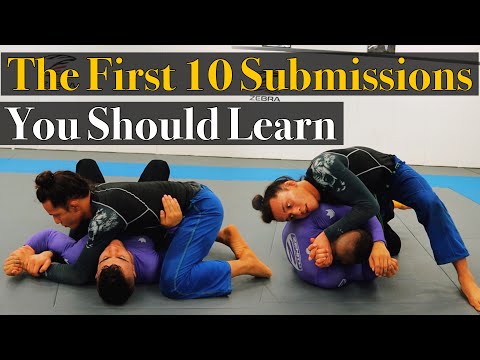
The First 10 Bjj Submissions You Should Learn
0
Armbar·Jedi Does Jiujitsu
In today’s video I’ll be giving you the 10 first bjj submissions that every white belt should learn. These are the submi…
Translation: arm crush cross hold
The armbar (juji-gatame) is the most fundamental elbow lock in grappling, hyperextending the elbow joint by controlling the opponent's wrist and pressing the hips upward against the back of the elbow. [1],[2] The attacker positions perpendicular to the opponent, traps the arm between the legs, and extends the hips while keeping the thumb pointed upward to ensure proper hyperextension alignment. [1] The armbar is applicable from guard, mount, back control, side control, and standing, making it the most versatile joint lock in martial arts. [1],[3]
Juji-gatame (十字固め, 'cross hold') is a foundational Kodokan Judo kansetsu-waza codified in the earliest judo technical curriculum. [2],[3] The technique was carried to Brazil by Mitsuyo Maeda and became central to BJJ's submission arsenal. [1] In MMA, the armbar is consistently among the top three most common submissions alongside the rear naked choke and triangle choke. [1]
The armbar (juji-gatame) is the most universal joint lock in grappling, hyperextending the elbow by trapping the arm between the thighs and lifting the hips against the joint. [1],[2] It is effective from virtually every position — guard, mount, side control, back, and standing. [1] Renzo Gracie and John Danaher describe the armbar as 'the king of submissions' due to its mechanical efficiency and the impossibility of defending once the hips are correctly positioned. [3]
Juji-gatame (十字固め) is a foundational technique of Kodokan Judo's kansetsu-waza, codified by Jigoro Kano. [1] The technique was transmitted to Brazil through Mitsuyo Maeda and became central to Gracie Jiu-Jitsu. [2] In the 1990s, Renzo Gracie and later Demian Maia refined armbar entries from diverse positions, while in judo, Hidehiko Yoshida and Kayla Harrison demonstrated its effectiveness at Olympic level. [3]
The armbar is the most common submission in UFC history, accounting for approximately 21% of all submission wins. [1] Royce Gracie's armbar of Jason DeLucia at UFC 2 (1994) was one of the earliest high-profile MMA armbars. [1] Ronda Rousey won 9 of her first 11 MMA fights by armbar, making it the signature technique of her career. [2] In judo, juji-gatame is the most frequent ippon-winning technique in ne-waza at the Olympic Games. [3]
No images yet for this technique.
Sign in to suggest an image.
In today’s video I’ll be giving you the 10 first bjj submissions that every white belt should learn. These are the submi…
Today's video comes as a request from a viewer named Jake. Jake is a white belt and ask for some Arm Bar techniques tha…
Get the Full Mount Attack Blueprint Course! http://mountattackblueprint.com/ Subscribe for more Jiu Jitsu Secrets to H…
The armbar is a fundamental elbow lock submission highly applicable across jiu-jitsu positions, requiring precise timing, positioning, and mechanics rather than athletic strength. Matt Arroyo Jiu Jitsu emphasizes the critical importance of setup and timing, teaching the technique primarily from mount position where initial control via body lock (heels under buttocks, hips dropped) prevents early escape attempts. Arroyo details the "what time is it" grip—a blade-of-the-forearm pressure applied to the opponent's jaw—as a means to provoke arm lift, followed by securing the S-mount position with the knee under the armpit at least level with the opponent's head. The finish requires locking the head into the shoulder, establishing foot placement under both armpits, then leaning weight to make the attacking leg light before throwing it over the head, clamping the wrist, and extending through the elbow while raising the hips. Chewjitsu presents the guard variation as more accessible for beginners, using grips on the tricep or wrist while controlling distance via collar or trap grip. Chewjitsu emphasizes the diamond guard as a controlled intermediate position when hip speed is limited, and stresses the importance of maintaining a crunched body position to facilitate the hip swivel. Both instructors agree on thumb orientation (facing ceiling), wrist control to prevent rotation, and knee pinching during the finish. Jedi Does Jiujitsu classifies the armbar as a high-percentage fundamental submission suitable for white belts, describing guard, mount, and side control variations while noting the critical importance of cutting angles and maintaining smooth transitions. All three instructors stress that the armbar succeeds through positional control and precise mechanics applied at the correct moment, not forceful rushing.
Synthesized from 3 instructors
No instructional courses yet for this technique.
Sign in to suggest a course.
Risk of injury to the person this technique is applied to
Armbars hyperextend the elbow; the most common joint lock submission in grappling and MMA
Skill level needed to execute this technique reliably
Whether this technique is allowed under major competition rule sets
Kodokan Judo — Official Katame-waza Classification
Kodokan — Ude-hishigi-juji-gatame (腕挫十字固) classification
Alias sources — [1] Kodokan Judo (Kano, 1986) [2] Brazilian Portuguese BJJ terminology [3] Brazilian Portuguese BJJ terminology
Standard Japanese martial arts terminology (kanji/hiragana)
Established Japanese martial arts naming convention — native Japanese term (和語/漢語)
Kodokan — Ude-hishigi-juji-gatame (腕挫十字固) classification
Alias sources — [1] Kodokan Judo (Kano, 1986) [2] Brazilian Portuguese BJJ terminology [3] Brazilian Portuguese BJJ terminology
hip flexibility, hip bridge power, leg clamping strength
long legs for controlling the opponent's torso
hip extensors (glutes), adductors, quadriceps, hamstrings
Control the angle of the wrist so your opponent can't turn it around, then pinch your knees together and clamp your heels down. Chewjitsu emphasizes turning the thumb slightly away toward the head and driving it down into your hip to maintain control.
You need to be in a crunched position so you can swivel more easily off your back. Chewjitsu notes this is a common problem for white belts—when you're slow or struggling to finish, the crunch position allows you to move your head from 12 o'clock to about 9 o'clock to complete the technique.
Timing is critical—Matt Arroyo Jiu Jitsu emphasizes that technique alone won't work if executed at the wrong time. You must lock your opponent down first by locking your feet under their butt with heels high, which prevents elbow escapes and allows you to tire them out before going for the finish.
Lean to control the arm position and make sure your opponent can't lock their hands together before you secure the finish. Matt Arroyo Jiu Jitsu advises lying down, extending the arm as you raise your hips with knees together, then clamping and pulling down to finish.
The armbar (juji-gatame) is the most fundamental elbow lock in grappling, hyperextending the elbow joint by controlling the opponent's wrist and pressing the hips upward against the back of the elbow. The attacker positions perpendicular to the opponent, traps the arm between the legs, and extends the hips while keeping the thumb pointed upward to ensure proper hyperextension alignment.
Juji-gatame (十字固め, 'cross hold') is a foundational Kodokan Judo kansetsu-waza codified in the earliest judo technical curriculum. The technique was carried to Brazil by Mitsuyo Maeda and became central to BJJ's submission arsenal.
IBJJF: legal — Legal at all belt levels, gi and no-gi; IJF: legal — Legal — elbow joint lock (kansetsu-waza), one of the permitted submission cat…; ADCC: legal — Legal — all submissions legal in ADCC; Unified MMA: legal — Legal submission technique; FIAS Sport Sambo: legal — Legal; FIAS Combat Sambo: legal — Legal
Danger rating 7/10. Armbars hyperextend the elbow; the most common joint lock submission in grappling and MMA
The standard setup chain: Control the Arm → Position the Hips → Pinch Knees → Extend for the Finish.
Standard counters include: Clasp Hands — grip own wrist to prevent arm extension / Stack — drive forward to compress the attacker and relieve elbow pressure / Hitchhiker Escape — rotate the thumb toward the mat and roll to extract the arm.
Common variants: Standard armbar (hips drive upward against the extended arm with legs clam…); Belly-down armbar (rolling to face the mat to prevent the opponent from stac…); S-mount armbar (transitioned from S-mount position for tighter control be…); Spinning armbar (rapid pivot from guard or side to catch the arm during tr…).
The armbar is the most common submission in UFC history, accounting for approximately 21% of all submission wins. Royce Gracie's armbar of Jason DeLucia at UFC 2 (1994) was one of the earliest high-profile MMA armbars.
Top errors to watch for: Not getting the arm across the centre line — the arm must cross your body's centre for proper leverage; an arm on the… / Squeezing only with the arms — the legs do the heavy work; the arms secure the wrist while the hips and legs create t… / Not pinching the knees together — open knees allow the opponent to extract the arm; keep knees tight around the upper… / Failing to control the wrist — without wrist control, the opponent bends the arm (hitchhiker escape) or pulls it out.
The Armbar is also known as Ude-hishigi-juji-gatame, Juji-gatame, Chave de Braço, Cross Armlock.
Three common causes: (1) Your hips are not tight against their shoulder — scoot your hips as close as possible to their armpit. (2) Your knees are not pinching together — squeeze your knees to clamp the arm in place. (3) You are pulling the arm toward your chest instead of lifting your hips — the armbar finishes by raising your hips against their elbow, not by pulling down.
Several options: (1) Squeeze your knees together and slowly pry by walking your grip down their wrist. (2) Attack the top hand with a wristlock — they will release to defend. (3) Put your foot on their hip and extend your hips to increase the leverage — their grip will break. (4) Transition to a triangle by swinging your leg over their head.
The S-mount armbar: from mount, swim to high mount with knees in their armpits. Use two-on-one control to isolate one arm, then transition to S-mount (one foot by their head, opposite knee on the mat). From S-mount, swing the leg over their face and sit back. The S-mount provides much more control than jumping directly to the armbar.
It depends on arm position. If one arm is inside and one is outside your guard, the triangle is right there. If both arms are extended toward you (like pushing on your chest), the armbar is more direct. The key insight is that both attacks share the same setups — a failed triangle attempt naturally transitions to an armbar, and vice versa.