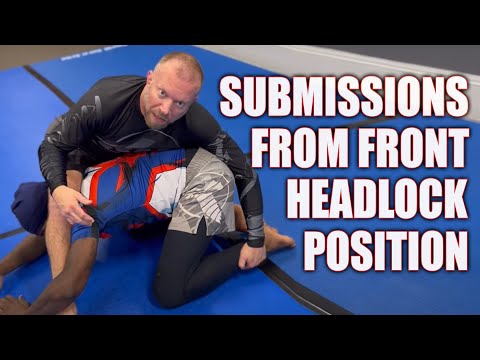
Front Headlock Submission Options | Jiu-Jitsu & Submission Grappling
0
Chin Strap From Front Headlock·Knight Jiu-Jitsu
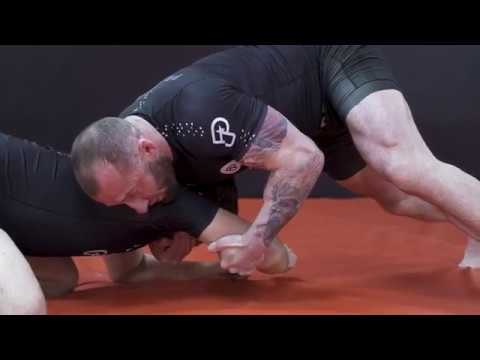
This video focuses on some options off the front headlock on the ground. Whether this was from a sprawl, reversal, snap …
Translation: Chin Strap (katakana loanword); cervical flexion neck crank
The chin strap neck crank from front headlock uses a cupping grip under the opponent's chin from the front headlock position, then drives the chin upward and sideways to create rotational and extension stress on the cervical spine. [1],[2] The front headlock provides the controlling position while the chin strap grip acts as the lever point for the crank. [1] The attacker can finish by twisting the head to one side, pulling upward to extend the neck, or combining both movements to create compound cervical stress. [1],[2]
Chin strap control is a fundamental wrestling concept used for head positioning and opponent manipulation in the clinch and on the ground. [1],[2] The conversion of chin strap control into a neck crank submission developed in catch wrestling and was carried into submission grappling and MMA. [1] The front headlock entry is the most natural setup, as the head is already controlled and the chin is accessible from this position. [1],[2]
A reliable neck crank from front headlock that manipulates the chin and cervical spine; effective when the opponent defends guillotine attempts by tucking the chin [1]
Rooted in catch wrestling's comprehensive front headlock system; the chin strap exploits the chin as a lever to apply cervical torque [1]
Occasional finish in submission-only and MMA events; often used to set up transitions to higher-percentage chokes [1]
No images yet for this technique.
Sign in to suggest an image.
This video focuses on some options off the front headlock on the ground. Whether this was from a sprawl, reversal, snap …
🔥 Upgrade Your Grappling With Our Instructional Courses https://thegrappleclub.com/pages/instructional-courses 🔥 Shop…
The chin strap from front headlock is a control technique that transitions into submissions or positional advantage. Knight Jiu-Jitsu emphasizes the chin strap as one hand positioning option within a broader front headlock system, where the placement of hands—whether blocking the neck on one side and the tricep/bicep on the other—determines submission sequences. From this configuration, Knight Jiu-Jitsu demonstrates multiple submission paths including anaconda chokes, guillotine-style grips, reverse triangles, and crotch lock transitions, with detailed hip mechanics and leg positioning for each variant. The Grapple Club's Kameron Atakuru approaches the chin strap differently, treating it as a primary control mechanism to prevent opponent mobility and escape. Atakuru emphasizes proper hand placement: the shoulder positioned at the back of the neck with the chin cupped in the palm (not forming a fist), avoiding premature hand-tying which invites hand-fighting and single-leg grab defenses. Atakuru's chin strap functions as a weight distribution tool that controls the opponent's head and elbow, allowing the top grappler to circle and achieve positional dominance. Both instructors agree the chin strap controls the neck region effectively, but Knight Jiu-Jitsu focuses on submission-finishing techniques while Atakuru prioritizes using the chin strap as a positional control device to restrict mobility before transitioning to attacks.
Synthesized from 2 instructors
No instructional courses yet for this technique.
Sign in to suggest a course.
Risk of injury to the person this technique is applied to
Flexion cranks force the chin toward the chest; compresses anterior cervical structures
Skill level needed to execute this technique reliably
Whether this technique is allowed under major competition rule sets
Japanese MMA/BJJ standard terminology
Japanese MMA/BJJ standard terminology
Standard katakana transliteration of Western martial arts terminology (外来語) — used in Japanese MMA, boxing, and BJJ communities
Japanese terminology sourced from Japanese MMA/BJJ standard terminology
grip or squeeze strength, positional control
strong upper body for sustained compression
forearms, biceps, pectorals, core stabilisers
Every move, in any martial art, shares a few universal traits. Mix and match below to pinpoint the right tool — or compare equivalents across styles.
The short-lever chin strap flexion applies cervical flexion cranking from front headlock using a short lever arm — the attacker's hands grip directly on the chin or jaw, applying downward force at minimal distance from the neck. [1] The short lever generates intense, concentrated pressure on the cervical spine because the force is applied close to the axis of rotation. [1,2] From front headlock, the attacker cups the chin with one or both hands and pushes it downward toward the opponent's chest while the body weight prevents posture recovery. [2] The short-lever variant trades overall torque for precision and speed, making it effective as a quick pain-compliance submission. [2,3]
The wrist-over-crown flexion places the attacker's wrist over the crown (top) of the opponent's head from a front headlock position, then drives downward to force extreme cervical flexion. [1] The wrist-over-crown placement creates a longer lever arm than the chin strap, as the force is applied at the top of the skull rather than under the jaw. [1,2] This lever arm drives the entire head forward and downward, compressing the cervical vertebrae from the top of the spine and generating intense flexion stress through all seven cervical segments. [2] The wrist-over-crown variant is particularly effective when the opponent is trying to posture up, as the downward force directly opposes their extension effort. [2,3]
According to Kameron Atakuru, the shoulder goes over the top of the neck and the chin is cupped right in the center of the hand. Avoid tying your hands together; instead, control the chin with your elbow to prevent hand fighting and maintain control without relying on grip strength alone.
Knight Jiu-Jitsu shows you can attack a reverse triangle choke by locking your leg in and pushing the opponent's head down to squeeze, or transition to a straight arm bar if the choke isn't available. The position of the opponent's head (inside or outside) determines which submission is most accessible.
Grab the opponent's ankle initially to buy yourself time and prevent them from immediately picking you up and dumping you, as shown in Knight Jiu-Jitsu's instructional. Additionally, Kameron Atakuru emphasizes removing your opponent's mobility by establishing control before they have any ability to escape.
The chin strap neck crank from front headlock uses a cupping grip under the opponent's chin from the front headlock position, then drives the chin upward and sideways to create rotational and extension stress on the cervical spine. The front headlock provides the controlling position while the chin strap grip acts as the lever point for the crank.
Chin strap control is a fundamental wrestling concept used for head positioning and opponent manipulation in the clinch and on the ground. The conversion of chin strap control into a neck crank submission developed in catch wrestling and was carried into submission grappling and MMA.
IBJJF: legal — Legal at all belt levels, gi and no-gi — chokes are the safest submission cat…; IJF: legal — Legal (shime-waza) — strangulation techniques are one of three permitted subm…; ADCC: legal — Legal; Unified MMA: legal — Legal — choke submissions are among the most common finishes in MMA; FIAS Sport Sambo: banned — All chokes prohibited in Sport Sambo; FIAS Combat Sambo: legal — Legal
Danger rating 8/10. Flexion cranks force the chin toward the chest; compresses anterior cervical structures
The standard setup chain: Establish Position → Create the Threat → Secure the Hold → Finish.
Standard counters include: Early Recognition — identify the submission attempt early and begin defence immediately / Posture and Base — maintain strong posture and base to prevent submission setups / Grip Fight — deny the attacker their preferred gripping configuration.
Common variants: Standard grip variation (primary hand configuration for maximum choking pressure); Gi variation (uses the lapel or collar as an anchor for additional fric…); No-gi variation (adapted grip and positioning for submission grappling wit…); Transition finish (applied during a positional change to catch the opponent …).
Occasional finish in submission-only and MMA events; often used to set up transitions to higher-percentage chokes
Top errors to watch for: Gripping the throat instead of the chin — the chin-strap specifically wraps the jaw; throat gripping is both dangerou… / Applying cervical manipulation without positional security — the front headlock must be secure before using the chin-… / Using only one direction of cranking — the chin-strap supports flexion, extension, and rotation; use all three to kee… / Applying explosive force — all cervical techniques require progressive application; the chin-strap's direct mechanica….
The Chin Strap From Front Headlock is also known as Chin Sutorappu, Front Headlock Chin Strap, Headlock Chinstrap Crank.