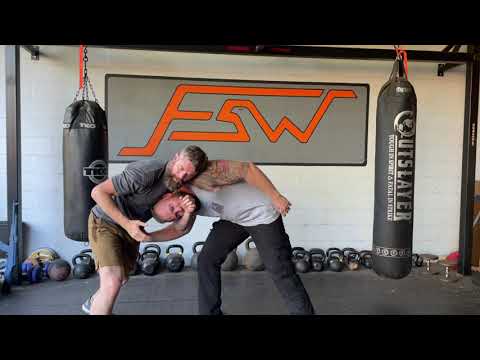
NAUKA Face Clinch Neck Crank Option
0
Chin Strap Neck Crank·Rich Graham·Added by Admin
This video shows another face clinch option from the NAUKA Fighting System. A couple quick points for this face clinch…
チンストラップ(Chin Sutorappu)
TransliterationTranslation: Chin Strap (katakana loanword); cervical flexion neck crank
The chin strap neck crank uses a cupping grip under the opponent's chin to force cervical flexion — driving the chin toward the chest. [1],[2] The attacker places one or both hands under the chin in a 'strap' configuration and pushes or pulls the head downward and forward. [1] Unlike the can opener which uses interlaced fingers behind the head, the chin strap applies direct upward pressure under the jaw to flex the neck. [1],[3] It is commonly used from top position to break posture or force a submission. [1]
Chin strap controls appear in wrestling and self-defense systems as a method to manipulate the opponent's head position. [1],[2] The cranking application developed naturally from the controlling position, becoming a recognized submission technique in catch wrestling and later in BJJ and MMA. [1],[3]
The chin strap provides reliable cervical manipulation through chin control and forced rotation or flexion; a versatile tool that functions as both a submission and a setup for chokes [1]
Found across catch wrestling, traditional jujutsu, and combat sambo systems. Systematized for modern grappling by catch wrestling instructors including Neil Melanson and Josh Barnett [1]
Used regularly in MMA and submission-only competition; finishes more common at regional events than at elite ADCC/IBJJF level [1]
No images yet for this technique.
Sign in to suggest an image.
This video shows another face clinch option from the NAUKA Fighting System. A couple quick points for this face clinch…
No instructional courses yet for this technique.
Sign in to suggest a course.
Risk of injury to the person this technique is applied to
Flexion cranks force the chin toward the chest; compresses anterior cervical structures
Skill level needed to execute this technique reliably
Whether this technique is allowed under major competition rule sets
Japanese MMA/BJJ standard terminology
Japanese MMA/BJJ standard terminology
Standard katakana transliteration of Western martial arts terminology (外来語) — used in Japanese MMA, boxing, and BJJ communities
Japanese terminology sourced from Japanese MMA/BJJ standard terminology
grip or squeeze strength, positional control
strong upper body for sustained compression
forearms, biceps, pectorals, core stabilisers
Unlike a headlock, the chin strap neck crank targets face tissue rather than restricting circulation or strangulation. Rich Graham emphasizes clenching the face versus attacking the neck directly, which makes it a pain-compliance based technique.
Position the bone of your forearm against the face, not the flat part of your arm. This bone-to-face contact creates the painful pressure that generates the quick pain-compliance response needed for the technique to work effectively.
Two things occur simultaneously: the opponent's neck is being bent and their head is being turned. This dual action of neck flexion and rotation is what makes the technique effective for control and pain compliance.
You can yank side to side or pull upward in a quick jerking motion to exit the position, which works even against opponents who significantly outweigh you.
The chin strap neck crank uses a cupping grip under the opponent's chin to force cervical flexion — driving the chin toward the chest. The attacker places one or both hands under the chin in a 'strap' configuration and pushes or pulls the head downward and forward.
Chin strap controls appear in wrestling and self-defense systems as a method to manipulate the opponent's head position. The cranking application developed naturally from the controlling position, becoming a recognized submission technique in catch wrestling and later in BJJ and MMA.
IBJJF: legal — Legal at all belt levels, gi and no-gi — chokes are the safest submission cat…; IJF: legal — Legal (shime-waza) — strangulation techniques are one of three permitted subm…; ADCC: legal — Legal; Unified MMA: legal — Legal — choke submissions are among the most common finishes in MMA; FIAS Sport Sambo: banned — All chokes prohibited in Sport Sambo; FIAS Combat Sambo: legal — Legal
Danger rating 8/10. Flexion cranks force the chin toward the chest; compresses anterior cervical structures
The standard setup chain: Establish Position → Create the Threat → Secure the Hold → Finish.
Standard counters include: Early Recognition — identify the submission attempt early and begin defence immediately / Posture and Base — maintain strong posture and base to prevent submission setups / Grip Fight — deny the attacker their preferred gripping configuration.
Common variants: Standard grip variation (primary hand configuration for maximum choking pressure); Gi variation (uses the lapel or collar as an anchor for additional fric…); No-gi variation (adapted grip and positioning for submission grappling wit…); Transition finish (applied during a positional change to catch the opponent …).
Used regularly in MMA and submission-only competition; finishes more common at regional events than at elite ADCC/IBJJF level
Top errors to watch for: Confusing the chin-strap with a throat grip — the strap wraps under the jaw, not around the throat; the jaw is skelet… / Using the chin-strap without understanding cervical anatomy — the three cranking directions (flexion, extension, rota… / Applying explosive cranking — all chin-strap cervical techniques require progressive force / Not maintaining positional control — the chin-strap requires a stable position for effective cranking; from unstable ….
The Chin Strap Neck Crank is also known as Chin Sutorappu, Chin Strap Crank, Chinstrap Lock, Front Chin Lock.