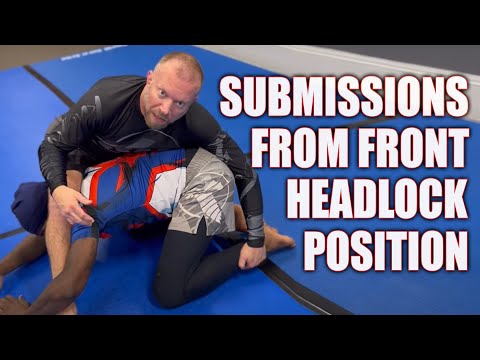
Front Headlock Submission Options | Jiu-Jitsu & Submission Grappling
0
Wrist-Over-Crown Flexion·Knight Jiu-Jitsu
This video focuses on some options off the front headlock on the ground. Whether this was from a sprawl, reversal, snap …
Translation: Chin Strap (katakana loanword); cervical flexion neck crank
The wrist-over-crown flexion places the attacker's wrist over the crown (top) of the opponent's head from a front headlock position, then drives downward to force extreme cervical flexion. [1] The wrist-over-crown placement creates a longer lever arm than the chin strap, as the force is applied at the top of the skull rather than under the jaw. [1],[2] This lever arm drives the entire head forward and downward, compressing the cervical vertebrae from the top of the spine and generating intense flexion stress through all seven cervical segments. [2] The wrist-over-crown variant is particularly effective when the opponent is trying to posture up, as the downward force directly opposes their extension effort. [2],[3]
Crown-of-head manipulation techniques appear in various traditional martial arts including aikido and classical jujutsu, where controlling the top of the head was recognised as a powerful method of directing an opponent's posture. [1] The front headlock application was systematised in modern submission grappling. [2],[3]
Effective cervical manipulation that uses wrist placement over the crown of the head to force neck flexion; a powerful control and submission tool from front headlock [1]
A catch wrestling technique refined by Neil Melanson; the wrist-over-crown detail provides precise pressure application for cervical flexion [1]
Occasionally seen in submission-only and MMA events; more common as a control tool than standalone finish [1]
No images yet for this technique.
Sign in to suggest an image.
This video focuses on some options off the front headlock on the ground. Whether this was from a sprawl, reversal, snap …
No instructional courses yet for this technique.
Sign in to suggest a course.
Risk of injury to the person this technique is applied to
Flexion cranks force the chin toward the chest; compresses anterior cervical structures
Skill level needed to execute this technique reliably
Whether this technique is allowed under major competition rule sets
Japanese MMA/BJJ standard terminology
Japanese MMA/BJJ standard terminology
Standard katakana transliteration of Western martial arts terminology (外来語) — used in Japanese MMA, boxing, and BJJ communities
Japanese terminology sourced from Japanese MMA/BJJ standard terminology
grip or squeeze strength, positional control
strong upper body for sustained compression
forearms, biceps, pectorals, core stabilisers
Knight Jiu-Jitsu teaches that you can lock in a straight armbar from this position, or if you want a choke, push the head down and squeeze to set up a reverse triangle.
Knight Jiu-Jitsu recommends initially grabbing the opponent's ankle to buy yourself time before they can pick you up and dump you.
Knight Jiu-Jitsu suggests using an over-hook or 'wizard' grip to prevent them from funneling you up as easily, which gives you more control of the position.
The wrist-over-crown flexion places the attacker's wrist over the crown (top) of the opponent's head from a front headlock position, then drives downward to force extreme cervical flexion. The wrist-over-crown placement creates a longer lever arm than the chin strap, as the force is applied at the top of the skull rather than under the jaw.
Crown-of-head manipulation techniques appear in various traditional martial arts including aikido and classical jujutsu, where controlling the top of the head was recognised as a powerful method of directing an opponent's posture. The front headlock application was systematised in modern submission grappling.
IBJJF: legal — Legal at all belt levels, gi and no-gi — chokes are the safest submission cat…; IJF: legal — Legal (shime-waza) — strangulation techniques are one of three permitted subm…; ADCC: legal — Legal; Unified MMA: legal — Legal — choke submissions are among the most common finishes in MMA; FIAS Sport Sambo: banned — All chokes prohibited in Sport Sambo; FIAS Combat Sambo: legal — Legal
Danger rating 8/10. Flexion cranks force the chin toward the chest; compresses anterior cervical structures
The standard setup chain: Establish Position → Create the Threat → Secure the Hold → Finish.
Standard counters include: Early Recognition — identify the submission attempt early and begin defence immediately / Posture and Base — maintain strong posture and base to prevent submission setups / Grip Fight — deny the attacker their preferred gripping configuration.
Common variants: Standard grip variation (primary hand configuration for maximum choking pressure); Gi variation (uses the lapel or collar as an anchor for additional fric…); No-gi variation (adapted grip and positioning for submission grappling wit…); Transition finish (applied during a positional change to catch the opponent …).
Occasionally seen in submission-only and MMA events; more common as a control tool than standalone finish
Top errors to watch for: Pushing on the back of the head instead of the crown — crown placement creates flexion; back-of-head pushing creates … / Not using the wrist bone — the bony wrist provides the anchor; a flat palm on the crown slips easily / Applying excessive downward force — cervical flexion across all segments is dangerous; use progressive application / Not maintaining front headlock throughout — the head must be controlled; losing the headlock allows the opponent to p….
The Wrist-Over-Crown Flexion is also known as Chin Sutorappu, Wrist-Over-Crown Chin Lock, Crown Press Chin Strap.