Front Headlock Submission Options | Jiu-Jitsu & Submission Grappling
0
Short-Lever Flexion·Knight Jiu-Jitsu
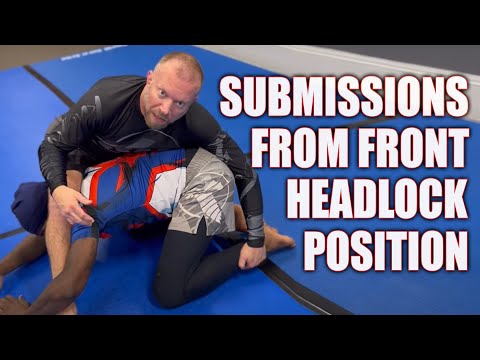
This video focuses on some options off the front headlock on the ground. Whether this was from a sprawl, reversal, snap …
Translation: Chin Strap (katakana loanword); cervical flexion neck crank
The short-lever chin strap flexion applies cervical flexion cranking from front headlock using a short lever arm — the attacker's hands grip directly on the chin or jaw, applying downward force at minimal distance from the neck. [1] The short lever generates intense, concentrated pressure on the cervical spine because the force is applied close to the axis of rotation. [1],[2] From front headlock, the attacker cups the chin with one or both hands and pushes it downward toward the opponent's chest while the body weight prevents posture recovery. [2] The short-lever variant trades overall torque for precision and speed, making it effective as a quick pain-compliance submission. [2],[3]
Chin-strap techniques originate in wrestling and military combatives where controlling the opponent's head through the chin was a standard method. [1] The short-lever flexion variant was classified in modern submission taxonomies to distinguish it from long-lever methods using the arms as extended levers. [2],[3]
The short lever creates intense localized pressure on the cervical spine through forced flexion; effective pain submission but carries injury risk [1]
A catch wrestling and combat sambo cervical technique; the short lever principle maximizes force on the neck through reduced moment arm [1]
Seen in catch wrestling and combat sambo events; rarely used in sport BJJ due to neck crank restrictions [1]
No images yet for this technique.
Sign in to suggest an image.
This video focuses on some options off the front headlock on the ground. Whether this was from a sprawl, reversal, snap …
No instructional courses yet for this technique.
Sign in to suggest a course.
Risk of injury to the person this technique is applied to
Flexion cranks force the chin toward the chest; compresses anterior cervical structures
Skill level needed to execute this technique reliably
Whether this technique is allowed under major competition rule sets
Japanese MMA/BJJ standard terminology
Japanese MMA/BJJ standard terminology
Standard katakana transliteration of Western martial arts terminology (外来語) — used in Japanese MMA, boxing, and BJJ communities
Japanese terminology sourced from Japanese MMA/BJJ standard terminology
grip or squeeze strength, positional control
strong upper body for sustained compression
forearms, biceps, pectorals, core stabilisers
Knight Jiu-Jitsu demonstrates that when the head is on the outside, you can lock the position with your foot behind their back and attack with a straight armbar, or transition to a reverse triangle by pushing their head down and squeezing.
Knight Jiu-Jitsu recommends grabbing the opponent's ankle initially to buy yourself time before they can pick you up and dump you.
Knight Jiu-Jitsu suggests using an over-hook or wizard grip to prevent them from controlling you as easily, which gives you more options to escape or transition.
The short-lever chin strap flexion applies cervical flexion cranking from front headlock using a short lever arm — the attacker's hands grip directly on the chin or jaw, applying downward force at minimal distance from the neck. The short lever generates intense, concentrated pressure on the cervical spine because the force is applied close to the axis of rotation.
Chin-strap techniques originate in wrestling and military combatives where controlling the opponent's head through the chin was a standard method. The short-lever flexion variant was classified in modern submission taxonomies to distinguish it from long-lever methods using the arms as extended levers.
IBJJF: legal — Legal at all belt levels, gi and no-gi — chokes are the safest submission cat…; IJF: legal — Legal (shime-waza) — strangulation techniques are one of three permitted subm…; ADCC: legal — Legal; Unified MMA: legal — Legal — choke submissions are among the most common finishes in MMA; FIAS Sport Sambo: banned — All chokes prohibited in Sport Sambo; FIAS Combat Sambo: legal — Legal
Danger rating 8/10. Flexion cranks force the chin toward the chest; compresses anterior cervical structures
The standard setup chain: Establish Position → Create the Threat → Secure the Hold → Finish.
Standard counters include: Early Recognition — identify the submission attempt early and begin defence immediately / Posture and Base — maintain strong posture and base to prevent submission setups / Grip Fight — deny the attacker their preferred gripping configuration.
Common variants: Standard grip variation (primary hand configuration for maximum choking pressure); Gi variation (uses the lapel or collar as an anchor for additional fric…); No-gi variation (adapted grip and positioning for submission grappling wit…); Transition finish (applied during a positional change to catch the opponent …).
Seen in catch wrestling and combat sambo events; rarely used in sport BJJ due to neck crank restrictions
Top errors to watch for: Applying explosive short-lever force — the concentrated pressure makes this technique dangerous; apply very progressi… / Gripping the throat instead of the chin — the chin-strap wraps under the chin and around the jaw; throat gripping is … / Not using body weight — the short lever works with body-weight-driven force; arm-only flexion is insufficient / Attempting without front headlock control — the chin must be accessible and the head controlled; without positional s….
The Short-Lever Flexion is also known as Chin Sutorappu, Short-Lever Chin Strap, Close-Grip Chin Lock.