Avellan Shows Bas Rutten Neck Crank for BJJ and MMA
0
Rear Neck Crank From Body Triangle·Freestyle Fighting Academy
http://www.FFAcoach.com Marcos Avellan Shows Bas Rutten Neck Crank for Brazilian Jiu-Jitsu (BJJ) and Mixed Martial Arts …
Translation: Rear Neck Crank (katakana loanword)
The rear neck crank from body triangle uses the stable body triangle back control to anchor the opponent's torso while the attacker grips under the chin, across the forehead, or on the face and pulls the head backward into cervical hyperextension. [1],[2] The body triangle's exceptional hip control means the opponent cannot rotate or slide down to relieve the cranking pressure, making this one of the most controlling positions from which to apply a neck crank. [1] The attacker uses the body triangle squeeze and upper body pull simultaneously. [1],[2]
The body triangle became a dominant back control method in high-level BJJ and MMA in the 2010s, particularly after fighters like Luke Rockhold and Islam Makhachev demonstrated its effectiveness. [1],[2] The neck crank from body triangle emerged as a secondary attack when rear naked choke attempts were defended — rather than abandoning the back position, attackers could threaten the spine to force a reaction or tap. [1] This technique represents the modern integration of cranking attacks into the back-attack system. [1],[2]
A powerful secondary attack from body triangle back control that pressures the cervical spine through extension; effective when the opponent defends rear naked choke by protecting the neck [1]
Developed in MMA and no-gi grappling as athletes recognized body triangle's potential for neck cranks beyond traditional chokes. Associated with Khabib Nurmagomedov's back control system [1]
Multiple UFC finishes from body triangle neck crank position; increasingly common in MMA as body triangle back control becomes standard [1]
No images yet for this technique.
Sign in to suggest an image.
http://www.FFAcoach.com Marcos Avellan Shows Bas Rutten Neck Crank for Brazilian Jiu-Jitsu (BJJ) and Mixed Martial Arts …
The can-opener works by simply levering the head forwards. It is rare that it gets a submission; most often it is used t…
Holding and attacking the back with the body triangle, stopping their escape, and tapping them with it, all the info all…
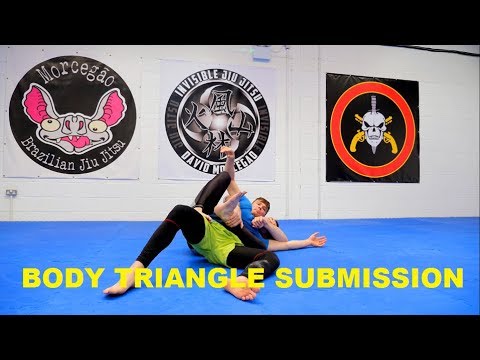
The rear neck crank from body triangle is a cervical extension submission executed from back control with a body triangle (leg lock across the opponent's torso). Freestyle Fighting Academy emphasizes that the technique requires the opponent to be flattened on their back before execution; the attacker must maintain control of one arm while circling the free leg underneath to grip their own thigh, keeping the opponent's arm extended as long as possible to prevent escape via elbow tuck. Once the leg is clasped around the thigh, the attacker leans back and brings the knees together to apply crushing pressure, functioning as both a positional lock and a choke mechanism. Invisible Jiu-Jitsu highlights that the body triangle submission works by restricting the opponent's diaphragm (positioning the triangle above the lungs rather than across the hips) to induce positional asphyxiation, and emphasizes keeping the triangle on the top side to prevent foot lock counters. Both sources note that the submission can succeed through either immediate tap from the neck crank or through sustained positional pressure that restricts breathing. Hand placement high on the inside of the thigh near the knees maximizes leverage (treating the leg as a lever with the handle, not hinge), and consistent squeezing pressure with the knees generates the primary finishing force. The technique is reliable against trained grapplers including wrestlers, though flexibility variations require positional adjustments.
Synthesized from 3 instructors
No instructional courses yet for this technique.
Sign in to suggest a course.
Risk of injury to the person this technique is applied to
Extension cranks force the head backward; risk of vertebral disc and ligament damage
Skill level needed to execute this technique reliably
Whether this technique is allowed under major competition rule sets
Japanese MMA/BJJ standard terminology
Japanese MMA/BJJ standard terminology
Standard katakana transliteration of Western martial arts terminology (外来語) — used in Japanese MMA, boxing, and BJJ communities
Japanese terminology sourced from Japanese MMA/BJJ standard terminology
hip flexibility, long legs relative to torso
longer limbs for easier figure-four lock around head and arm
hip adductors, hamstrings, quadriceps
Every move, in any martial art, shares a few universal traits. Mix and match below to pinpoint the right tool — or compare equivalents across styles.
You want to sit the triangle above the diaphragm, just below the lungs, so you constrict the opponent's ability to move their diaphragm and they choke themselves through positional asphyxiation. Invisible Jiu Jitsu emphasizes positioning high on the body, not low across the hips, which only provides control without the choke.
The pressure works just like a regular triangle—flare your heel and squeeze your knees together in a downward and inward motion. Invisible Jiu Jitsu notes that most of the real squeeze comes from the knees rather than pulling back with your hands.
Fall to the side of your choking hand so it doesn't get trapped underneath your opponent, and position yourself to get high on their thigh so you can apply pressure back and in toward the diaphragm. Invisible Jiu Jitsu stresses not letting the triangle drop to the floor, as your opponent can then escape by stepping over your foot.
The rear neck crank from body triangle uses the stable body triangle back control to anchor the opponent's torso while the attacker grips under the chin, across the forehead, or on the face and pulls the head backward into cervical hyperextension. The body triangle's exceptional hip control means the opponent cannot rotate or slide down to relieve the cranking pressure, making this one of the most controlling positions from which to apply a neck crank.
The body triangle became a dominant back control method in high-level BJJ and MMA in the 2010s, particularly after fighters like Luke Rockhold and Islam Makhachev demonstrated its effectiveness. The neck crank from body triangle emerged as a secondary attack when rear naked choke attempts were defended — rather than abandoning the back position, attackers could threaten the spine to force a reaction or tap.
IBJJF: legal — Legal at all belt levels, gi and no-gi — chokes are the safest submission cat…; IJF: legal — Legal (shime-waza) — strangulation techniques are one of three permitted subm…; ADCC: legal — Legal; Unified MMA: legal — Legal — choke submissions are among the most common finishes in MMA; FIAS Sport Sambo: banned — All chokes prohibited in Sport Sambo; FIAS Combat Sambo: legal — Legal
Danger rating 9/10. Extension cranks force the head backward; risk of vertebral disc and ligament damage
The standard setup chain: Establish Position → Create the Threat → Secure the Hold → Finish.
Standard counters include: Early Recognition — identify the submission attempt early and begin defence immediately / Posture and Base — maintain strong posture and base to prevent submission setups / Grip Fight — deny the attacker their preferred gripping configuration.
Common variants: Standard triangle (classic figure-four leg lock around the head and one arm …); Reverse triangle (legs locked from behind or inverted angle for different a…); Mounted triangle (applied from mount position with gravity assisting the sq…); No-arm triangle (both arms excluded, legs-only compression on the neck).
Multiple UFC finishes from body triangle neck crank position; increasingly common in MMA as body triangle back control becomes standard
Top errors to watch for: Applying cervical manipulation without the body triangle locked — the torso must be stabilised first; without it, the… / Using explosive force — body triangle cranks concentrate force on the cervical spine; progressive application is esse… / Not transitioning to the RNC — the crank forces head movement; capitalise on the opened chin with the choking arm / Holding cranking positions without purpose — the crank should create transitions, not be held at end range.
The Rear Neck Crank From Body Triangle is also known as Ria Nekku Kuranku, Body Triangle Neck Crank, BT Extension Crank.