Introduction to the Rear Neck Crank
The rear neck crank, popularized by Bas Rutten in combat sports literature, is a highly effective submission technique that combines neck and spinal pressure. Despite its appearance as an unconventional or 'circus-like' move, this technique's effectiveness is undeniable, capable of rendering opponents unable to train for weeks if applied with proper pressure.
Prerequisites and Positioning
The rear neck crank requires the opponent to be positioned flat on their back before execution. If the opponent is on their side, the instructor must first flatten their back before attempting the submission. This foundational positioning is critical for the technique's success.
Arm Control and Setup
Maintaining control of the opponent's arm is essential during the initial setup phase. The instructor should press their hand on the opponent's thigh while keeping the arm engaged for as long as possible to prevent escape. Releasing arm control prematurely allows collegiate-level wrestlers to tuck their elbow and bail out of the position.
Leg Positioning and Wrap
The attacking grappler circles their leg through to cup their own thigh, creating a secure leg wrap around the opponent's neck and torso. This leg movement must be executed while maintaining pressure and control, creating the foundation for the final cranking motion.
Final Compression and Finish
Once the leg wrap is secured, the instructor brings their knees together using a 'thigh-master' compression technique to intensify the crank. Most opponents will tap before the knees fully connect; however, holding maximum pressure is advised if initial tapping does not occur, as the positional compression will eventually force submission through respiratory or positional distress.
Hand Placement Mechanics
Critical hand placement should be positioned as close to the knees as possible, functioning as a lever similar to a door handle rather than near the hinge. High hand placement on the thigh ensures maximum mechanical advantage and prevents the opponent from counteracting the pressure. Proper leverage application is essential to avoid telegraphing the technique or allowing defensive adjustments.
Avellan Shows Bas Rutten Neck Crank for BJJ and MMA
Key Takeaways
- •Introduction to the Rear Neck Crank
- •Prerequisites and Positioning
- •Arm Control and Setup
- •Leg Positioning and Wrap
http://www.FFAcoach.com Marcos Avellan Shows Bas Rutten Neck Crank for Brazilian Jiu-Jitsu (BJJ) and Mixed Martial Arts (MMA).
Related Techniques
Frequently Asked Questions
What does this video teach about rear neck crank from body triangle?
This video covers introduction to the rear neck crank, prerequisites and positioning, arm control and setup. It provides detailed instruction from Freestyle Fighting Academy.
How long does it take to learn rear neck crank from body triangle?
The basic mechanics can be understood in a single session, but developing reliable execution requires consistent drilling over weeks of practice. This 6-part breakdown helps structure your training by isolating each phase of the technique.
What are the key details for finishing rear neck crank from body triangle?
Once the leg wrap is secured, the instructor brings their knees together using a 'thigh-master' compression technique to intensify the crank. Most opponents will tap before the knees fully connect; however, holding maximum pressure is advised if initial tapping does not occur, as the positional compression will eventually force submission through respiratory or positional distress.
Related videos

How to counter Can Opener neck crank from closed guard for BJJ
Brazilian Jiu-Jitsu & Submission Grappling

BODY TRIANGLE SUBMISSION!!
Invisible Jiu Jitsu

Avellan Shows Bas Rutten Neck Crank for BJJ and MMA
Freestyle Fighting Academy
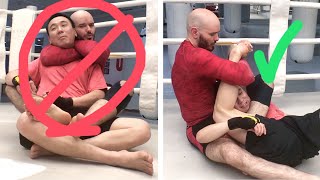
16 backmount submissions besides the RNC
Ramsey Dewey
MMA BJJ Neck Crank Armbar by Avellan! FFA Technique
Freestyle Fighting Academy