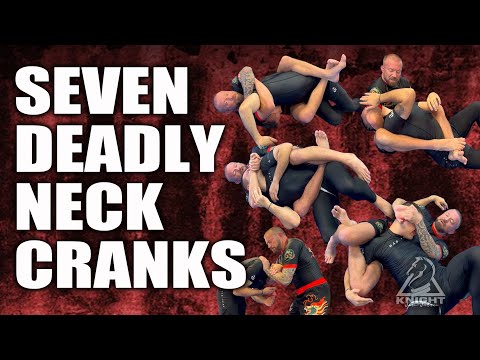
Seven Deadly Neck Cranks | Jiu-Jitsu & Submission Grappling
0
Rear Neck Crank·Knight Jiu-Jitsu
There are obviously more than 7 neck cranks in grappling, but the title has to be catchy... Neck cranks are some of the …
Translation: Rear Neck Wrench
The rear neck crank from back without hooks is a cervical-spine submission applied from a partial back position — chest-to-back contact established, but no hooks or body triangle. [1] Rather than relying on positional control, the attacker uses upper-body grips alone to crank the cervical spine. [1],[2] In the cervical-extension form, the hands gable-grip behind the opponent's head (or the radius bone of the forearm presses under the cheekbone) and drive the chin upward and back while the chest pulls in the opposite direction, forcing extension at the cervical spine. [2] Without hooks, the attacker trades positional stability for speed of attack, making this common in scramble situations and transitions; the absence of leg control means the opponent can potentially rotate free, so the technique requires rapid application. [2],[3]
Rear neck cranks without hooks reflect the reality of scramble-based grappling where back control is incomplete, a situation common in both wrestling and MMA. [1],[2] Wrestlers transitioning to submission grappling brought the instinct to crank the neck from behind even without lower-body control, as wrestling does not require hooks for back control. [1] This variant became recognized in submission grappling as a legitimate finishing option during transitional moments. [1],[2]
The rear neck crank applies extension pressure to the cervical spine from behind, a powerful but dangerous submission. [1]
Rear neck cranks appear in catch wrestling and early MMA as finishing techniques from back control. [1]
Rear neck cranks are legal in MMA and some submission grappling events. [1]
No images yet for this technique.
Sign in to suggest an image.
There are obviously more than 7 neck cranks in grappling, but the title has to be catchy... Neck cranks are some of the …
http://www.FFAcoach.com Marcos Avellan Shows Bas Rutten Neck Crank for Brazilian Jiu-Jitsu (BJJ) and Mixed Martial Arts …
Neck cranks So after a lot of very practical and super professional videos we decided it was time to teach you guys how…
The rear neck crank is a cervical extension submission that applies pressure by hyperextending the opponent's neck backward, typically executed from positions like side control, closed guard, front headlock, or back control. Knight Jiu-Jitsu identifies the foundational "can opener" variation from closed guard, where the attacker bases out, cups the back of the head at the crown, frames the forearm on the collarbone, and sits back while curling the head into the chest to force guard opening. From scarf hold or modified side control, Knight Jiu-Jitsu describes a compression-based variant involving a butterfly or s-grip with forearm placement crucial for rolling ribs backward into the opponent's ribs. Knight Jiu-Jitsu further catalogs advanced applications including the snuff-box crank from rear control (using the radial bone beneath the cheekbone), the front headlock variation (walking hips underneath while clamping the shoulder), and the crucifix-based crank (pulling high by the hairline with hips extended). Energia Martial Arts demonstrates legal progressions toward mounted triangles while emphasizing the illegal chin-strap gable-grip variation from side control, where the foot replaces the hand to trap the arm before twisting upward. Freestyle Fighting Academy presents the Bas Rutten leg-scissor crank (also called the accordion squeeze or trash compactor), requiring the opponent flat on their back, executed by circling a leg underneath while maintaining arm control, then achieving leg lock while cranking—emphasizing hand placement near the knees for maximum leverage. All three instructors stress legality variability by jurisdiction, the dangerous nature of these submissions, and the importance of controlled training.
Synthesized from 3 instructors
No instructional courses yet for this technique.
Sign in to suggest a course.
Risk of injury to the person this technique is applied to
Cervical extension cranks force the head backward, risking vertebral disc injury and nerve damage
Skill level needed to execute this technique reliably
Whether this technique is allowed under major competition rule sets
Koryu Jujutsu; Daito-ryu Aiki-jujutsu — ushiro-waza
Japanese terminology sourced from Koryu Jujutsu; Daito-ryu Aiki-jujutsu — ushiro-waza
Classical schools: Tenjin Shin'yo-ryu, Takenouchi-ryu, etc.
Classical aiki-jujutsu tradition
Standard Japanese martial arts terminology (kanji/hiragana)
Established Japanese martial arts naming convention — native Japanese term (和語/漢語)
Japanese terminology sourced from Koryu Jujutsu; Daito-ryu Aiki-jujutsu — ushiro-waza
hip flexibility, long legs relative to torso
longer limbs for easier figure-four lock around head and arm
hip adductors, hamstrings, quadriceps
Every move, in any martial art, shares a few universal traits. Mix and match below to pinpoint the right tool — or compare equivalents across styles.
The Rear Neck Crank From Back Without Hooks is a neck crank submission applied from a back-control position where the attacker does not have hooks (feet inside the opponent's thighs) — instead maintaining back position through body weight, chest-to-back pressure, or a body triangle while cranking the neck. [1] This variation occurs when standard back hooks have been stripped but the attacker maintains enough positional control to attack the neck. [1,2]
The rear neck crank from body triangle uses the stable body triangle back control to anchor the opponent's torso while the attacker grips under the chin, across the forehead, or on the face and pulls the head backward into cervical hyperextension. [1,2] The body triangle's exceptional hip control means the opponent cannot rotate or slide down to relieve the cranking pressure, making this one of the most controlling positions from which to apply a neck crank. [1] The attacker uses the body triangle squeeze and upper body pull simultaneously. [1,2]
According to Knight Jiu-Jitsu, cranking the neck means applying pressure going up higher toward the temple or hairline, whereas a choke focuses on compressing the neck itself. A neck crank applies rotational or bending force to the neck structure, while a choke restricts blood flow.
Yes. Knight Jiu-Jitsu explains that using a neck crank can force your opponent to open their guard, which allows you to initiate a pass by applying consistent pressure while maintaining good base and hip control.
Knight Jiu-Jitsu recommends placing your forearm's snuff box (the part near your wrist/radius) under the opponent's cheekbone to break their chin tuck, then transitioning to a short choke to crank the neck effectively.
Knight Jiu-Jitsu emphasizes that constantly defending neck cranks causes cumulative neck damage over time, making neck strengthening essential for injury prevention and longevity in a jiu-jitsu career.
The rear neck crank from back without hooks is a cervical-spine submission applied from a partial back position — chest-to-back contact established, but no hooks or body triangle. Rather than relying on positional control, the attacker uses upper-body grips alone to crank the cervical spine.
Rear neck cranks without hooks reflect the reality of scramble-based grappling where back control is incomplete, a situation common in both wrestling and MMA. Wrestlers transitioning to submission grappling brought the instinct to crank the neck from behind even without lower-body control, as wrestling does not require hooks for back control.
IBJJF: banned — Neck cranks and spinal locks prohibited at all belt levels; IJF: banned — Neck cranks prohibited; ADCC: legal — Legal; Unified MMA: legal — Legal — choke submissions are among the most common finishes in MMA; FIAS Sport Sambo: banned — All chokes prohibited in Sport Sambo; FIAS Combat Sambo: legal — Legal
Danger rating 9/10. Cervical extension cranks force the head backward, risking vertebral disc injury and nerve damage
The standard setup chain: Establish Position → Create the Threat → Secure the Hold → Finish.
Standard counters include: Early Recognition — identify the submission attempt early and begin defence immediately / Posture and Base — maintain strong posture and base to prevent submission setups / Grip Fight — deny the attacker their preferred gripping configuration.
Common variants: Standard triangle (classic figure-four leg lock around the head and one arm …); Reverse triangle (legs locked from behind or inverted angle for different a…); Mounted triangle (applied from mount position with gravity assisting the sq…); No-arm triangle (both arms excluded, legs-only compression on the neck).
Rear neck cranks are legal in MMA and some submission grappling events.
Top errors to watch for: Using the rear neck crank as a punishing technique — it should be a control-to-submission tool, not a way to cause un… / Applying explosive flexion from behind — the cervical spine is vulnerable; progressive application allows the opponen… / Not transitioning to the choke when the neck opens — the crank forces the opponent to expose their neck; if you don't… / Attempting from a loose back control — the crank requires the body to be stabilised; without hooks, the opponent simp….
The Rear Neck Crank is also known as Ushiro Kubi Kujiki, Posterior Neck Crank, Ushiro-kubi-hishigi, Back Neck Crank.