Introduction: The Can Opener Problem
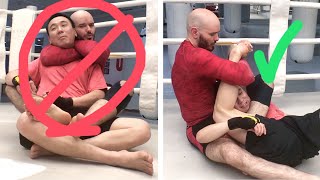
The can opener neck crank from closed guard presents a serious injury risk, hyperextending the spine and potentially causing long-term damage. This instructional guide addresses proven counter-techniques developed by experienced instructors, particularly effective for smaller practitioners.
Foundational Defense: Neck Strengthening
Before executing technical defenses, practitioners must develop baseline neck strength through consistent conditioning during warm-ups. A strong neck provides the first line of defense against spinal hyperextension and allows proper execution of counter-techniques.
Primary Counter: Arm Isolation and Frame
When the opponent initiates the can opener grip, the defender isolates one arm by threading an over-under control and creates a strong frame by flexing the neck muscles. Maintaining active resistance throughout this sequence is critical, as passive acceptance compounds injury risk.
Transition to Armbar: Leg Opening and Hip Swing
From the established frame, the defender opens the legs and rotates the hips to swing into position for an armbar. The opponent's forward pressure inadvertently creates the necessary space for this transition, making the technique flow naturally with proper timing.
Secondary Armbar Option
If the primary armbar angle proves unavailable, an alternative setup utilizing the same initial frame provides a secondary finishing option. Crossed feet do not inhibit this variation's effectiveness.
Alternative Defense: Genie Position and Double Armbar
When the opponent reaches for the can opener grip, the defender immediately brings both arms over the opponent's arms and clasps the elbows while using leg pressure to flatten the body. This creates a momentary opening to transition into a double armbar by extending the neck away from danger and executing a shoulder hop.
Elbows-to-Body Defense Variation
A third option involves pinning the opponent's elbows directly to the defender's torso while using leg extension to move the neck to safety. Though a double armbar may not always result from this position, the technique effectively clears the dangerous position.
Key Principles and Review
Success depends on active neck flexion, creating frames to establish space, and using significantly stronger leg muscles to execute transitions. These techniques apply universally but prove especially valuable for smaller practitioners facing larger opponents.
How to counter Can Opener neck crank from closed guard for BJJ
Key Takeaways
- •Introduction: The Can Opener Problem
- •Foundational Defense: Neck Strengthening
- •Primary Counter: Arm Isolation and Frame
- •Transition to Armbar: Leg Opening and Hip Swing
The can-opener works by simply levering the head forwards. It is rare that it gets a submission; most often it is used to open an opponent’s legs in guard and force them to move. In theory, hyperflexion of the neck can cause extremely serious injuries. The list includes muscle strain, ligament sprain, rupture of the intervertebral discs, facet dislocation or fracture of the vertebrae. The scary thing about necks is that any damage to the spinal cord or the nerves coming from it can cause pain, numbness, weakness or paralysis. The nervous system is particularly unforgiving of injury, and any damage may prove permanent. In the worst case, a dislocated or fractured vertebra could lead to spinal cord damage and paralysis or even death. Worrying though this is, damage of this nature is fairly unlikely in the case of this particular neck crank. It is recommended to practice this at your martial arts school only with supervision. Professor Vanessa Waltz demonstrates two counters to the Can Opener neck crank from closed guard for BJJ or MMA. 1: Frame and Armbar(s) 0:59 2: Genie Grip Double Armbar 2:15 Thank you for watching! www.gbcoloradosprings.com
Related Techniques
Frequently Asked Questions
What does this video teach about rear neck crank from body triangle?
This video covers introduction: the can opener problem, foundational defense: neck strengthening, primary counter: arm isolation and frame. It provides detailed instruction from Brazilian Jiu-Jitsu & Submission Grappling.
How long does it take to learn rear neck crank from body triangle?
The basic mechanics can be understood in a single session, but developing reliable execution requires consistent drilling over weeks of practice. This 8-part breakdown helps structure your training by isolating each phase of the technique.
What are the key details for finishing rear neck crank from body triangle?
A third option involves pinning the opponent's elbows directly to the defender's torso while using leg extension to move the neck to safety. Though a double armbar may not always result from this position, the technique effectively clears the dangerous position.
Related videos

BODY TRIANGLE SUBMISSION!!
Invisible Jiu Jitsu

Avellan Shows Bas Rutten Neck Crank for BJJ and MMA
Freestyle Fighting Academy
Avellan Shows Bas Rutten Neck Crank for BJJ and MMA
Freestyle Fighting Academy
16 backmount submissions besides the RNC
Ramsey Dewey

MMA BJJ Neck Crank Armbar by Avellan! FFA Technique
Freestyle Fighting Academy