Introduction to the Rear Neck Crank
The rear neck crank, popularized by Bas Rutten, is a highly effective submission technique despite its unconventional appearance. Many practitioners initially dismiss it as a circus move, but its devastating effectiveness quickly becomes apparent once properly applied. This technique is particularly valuable in both BJJ and MMA contexts.
Positioning Requirements
The opponent must be positioned flat on their back for optimal execution of this submission. If the opponent is on their side, the instructor must first flatten them to their back before attempting the technique. This positioning is critical for minimizing escape opportunities and maximizing control.
Arm Control and Setup
Maintaining control of the opponent's arm is essential during the initial setup phase. The instructor should keep the arm controlled as long as possible to prevent the opponent from tucking their elbow and escaping. This arm control must be maintained while circling the leg to achieve the proper grip.
Leg Positioning and Grip Acquisition
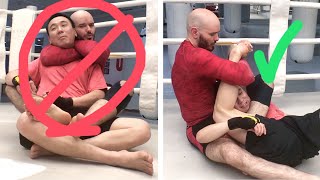
From the controlled position, circle the leg outward to reach underneath the opponent's leg and cup your own thigh. Hand placement should be on the thigh rather than hooked on the quadriceps to maximize leverage. Once the grip is secured, the submission transitions to the final cranking phase.
The Cranking Mechanism
Apply backward pressure while bringing the knees together in a scissor motion, similar to a thigh-master exercise. Most opponents will tap before the knees fully connect; however, continuing the crank creates severe positional pressure that collapses the lungs. Weight distribution should be managed to keep the opponent pinned on their back throughout the motion.
Hand Placement for Maximum Leverage
Hand placement must be as close to the knees as possible on the inside of the thighs to function as a lever. The principle is identical to opening a door—maximum leverage occurs at the handle, not the hinge. Placing hands too low on the quadriceps significantly reduces the mechanical advantage of the submission.
Common Mistakes and Escape Prevention
Against experienced wrestlers, releasing arm control too early allows the opponent to tuck their elbow and escape the position. Minimizing exposure time by maintaining arm control while achieving the leg configuration is critical. Proper hand positioning and weight distribution eliminate most escape routes and ensure submission completion.
Avellan Shows Bas Rutten Neck Crank for BJJ and MMA
Key Takeaways
- •Introduction to the Rear Neck Crank
- •Positioning Requirements
- •Arm Control and Setup
- •Leg Positioning and Grip Acquisition
http://www.FFAcoach.com Marcos Avellan Shows Bas Rutten Neck Crank for Brazilian Jiu-Jitsu (BJJ) and Mixed Martial Arts (MMA).
Related Techniques
Frequently Asked Questions
What does this video teach about rear neck crank?
This video covers introduction to the rear neck crank, positioning requirements, arm control and setup. It provides detailed instruction from Freestyle Fighting Academy.
How long does it take to learn rear neck crank?
The basic mechanics can be understood in a single session, but developing reliable execution requires consistent drilling over weeks of practice. This 7-part breakdown helps structure your training by isolating each phase of the technique.
What are the key details for finishing rear neck crank?
Hand placement must be as close to the knees as possible on the inside of the thighs to function as a lever. The principle is identical to opening a door—maximum leverage occurs at the handle, not the hinge. Placing hands too low on the quadriceps significantly reduces the mechanical advantage of the submission.
Related videos

Neck cranks
Energia Martial Arts

Seven Deadly Neck Cranks | Jiu-Jitsu & Submission Grappling
Knight Jiu-Jitsu

Avellan Shows Bas Rutten Neck Crank for BJJ and MMA
Freestyle Fighting Academy
16 backmount submissions besides the RNC
Ramsey Dewey

Breaking down the Turtle using the Power Half/half-Nelson
Five Points Jiu Jitsu