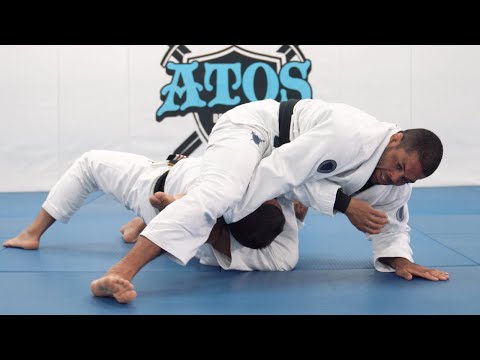
S Mount Triangle Strangle - Andre Galvao
0
Triangular Strangle·Atos Jiu-Jitsu HQ | World's Best BJJ Academy - Home Page
NOW 35%OFF your first year - ALL ACCESS: https://live.atosbjjondemand.com/checkout/subscribe/purchase?code=LEVELUP35&pla…
Translation: Triangle Strangle
The triangular strangle (sankaku-jime) is the primary triangle choke — the attacker locks a figure-four with the legs around the opponent's head and one arm, squeezing the thighs together to compress both carotid arteries. [1],[2] The trapped arm acts as a wedge against one side of the neck while the attacker's thigh compresses the other side. Applied most commonly from closed guard, the triangle can also be executed from mount, side control, and back control. [3],[4],[5]
The triangular strangle uses the triangular configuration of the legs (sankaku) to compress the carotid arteries, one of the most mechanically efficient choke configurations. [1]
The triangular strangle was developed in judo as sankaku-jime and became one of the most important techniques in BJJ. [1]
Triangular strangles are among the most commonly finished submissions across all grappling competition formats. [1]
No images yet for this technique.
Sign in to suggest an image.
NOW 35%OFF your first year - ALL ACCESS: https://live.atosbjjondemand.com/checkout/subscribe/purchase?code=LEVELUP35&pla…
No instructional courses yet for this technique.
Sign in to suggest a course.
Risk of injury to the person this technique is applied to
Triangle chokes compress the carotid arteries using the legs; loss of consciousness in 8-12 seconds
Skill level needed to execute this technique reliably
Whether this technique is allowed under major competition rule sets
Kodokan Judo — Sankaku-jime
Japanese terminology sourced from Kodokan Judo — Sankaku-jime
Official Kodokan ground technique classification system
Standard Japanese martial arts terminology (kanji/hiragana)
Established Japanese martial arts naming convention — native Japanese term (和語/漢語)
Japanese terminology sourced from Kodokan Judo — Sankaku-jime
hip flexibility, long legs relative to torso
longer limbs for easier figure-four lock around head and arm
hip adductors, hamstrings, quadriceps
Every move, in any martial art, shares a few universal traits. Mix and match below to pinpoint the right tool — or compare equivalents across styles.
According to Andre Galvao, you must keep your opponent's arm connected to their body and avoid letting them disconnect their elbow, as this gives them a powerful frame to escape. Keeping the arm tight against the body prevents them from framing effectively.
Andre Galvao emphasizes mounting over the bicep and tricep area rather than the forearm, then bringing your opponent's bicep against their face before going into an ass mount position. Once your knee hits the floor, connect their elbow to their body and clamp your legs super tight.
Pull their head toward you consistently—if their head touches the mat, they can bridge more easily. Keep a pillow grip with your shin to block the bridge, and maintain constant pressure by squeezing your legs while keeping their arm pinned against their body.
Andre Galvao recommends using a C-grip on the wrist and then pulsing it to the floor before getting an underhook. This allows you to control the arm effectively while you position yourself for the strangle.
The triangular strangle (sankaku-jime) is the primary triangle choke — the attacker locks a figure-four with the legs around the opponent's head and one arm, squeezing the thighs together to compress both carotid arteries. The trapped arm acts as a wedge against one side of the neck while the attacker's thigh compresses the other side.
Sankaku-jime (三角絞め) is classified in Kodokan Judo's shime-waza division. Rolls Gracie is widely credited with popularizing the triangle from guard in Brazilian Jiu-Jitsu during the 1970s-1980s.
IBJJF: legal — Legal at all belt levels, gi and no-gi — chokes are the safest submission cat…; IJF: legal — Legal (shime-waza) — strangulation techniques are one of three permitted subm…; ADCC: legal — Legal; Unified MMA: legal — Legal — choke submissions are among the most common finishes in MMA; FIAS Sport Sambo: banned — All chokes prohibited in Sport Sambo; FIAS Combat Sambo: legal — Legal
Danger rating 8/10. Triangle chokes compress the carotid arteries using the legs; loss of consciousness in 8-12 seconds
The standard setup chain: Achieve Controlling Position → Isolate the Neck → Set the Grip → Apply Pressure.
Standard counters include: Tuck Chin — protect the neck by lowering the chin to prevent the choke from sinking / Two-on-One Grip Fight — use both hands to strip the choking grip before it locks / Turn Into — rotate toward the choking arm to relieve carotid pressure / Posture Up — straighten the spine and create distance to break the choking angle.
Common variants: Standard triangle (classic figure-four leg lock around the head and one arm …); Reverse triangle (legs locked from behind or inverted angle for different a…); Mounted triangle (applied from mount position with gravity assisting the sq…); No-arm triangle (both arms excluded, legs-only compression on the neck).
Triangular strangles are among the most commonly finished submissions across all grappling competition formats.
Top errors to watch for: Confusing the triangular strangle with a headscissors — the triangle specifically includes one arm to create the thre… / Not understanding the three-side principle — identify which limb is across the neck, which provides the lock, and whi… / Applying the triangle shape without proper tightness — the geometric shape alone doesn't choke; the triangle must be … / Not cutting the angle — triangular strangles require angular displacement to drive the shoulder into the neck; straig….
The Triangular Strangle is also known as Sankaku-jime, Triangle Choke Family, Leg Triangle.