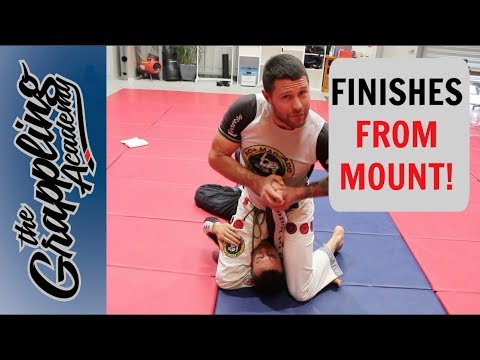
Mounted Triangle - The Easy Way!
0
Mounted Triangle·The Grappling Academy
SALE SALE SALE OVER 50% OFF – BOX SET – ALL 4 COURSES 50% OFF CLICK HERE – https://bit.ly/2lAOHmp • The Blue Belt Sup…
Translation: Triangle Strangle — From Mount
The mounted triangle applies the triangle choke from the mounted position, where the attacker transitions from mount to a triangle configuration by isolating one arm and threading the legs around the opponent's head. [1] From mount, the attacker pushes one of the opponent's arms across their body, then slides the knee over the opponent's neck on the armless side and locks the triangle by hooking the ankle behind the opposite knee. [1],[2] The mounted triangle combines the control advantages of mount with the finishing power of the triangle, and gravity assists the compression as the attacker sits back into the choke. [2] The mount provides multiple control redundancies — even if the triangle isn't perfectly locked, the mount position prevents escape. [2],[3]
The mounted triangle became a standard transition in BJJ competition during the 2000s, as athletes developed systematic pathways from mount to triangle as an alternative to arm locks and collar chokes. [1] This transition represented the integration of positional dominance with leg-based submission attacks. [2],[3]
The mounted triangle applies a triangle choke from the mount, combining positional dominance with one of the strongest choke mechanics. [1]
The mounted triangle was refined in BJJ competition as an advanced mount attack. [1]
Mounted triangles are finished at high-level BJJ competition and in MMA, notably by Demetrious Johnson and Vicente Luque. [1]
No images yet for this technique.
Sign in to suggest an image.
SALE SALE SALE OVER 50% OFF – BOX SET – ALL 4 COURSES 50% OFF CLICK HERE – https://bit.ly/2lAOHmp • The Blue Belt Sup…
No instructional courses yet for this technique.
Sign in to suggest a course.
Risk of injury to the person this technique is applied to
Mounted triangle adds top pressure to the leg choke, making escape more difficult
Skill level needed to execute this technique reliably
Whether this technique is allowed under major competition rule sets
Kodokan Judo — Sankaku-jime
Japanese terminology sourced from Kodokan Judo — Sankaku-jime
Official Kodokan ground technique classification system
Standard Japanese martial arts terminology (kanji/hiragana)
Established Japanese martial arts naming convention — native Japanese term (和語/漢語)
Japanese terminology sourced from Kodokan Judo — Sankaku-jime
hip flexibility, long legs relative to torso
longer limbs for easier figure-four lock around head and arm
hip adductors, hamstrings, quadriceps
The mounted triangle appears in 7 passages across 2 books. Applied from mount by threading one leg under the opponent's chin and locking the triangle — combines the dominance of mount with the choking power of the triangle. Extremely difficult to escape once locked. (2 books in corpus)
Your knee should be positioned high up on the opponent's chest, ideally as far up as you can realistically achieve. The Grappling Academy emphasizes that your knee should look like another arm, and the further up the better, as this creates proper angle and control for the technique.
Sealing the gap between your heel and knee is critical, as this prevents the opponent from escaping by inserting their arm into the space. The Grappling Academy stresses that you should heel as hard as you can while squeezing your knee to your heel with all your body weight, not muscular strength.
If you lack the limb length, flexibility, or trust to complete the triangle, you can bring your knee forward and hit an armbar instead, which The Grappling Academy notes is very effective.
Once you've rolled to your back and secured the triangle position, pull your opponent's head down toward your hamstring rather than straight down, then squeeze to finish. The Grappling Academy emphasizes the direction of the pull is important for proper finishing mechanics.
The mounted triangle applies the triangle choke from the mounted position, where the attacker transitions from mount to a triangle configuration by isolating one arm and threading the legs around the opponent's head. From mount, the attacker pushes one of the opponent's arms across their body, then slides the knee over the opponent's neck on the armless side and locks the triangle by hooking the ankle behind the opposite knee.
The mounted triangle became a standard transition in BJJ competition during the 2000s, as athletes developed systematic pathways from mount to triangle as an alternative to arm locks and collar chokes. This transition represented the integration of positional dominance with leg-based submission attacks.
IBJJF: legal — Legal at all belt levels, gi and no-gi — chokes are the safest submission cat…; IJF: legal — Legal (shime-waza) — strangulation techniques are one of three permitted subm…; ADCC: legal — Legal; Unified MMA: legal — Legal — choke submissions are among the most common finishes in MMA; FIAS Sport Sambo: banned — All chokes prohibited in Sport Sambo; FIAS Combat Sambo: legal — Legal
Danger rating 8/10. Mounted triangle adds top pressure to the leg choke, making escape more difficult
The standard setup chain: Achieve Controlling Position → Isolate the Neck → Set the Grip → Apply Pressure.
Standard counters include: Tuck Chin — protect the neck by lowering the chin to prevent the choke from sinking / Two-on-One Grip Fight — use both hands to strip the choking grip before it locks / Turn Into — rotate toward the choking arm to relieve carotid pressure / Posture Up — straighten the spine and create distance to break the choking angle.
Common variants: Standard triangle (classic figure-four leg lock around the head and one arm …); Reverse triangle (legs locked from behind or inverted angle for different a…); Mounted triangle (applied from mount position with gravity assisting the sq…); No-arm triangle (both arms excluded, legs-only compression on the neck).
Mounted triangles are finished at high-level BJJ competition and in MMA, notably by Demetrious Johnson and Vicente Luque.
Top errors to watch for: Losing mount during the leg-threading transition — maintain weight and base as the leg slides under the neck; the tra… / Not isolating the arm before threading the leg — the arm must be on one side; without isolation, both arms can defend… / Threading the leg too slowly — the transition must be smooth and decisive; slow leg threading allows the opponent to … / Not angling the body after locking — the mounted triangle still requires angular displacement to drive the shoulder i….
The Mounted Triangle is also known as Sankaku-jime — From Mount, Mount Triangle, Top-Position Sankaku.