Strike & defenceLocksClose rangeFighting multiple people
Distance
CloseMiddleLong
Body target
Upper bodyMiddle bodyLower body
Overview
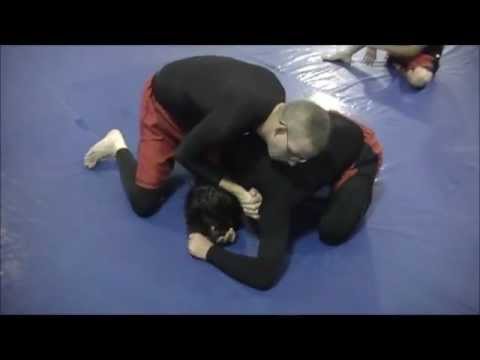
The shoulder-post Peruvian necktie variant modifies the standard entry by using the shoulder as a posting point against the opponent's back while applying the shin-across-neck compression. [1] Instead of sitting fully to the hip, the attacker posts the shoulder against the opponent's upper back, creating an additional pressure point that prevents the opponent from rolling or posturing out. [1],[2] The shoulder post acts as a third contact point — combined with the shin on the neck and the hands on the head, it creates a triangulated pressure system that controls the opponent's entire upper body. [2] This variant is preferred when the opponent is actively resisting by trying to lift or roll through the standard finish. [2],[3]
The shoulder-post modification was developed by competitors who encountered defensive adjustments to the standard Peruvian necktie. [1] As the technique became more widely known in the 2010s, the shoulder post emerged as a necessary adaptation to overcome improved defensive awareness. [2],[3]
Country of origin· shown in random order
🇧🇷BrazilBJJ, Submission Grappling, MMA
🇯🇵JapanBJJ, Judo, Submission Grappling
🇺🇸USASubmission Grappling, MMA
🇷🇺RussiaSambo
Effectiveness
Effective variation that uses a shoulder post to prevent opponent's escape while maintaining head-and-arm pressure; slightly less tight than shin-across-neck but easier to hold [1]
Lineage
Evolved from DeSouza's original Peruvian Necktie; the shoulder post detail was developed by no-gi competitors seeking a more stable finishing position [1]
Competition Record
Seen in ADCC trials and no-gi worlds; less common than the shin variant but used successfully by competitors who prefer a more controlled finish [1]
Images
No images yet for this technique.
Sign in to suggest an image.
Biomechanical Mechanism
Primary Action — Compression of the neck structures — restricts blood flow or airway depending on technique application
Joints Involved — Cervical spine, surrounding musculature, and vascular structures of the neck
Force Vector — Directed compression against the neck from the choking limb or body position
Finishing Mechanic — Sustained pressure causes either vascular occlusion (unconsciousness) or tracheal restriction (breathing difficulty)
Position & Entry
From back control with seatbelt — Establish hooks or body triangle, slide choking arm under the chin, connect hands and squeeze
From turtle top (back take) — Break down the turtle, insert hooks, secure seatbelt grip, slide to back control and apply the choke
From standing back clinch — Secure rear body lock, drag opponent to the mat while inserting hooks, transition to choking position
Variants
Standard grip variation — primary hand configuration for maximum choking pressure
Gi variation — uses the lapel or collar as an anchor for additional friction and control
No-gi variation — adapted grip and positioning for submission grappling without the gi
Transition finish — applied during a positional change to catch the opponent off-guard
✓The Peruvian necktie shoulder-post variant uses the attacker's shoulder pressing into the opponent's back as the compression lever — instead of a shin across the neck, the shoulder drives the body downward while the arms choke (Danaher, Front Headlock System: Go Further Faster, 2019)
✓From front headlock: establish the necktie grip, then drive the shoulder into the opponent's upper back while sprawling — the shoulder pushes the torso down, which forces the head deeper into the choking arm
✓The shoulder post variant doesn't require leg placement: the shoulder serves as the lever, keeping both legs free for base and movement
✓The compression mechanism: the shoulder drives the upper body down while the headlock grip prevents the head from following — the neck is compressed between the downward body and the fixed head
✓This variant is accessible when the leg can't reach over the back: smaller attackers or positions where the leg swing is blocked can use the shoulder post as an alternative
✓Finishing: sprawl the hips aggressively while driving the shoulder forward — the sprawl and shoulder combine to create the downward force that tightens the necktie
✓The shoulder-post variant is more stable than the leg-over-back: both feet remain on the mat, providing better base and balance during the finish
Common Mistakes
!Not sprawling aggressively enough — the shoulder post requires hip drive; a mild sprawl doesn't generate sufficient downward force
!Posting the shoulder on the lower back instead of upper back — the shoulder should press between the shoulder blades; lower placement doesn't affect the neck
!Not maintaining the headlock grip — the grip is the strangle; the shoulder post adds force but can't substitute for the arm position
!Lifting the hips instead of driving them down — the sprawl drives hips toward the mat; lifting the hips removes the force
!Not driving forward with the shoulder — the shoulder must actively push; passive resting on the back doesn't create compression
!Attempting without the opponent in a head-down position — the necktie requires the head to be low; shoulder posting on an upright opponent is ineffective
!Over-relying on the shoulder post for force — the headlock grip and arm positioning are primary; the shoulder post supplements but doesn't replace proper technique
Japanese terminology sourced from Yahoo知恵袋 BJJ community; Acai Cafe (cafe.quietwarriors.com)
Community
Athletics
Requires
grip or squeeze strength, positional control
Favours
strong upper body for sustained compression
Key muscles
forearms, biceps, pectorals, core stabilisers
Frequently Asked Questions
How do I position my shoulder when setting up the front headlock for the Peruvian Necktie?
Rest your shoulder in the middle of the opponent's shoulder blades and get up on your toes. According to Donny Blue, when they land, you want their shoulder in your crotch—not their arm—which creates a tight setup.
What's the key to finishing the Peruvian Necktie when the choke isn't working?
Donny Blue emphasizes squeezing your knees together aggressively while digging deep with your hands. If you can't finish the choke, start ripping and squeezing your knees—this pressure alone can force a tap.
How tight should I be, and what does a bad choke position look like?
You want no space between you and your opponent—if you can see their neck, it's a bad choke position. Donny Blue stresses getting up high and tight, then executing an oblique crunch by pushing off the hip and trying to touch your ear with the back of your hands.
What grip should I use when transitioning from front headlock to the Peruvian Necktie finish?
Use a thumbless grip with one hand underneath. According to Donny Blue, scoop low with your elbow, then when finishing, squeeze your elbows together while your hands aim to touch your ears.
How does the Peruvian Necktie From Front Headlock Shoulder-Post Variant work?
The shoulder-post Peruvian necktie variant modifies the standard entry by using the shoulder as a posting point against the opponent's back while applying the shin-across-neck compression. Instead of sitting fully to the hip, the attacker posts the shoulder against the opponent's upper back, creating an additional pressure point that prevents the opponent from rolling or posturing out.
Where does the Peruvian Necktie From Front Headlock Shoulder-Post Variant come from?
The shoulder-post modification was developed by competitors who encountered defensive adjustments to the standard Peruvian necktie. As the technique became more widely known in the 2010s, the shoulder post emerged as a necessary adaptation to overcome improved defensive awareness.
Is the Peruvian Necktie From Front Headlock Shoulder-Post Variant legal in competition?
IBJJF: legal — Legal at all belt levels, gi and no-gi — chokes are the safest submission cat…; IJF: legal — Legal (shime-waza) — strangulation techniques are one of three permitted subm…; ADCC: legal — Legal; Unified MMA: legal — Legal — choke submissions are among the most common finishes in MMA; FIAS Sport Sambo: banned — All chokes prohibited in Sport Sambo; FIAS Combat Sambo: legal — Legal
How dangerous is the Peruvian Necktie From Front Headlock Shoulder-Post Variant?
Danger rating 9/10. Necktie chokes use leg pressure over the back combined with front headlock grip for extreme compression
How do I set up the Peruvian Necktie From Front Headlock Shoulder-Post Variant?
The standard setup chain: Control Position → Isolate the Arm → Lock the Figure-Four → Apply Rotation.
How do I defend against the Peruvian Necktie From Front Headlock Shoulder-Post Variant?
Standard counters include: Straighten the Arm — extend the arm to break the figure-four grip angle / Roll Toward — roll in the direction of the lock to relieve rotational pressure / Grip the Belt/Shorts — anchor the hand to prevent the arm from being isolated.
What are the variants of the Peruvian Necktie From Front Headlock Shoulder-Post Variant?
Common variants: Standard grip variation (primary hand configuration for maximum choking pressure); Gi variation (uses the lapel or collar as an anchor for additional fric…); No-gi variation (adapted grip and positioning for submission grappling wit…); Transition finish (applied during a positional change to catch the opponent …).
How effective is the Peruvian Necktie From Front Headlock Shoulder-Post Variant in competition?
Seen in ADCC trials and no-gi worlds; less common than the shin variant but used successfully by competitors who prefer a more controlled finish
What are common mistakes when doing the Peruvian Necktie From Front Headlock Shoulder-Post Variant?
Top errors to watch for: Not sprawling aggressively enough — the shoulder post requires hip drive; a mild sprawl doesn't generate sufficient d… / Posting the shoulder on the lower back instead of upper back — the shoulder should press between the shoulder blades;… / Not maintaining the headlock grip — the grip is the strangle; the shoulder post adds force but can't substitute for t… / Lifting the hips instead of driving them down — the sprawl drives hips toward the mat; lifting the hips removes the f….
What are other names for the Peruvian Necktie From Front Headlock Shoulder-Post Variant?
The Peruvian Necktie From Front Headlock Shoulder-Post Variant is also known as Peruvian Nekutai, Shoulder-Post Peruvian Necktie, Posted Peruvian Necktie.