Strike & defenceLocksClose rangeFighting multiple people
Distance
CloseMiddleLong
Body target
Upper bodyMiddle bodyLower body
Overview
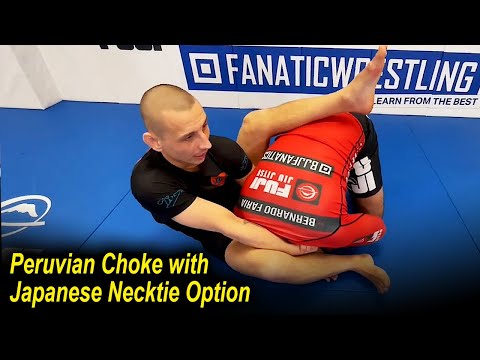
The Peruvian necktie from closed guard with shin across the neck applies the necktie's signature leg-over-head mechanic from a bottom guard position. [1] The attacker, playing closed guard, wraps the opponent's neck in a front headlock grip, then opens the guard and swings one shin across the back of the opponent's neck, pressing downward to create a lever effect. [1],[2] The shin acts as a wedge that drives the opponent's head forward into the choking arm, dramatically amplifying the compression without requiring upper body strength. [2] This guard application is less common than the top-position entries but is effective as a surprise attack when the opponent drops their head low while attempting to pass. [2],[3]
The Peruvian necktie was originated by Tony DeSouza, a Peruvian-American MMA fighter, who first demonstrated it in professional competition. [1] The closed guard variant emerged as creative BJJ players adapted DeSouza's technique into their guard attack systems during the late 2000s. [2],[3]
Country of origin· shown in random order
🇧🇷BrazilBJJ, Submission Grappling, MMA
🇯🇵JapanBJJ, Judo, Submission Grappling
🇺🇸USASubmission Grappling, MMA
🇷🇺RussiaSambo
Effectiveness
Rarely seen in competition due to the difficulty of securing shin-across-neck from closed guard; more of a novelty setup than a reliable finish [1]
Lineage
Derived from Tony DeSouza's original Peruvian Necktie concept, adapted to guard by creative no-gi grapplers in the late 2000s [1]
Competition Record
Virtually no recorded finishes at major competition level; occasionally attempted in local no-gi events [1]
Images
No images yet for this technique.
Sign in to suggest an image.
Biomechanical Mechanism
Primary Action — Compression of the neck structures — restricts blood flow or airway depending on technique application
Joints Involved — Cervical spine, surrounding musculature, and vascular structures of the neck
Force Vector — Directed compression against the neck from the choking limb or body position
Finishing Mechanic — Sustained pressure causes either vascular occlusion (unconsciousness) or tracheal restriction (breathing difficulty)
Position & Entry
From back control with seatbelt — Establish hooks or body triangle, slide choking arm under the chin, connect hands and squeeze
From turtle top (back take) — Break down the turtle, insert hooks, secure seatbelt grip, slide to back control and apply the choke
From standing back clinch — Secure rear body lock, drag opponent to the mat while inserting hooks, transition to choking position
Variants
Standard grip variation — primary hand configuration for maximum choking pressure
Gi variation — uses the lapel or collar as an anchor for additional friction and control
No-gi variation — adapted grip and positioning for submission grappling without the gi
Transition finish — applied during a positional change to catch the opponent off-guard
✓The Peruvian necktie from closed guard with shin across the neck uses the shinbone as an additional compression surface while maintaining the headlock grip — the shin reinforces the strangle from a guard-based entry (Danaher, Front Headlock System: Go Further Faster, 2019)
✓From closed guard: establish the Peruvian necktie headlock grip, then place the shin of one leg across the back of the opponent's neck — the shin acts as a bar that drives the head into the choking arm
✓The shin across the neck is the key detail: the hard shinbone creates a rigid surface that prevents the opponent from posturing while adding downward compression
✓The guard-based entry: pull guard with the necktie grip already established, then work the leg into the shin-across-neck position — the leg placement converts the headlock into a finished choke
✓The shin and arm work in opposition: the arm pulls the neck in one direction while the shin pushes from the other — the neck is caught between two rigid surfaces
✓This variation is effective when the standard Peruvian necktie finish (leg over back from top) isn't available: the guard version provides an alternative finishing angle
✓The shin-across-neck position also creates a platform for transitioning to triangles and gogoplata if the necktie doesn't finish
Common Mistakes
!Placing the calf instead of the shin — the shin bone creates focal pressure; the soft calf muscle disperses force
!Not maintaining the headlock grip while positioning the leg — the grip must stay tight; loosening during the leg placement allows escape
!Attempting without breaking the opponent's posture — the opponent must be pulled into the guard; an upright opponent's neck is out of reach for the shin
!Not using the other leg to control the opponent's body — the non-shin leg should hook the opponent's back or hip to prevent them from pulling away
!Placing the shin too high (on the head) or too low (on the upper back) — the shin must be on the neck, behind the skull base
!Not pulling the head into the shin — the arm must actively pull the opponent's head into the shin bar; passive positioning lacks compression
!Over-focusing on the shin placement and losing the guard position — maintain guard control throughout; losing guard position negates the choke
Japanese terminology sourced from Yahoo知恵袋 BJJ community; Acai Cafe (cafe.quietwarriors.com)
Community
Athletics
Requires
grip or squeeze strength, positional control
Favours
strong upper body for sustained compression
Key muscles
forearms, biceps, pectorals, core stabilisers
Frequently Asked Questions
Why shouldn't I wrap my arms around my opponent's body when setting up the Peruvian Necktie from closed guard?
Bernardo Faria emphasizes that wrapping your arms around your opponent's body allows them to trap your arm and roll you over, a common escape in wrestling. Instead, focus on connecting your rib cage to theirs and use your hands for control points like the far hip and back of the head.
How should I position my forearm when finishing the Peruvian Necktie with a gable grip?
Bernardo Faria explains that the blade of your forearm must continue pressing against your opponent's neck, and you should place it where the hair starts on the back of the head—not too high—to prevent your arm from slipping off when they try to defend.
What's the importance of hooking my opponent's leg when finishing the Peruvian Necktie?
According to Bernardo Faria, hooking the leg prevents your opponent from rolling away or escaping over the hook, significantly strengthening the finish even though the choke can work without it.
How do I control my opponent's head to set up the Peruvian Necktie?
Bernardo Faria advises keeping your free hand on the back of your opponent's head and pushing it down, explaining that the body follows the head in the same direction, making them uncomfortable and harder to escape.
How does the Peruvian Necktie From Closed Guard Shin-Across Neck work?
The Peruvian necktie from closed guard with shin across the neck applies the necktie's signature leg-over-head mechanic from a bottom guard position. The attacker, playing closed guard, wraps the opponent's neck in a front headlock grip, then opens the guard and swings one shin across the back of the opponent's neck, pressing downward to create a lever effect.
Where does the Peruvian Necktie From Closed Guard Shin-Across Neck come from?
The Peruvian necktie was originated by Tony DeSouza, a Peruvian-American MMA fighter, who first demonstrated it in professional competition. The closed guard variant emerged as creative BJJ players adapted DeSouza's technique into their guard attack systems during the late 2000s.
Is the Peruvian Necktie From Closed Guard Shin-Across Neck legal in competition?
IBJJF: legal — Legal at all belt levels, gi and no-gi — chokes are the safest submission cat…; IJF: legal — Legal (shime-waza) — strangulation techniques are one of three permitted subm…; ADCC: legal — Legal; Unified MMA: legal — Legal — choke submissions are among the most common finishes in MMA; FIAS Sport Sambo: banned — All chokes prohibited in Sport Sambo; FIAS Combat Sambo: legal — Legal
How dangerous is the Peruvian Necktie From Closed Guard Shin-Across Neck?
Danger rating 9/10. Necktie chokes use leg pressure over the back combined with front headlock grip for extreme compression
How do I set up the Peruvian Necktie From Closed Guard Shin-Across Neck?
The standard setup chain: Establish Position → Create the Threat → Secure the Hold → Finish.
How do I defend against the Peruvian Necktie From Closed Guard Shin-Across Neck?
Standard counters include: Early Recognition — identify the submission attempt early and begin defence immediately / Posture and Base — maintain strong posture and base to prevent submission setups / Grip Fight — deny the attacker their preferred gripping configuration.
What are the variants of the Peruvian Necktie From Closed Guard Shin-Across Neck?
Common variants: Standard grip variation (primary hand configuration for maximum choking pressure); Gi variation (uses the lapel or collar as an anchor for additional fric…); No-gi variation (adapted grip and positioning for submission grappling wit…); Transition finish (applied during a positional change to catch the opponent …).
How effective is the Peruvian Necktie From Closed Guard Shin-Across Neck in competition?
Virtually no recorded finishes at major competition level; occasionally attempted in local no-gi events
What are common mistakes when doing the Peruvian Necktie From Closed Guard Shin-Across Neck?
Top errors to watch for: Placing the calf instead of the shin — the shin bone creates focal pressure; the soft calf muscle disperses force / Not maintaining the headlock grip while positioning the leg — the grip must stay tight; loosening during the leg plac… / Attempting without breaking the opponent's posture — the opponent must be pulled into the guard; an upright opponent'… / Not using the other leg to control the opponent's body — the non-shin leg should hook the opponent's back or hip to p….
What are other names for the Peruvian Necktie From Closed Guard Shin-Across Neck?
The Peruvian Necktie From Closed Guard Shin-Across Neck is also known as Peruvian Nekutai, Guard Shin-Across Peruvian, Shin-Press Guard Peruvian.