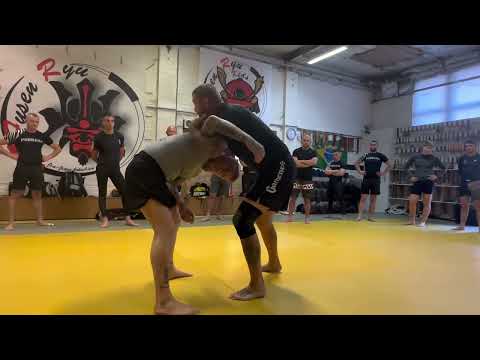
Cow Catcher - Catching the Head Standing
0
Cattle Choke From Standing Headlock S-Grip·Brandon Quick
@fusenryu-jiu-jitsubresilie910 Fusen Ryu Tournai, Belgium 🇧🇪 -Flare a palm, flare an elbow to gain an Underhook -G…
Not yet documented
The S-Grip variation of the standing Cattle Choke uses an S-grip (four fingers interlocked) to clasp the hands during the choke — providing a different grip texture than the Gable grip that some practitioners find more secure for this particular choke angle. [1],[2]
Developed within the BJJ/grappling submission system. [1]
Used in BJJ, MMA, and submission grappling competition. [1]
No images yet for this technique.
Sign in to suggest an image.
@fusenryu-jiu-jitsubresilie910 Fusen Ryu Tournai, Belgium 🇧🇪 -Flare a palm, flare an elbow to gain an Underhook -G…
No instructional courses yet for this technique.
Sign in to suggest a course.
Risk of injury to the person this technique is applied to
Chokes and neck cranks carry significant risk; blood chokes cause unconsciousness in 6-10 seconds; neck cranks can cause cervical spine damage; always tap early
Skill level needed to execute this technique reliably
Whether this technique is allowed under major competition rule sets
Jiu-Jitsu University (Saulo Ribeiro, 2008)
Description sources — [1] Choking/cranking technique curriculum [2] Competition analysis
Standard katakana transliteration of Western martial arts terminology (外来語) — used in Japanese MMA, boxing, and BJJ communities
Description sources — [1] Choking/cranking technique curriculum [2] Competition analysis
grip strength, arm positioning precision, back control ability
forearms (squeeze), biceps (compression), shoulders (positioning)
Leaning over the head is ineffective technique—instead, you should bring your opponent's head to your arm to maintain proper control and positioning. Brandon Quick emphasizes avoiding this common white belt mistake of allowing your elbow to come over your shoulder.
Without solid head control, your opponent can escape into chain wrestling entries like a fireman's carry, single leg, or double leg takedown. Brandon Quick stresses that head control is essential to prevent these escape options.
Don't reach for the back pocket while standing. Brandon Quick advises pulling your opponent down to the floor first before reaching for the back pocket to finish the technique.
The S-Grip variation of the standing Cattle Choke uses an S-grip (four fingers interlocked) to clasp the hands during the choke — providing a different grip texture than the Gable grip that some practitioners find more secure for this particular choke angle.
This variation developed within the broader choking/cranking system of its parent technique family.
IBJJF: legal — Legal at all belt levels, gi and no-gi — chokes are the safest submission cat…; IJF: legal — Legal (shime-waza) — strangulation techniques are one of three permitted subm…; ADCC: legal — Legal; Unified MMA: legal — Legal — choke submissions are among the most common finishes in MMA; FIAS Sport Sambo: banned — All chokes prohibited in Sport Sambo; FIAS Combat Sambo: legal — Legal
Danger rating 8/10. High — chokes and neck cranks carry significant risk; blood chokes cause unconsciousness in 6-10 seconds; neck cranks can cause cervical spine damage; always tap early
The standard setup chain: Establish Control Position → Secure the Specific Grip → Position the Choking Surface → Apply Compression → Finish.
Standard counters include: Hand fighting — stripping the grip before the choke is set / Chin tuck — protecting the throat / Posture — creating distance to prevent the choke / Turning — turning to face the attacker.
Common variants: This is a specific variation (see parent genus/species for alternative variations).
Used in BJJ, MMA, and submission grappling competition.
Top errors to watch for: Applying too fast — gradual application is safer and often more effective / Wrong grip positioning — the specific grip variation defines this technique; incorrect grip = different technique / Not controlling posture before applying / Holding after the tap — release immediately.
The Cattle Choke From Standing Headlock S-Grip is also known as Standing Cattle Choke S-Grip, Headlock S-Grip Finish.