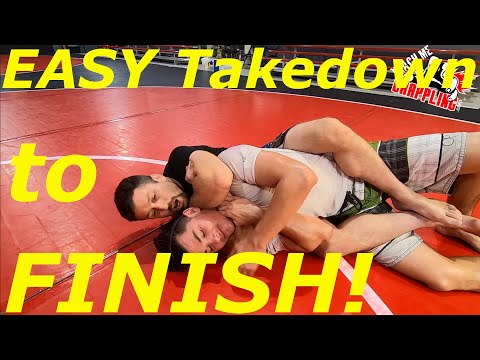
How to do a PERFECT Armdrag to a Choke FINISH! (BASIC)
0
Cattle Choke (Bulldog)·TeachMeGrappling Coach Brian·Added by Admin
PLEASE Click this link to SUPPORT the TeachMeGrappling Channel!!! https://www.patreon.com/TeachMeGrappling or https:/…
Translation: Cattle Choke (katakana loanword); also ブルドッグチョーク
The cattle choke (bulldog choke) uses a headlock compression where the attacker wraps the arm around the opponent's neck from a front or side headlock and drives downward, using body weight and the wrapped arm to crush the neck against the chest or shoulder. [1],[2] The 'bulldog' name comes from the controlling position resembling a bulldog grip — the attacker holds the head tightly while sprawling or lying across the opponent's back. [1] The compression is primarily against the trachea and carotid arteries. [1],[3]
The cattle choke is effective in scrambles due to its simplicity — basic headlock wrap and squeeze. Works when more technical chokes aren't available. Crude but effective under pressure. [1]
Traditional catch wrestling and folk wrestling technique. Named for the resemblance to cattle-roping holds. The bulldog choke is a synonym. Present in virtually all wrestling traditions. [1]
Appears in MMA and catch wrestling competition. Less common in BJJ due to the availability of more technical alternatives from front headlock. [1]
No images yet for this technique.
Sign in to suggest an image.
PLEASE Click this link to SUPPORT the TeachMeGrappling Channel!!! https://www.patreon.com/TeachMeGrappling or https:/…
No instructional courses yet for this technique.
Sign in to suggest a course.
Risk of injury to the person this technique is applied to
Headlock compression chokes use a tight headlock grip to restrict blood flow to the brain
Skill level needed to execute this technique reliably
Whether this technique is allowed under major competition rule sets
Japanese BJJ community standard katakana transliteration
Japanese BJJ community standard katakana transliteration
Standard katakana transliteration of Western martial arts terminology (外来語) — used in Japanese MMA, boxing, and BJJ communities
Japanese terminology sourced from Japanese BJJ community standard katakana transliteration
grip or squeeze strength, positional control
strong upper body for sustained compression
forearms, biceps, pectorals, core stabilisers
Every move, in any martial art, shares a few universal traits. Mix and match below to pinpoint the right tool — or compare equivalents across styles.
The Cattle Choke From Side Ride is a compression choke applied from a side-riding position (the attacker is beside the opponent) rather than from standing — using the side control or side ride angle to wrap the arms around the neck and squeeze. [1,2]
The Cattle Choke (also called the Bulldog Choke) From Standing Headlock is a compression choke applied from a standing headlock position where the attacker wraps both arms around the opponent's neck and squeezes — named because the control resembles a cowboy roping cattle. [1] The standing entry creates momentum and positional advantage for the choke. [1,2]
Use a seat belt grip positioned at the opponent's neck. Coach Brian emphasizes applying pressure with your elbow like an elbow strike to the neck, then trapping your wrist behind their head with your own head before squeezing.
Do not bring your hand up prematurely or reach upward as you apply the grip—the opponent can pull your hand down. Instead, keep a rock climbing grip to cover your hand, apply elbow pressure first, and only pop your hand up once you've established pressure.
Rotate your hips and turn your shoulder to establish a good grip on the waist or hip before securing the choke. A loose grip will cause you to lose control if your opponent turns to face you.
The cattle choke (bulldog choke) uses a headlock compression where the attacker wraps the arm around the opponent's neck from a front or side headlock and drives downward, using body weight and the wrapped arm to crush the neck against the chest or shoulder. The 'bulldog' name comes from the controlling position resembling a bulldog grip — the attacker holds the head tightly while sprawling or lying across the opponent's back.
The cattle choke has origins in catch wrestling and folk wrestling, where headlock compressions were fundamental finishing methods. The technique was adopted into BJJ and MMA as a practical finish from the front headlock when cleaner chokes like the guillotine could not be secured.
IBJJF: legal — Legal at all belt levels, gi and no-gi — chokes are the safest submission cat…; IJF: legal — Legal (shime-waza) — strangulation techniques are one of three permitted subm…; ADCC: legal — Legal; Unified MMA: legal — Legal — choke submissions are among the most common finishes in MMA; FIAS Sport Sambo: banned — All chokes prohibited in Sport Sambo; FIAS Combat Sambo: legal — Legal
Danger rating 7/10. Headlock compression chokes use a tight headlock grip to restrict blood flow to the brain
The standard setup chain: Achieve Controlling Position → Isolate the Neck → Set the Grip → Apply Pressure.
Standard counters include: Tuck Chin — protect the neck by lowering the chin to prevent the choke from sinking / Two-on-One Grip Fight — use both hands to strip the choking grip before it locks / Turn Into — rotate toward the choking arm to relieve carotid pressure / Posture Up — straighten the spine and create distance to break the choking angle.
Common variants: Standard grip variation (primary hand configuration for maximum choking pressure); Gi variation (uses the lapel or collar as an anchor for additional fric…); No-gi variation (adapted grip and positioning for submission grappling wit…); Transition finish (applied during a positional change to catch the opponent …).
Appears in MMA and catch wrestling competition. Less common in BJJ due to the availability of more technical alternatives from front headlock.
Top errors to watch for: Using the cattle choke from inferior position — the technique requires top or neutral position; from bottom, the head… / Squeezing the trachea exclusively — while the cattle choke can be an air choke, angling the forearm to the lateral ne… / Not driving body weight into the choke — lean into the headlock; arm squeezing alone is often insufficient / Holding the headlock without increasing pressure — the transition from control to choke requires actively increasing ….
The Cattle Choke (Bulldog) is also known as Kyatoru Chōku, Bulldog Choke, Cattle Catch, Bulldog Headlock.