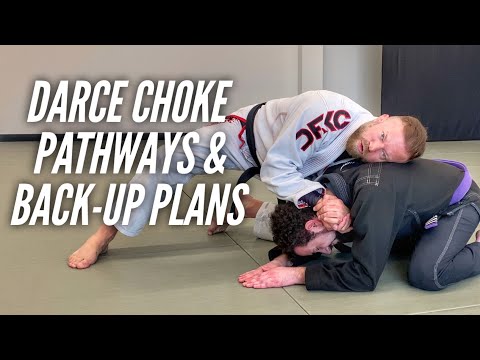
All About the Darce Choke - Pathways & Back-Up Plans
0
D'Arce Choke From Turtle Palm-to-Palm·Knight Jiu-Jitsu
Hundreds more class instruction videos at Patreon.com/KnightJiuJitsu The Darce choke is an extremely popular head and a…
Not yet documented
Developed within the BJJ/grappling submission system. [1]
Used in BJJ, MMA, and submission grappling competition. [1]
No images yet for this technique.
Sign in to suggest an image.
Hundreds more class instruction videos at Patreon.com/KnightJiuJitsu The Darce choke is an extremely popular head and a…
No instructional courses yet for this technique.
Sign in to suggest a course.
Risk of injury to the person this technique is applied to
Chokes and neck cranks carry significant risk; blood chokes cause unconsciousness in 6-10 seconds; neck cranks can cause cervical spine damage; always tap early
Skill level needed to execute this technique reliably
Whether this technique is allowed under major competition rule sets
Jiu-Jitsu University (Saulo Ribeiro, 2008)
Description sources — [1] Choking/cranking technique curriculum [2] Competition analysis
Standard katakana transliteration of Western martial arts terminology (外来語) — used in Japanese MMA, boxing, and BJJ communities
Description sources — [1] Choking/cranking technique curriculum [2] Competition analysis
grip strength, arm positioning precision, back control ability
forearms (squeeze), biceps (compression), shoulders (positioning)
Knight Jiu-Jitsu recommends centering yourself perpendicular to your opponent while keeping pushing their head in and reaching your arm through to achieve proper depth.
Knight Jiu-Jitsu emphasizes that understanding how your opponent will respond to your initial setup allows you to have backup plans ready in the chamber for when they defend a certain way.
Yes—Knight Jiu-Jitsu shows entries from turtle position as well as off the ghost escape from side control, offering multiple routes to set up the choke.
Knight Jiu-Jitsu confirms the D'Arce works effectively in both gi and no-gi variations, describing it as a really nasty tight choke.
The Palm-to-Palm D'Arce from the turtle position uses a Gable-style grip to finish the D'Arce choke when the opponent is in turtle — the palm-to-palm clasp provides maximum squeeze force from the turtle-to-D'Arce angle.
This variation developed within the broader choking/cranking system of its parent technique family.
IBJJF: legal — Legal at all belt levels, gi and no-gi — chokes are the safest submission cat…; IJF: legal — Legal (shime-waza) — strangulation techniques are one of three permitted subm…; ADCC: legal — Legal; Unified MMA: legal — Legal — choke submissions are among the most common finishes in MMA; FIAS Sport Sambo: banned — All chokes prohibited in Sport Sambo; FIAS Combat Sambo: legal — Legal
Danger rating 8/10. High — chokes and neck cranks carry significant risk; blood chokes cause unconsciousness in 6-10 seconds; neck cranks can cause cervical spine damage; always tap early
The standard setup chain: Establish Control Position → Secure the Specific Grip → Position the Choking Surface → Apply Compression → Finish.
Standard counters include: Hand fighting — stripping the grip before the choke is set / Chin tuck — protecting the throat / Posture — creating distance to prevent the choke / Turning — turning to face the attacker.
Common variants: This is a specific variation (see parent genus/species for alternative variations).
Used in BJJ, MMA, and submission grappling competition.
Top errors to watch for: Applying too fast — gradual application is safer and often more effective / Wrong grip positioning — the specific grip variation defines this technique; incorrect grip = different technique / Not controlling posture before applying / Holding after the tap — release immediately.
The D'Arce Choke From Turtle Palm-to-Palm is also known as Dāsu Chōku Pāmu tu Pāmu, Turtle D'Arce, D'Arce from Turtle Position.