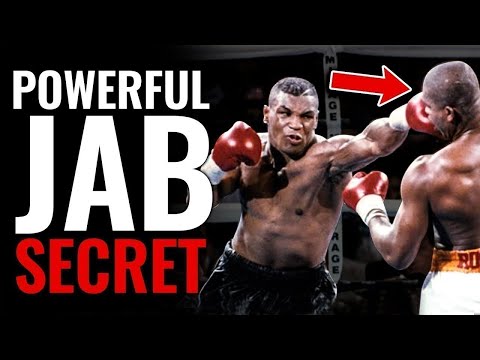
4 Tips for KO Power in your Jab
0
Power Jab·Tony Jeffries
Tony Jeffries shares how to increase the punching power of your boxing jab. Jab is one of the most important punch in bo…
Translation: power jab
The power jab is a heavier version of the standard jab that incorporates greater hip rotation and weight transfer to generate significant force with the lead hand. [1] The power jab evolved as fighters discovered that committing more body weight to the lead hand could turn the jab from a range-finding tool into a genuine hurting punch. [1] Lennox Lewis was renowned for his power jab, which was described as harder than many fighters' crosses, and he used it to control fights during his undisputed heavyweight championship reign (1999-2004). [2] Sonny Liston's power jab was similarly devastating — Liebling described it as 'the heaviest jab in boxing.' [3]
The power jab adds body rotation to the standard jab for increased impact. [1]
No images yet for this technique.
Sign in to suggest an image.
Tony Jeffries shares how to increase the punching power of your boxing jab. Jab is one of the most important punch in bo…
No instructional courses yet for this technique.
Sign in to suggest a course.
Risk of injury to the person this technique is applied to
Jab/cross; fundamental striking tool, cumulative brain trauma risk
Skill level needed to execute this technique reliably
Whether this technique is allowed under major competition rule sets
Karate-Do Kyohan: The Master Text (Gichin Funakoshi, 1935)
Alias sources — [1] Championship Fighting (Dempsey, 1950) [2] Boxing (Fleischer, 1958) [3] Boxing Mastery (Hatmaker, 2004)
Effectiveness sources — [1] Championship Fighting (Dempsey, 1950)
Standard katakana transliteration of Western martial arts terminology (外来語) — used in Japanese MMA, boxing, and BJJ communities
Alias sources — [1] Championship Fighting (Dempsey, 1950) [2] Boxing (Fleischer, 1958) [3] Boxing Mastery (Hatmaker, 2004)
Effectiveness sources — [1] Championship Fighting (Dempsey, 1950)
hand speed, shoulder endurance, quick retraction
longer reach for keeping opponents at distance
anterior deltoid, triceps, serratus anterior, core
Tony Jeffries emphasizes four key elements: step and punch simultaneously (not sequentially), keep your fist tight at the moment of impact while maintaining a relaxed body, exhale on the punch, and punch through the target rather than at it—think of getting your hand inside the bag.
Tony Jeffries stresses that pushing and punching are completely different techniques, and pushing is a common mistake when trying to generate power; true punching involves driving through the target with proper mechanics rather than extending outward.
According to Tony Jeffries, you must step and punch at the same time; if you step first then punch, the movement becomes awkward and loses power.
A jab thrown with increased commitment and hip rotation to deliver greater impact, sacrificing some speed and recovery time.
The power jab is a heavier version of the standard jab that incorporates greater hip rotation and weight transfer to generate significant force with the lead hand. The power jab evolved as fighters discovered that committing more body weight to the lead hand could turn the jab from a range-finding tool into a genuine hurting punch.
Unified MMA: legal — Legal striking technique; WBC/Boxing: legal — Legal — punches are the core technique of boxing; WKF: legal — Legal, jodan/chudan punch scores 1 point (yuko) — controlled contact required; Kyokushin: restricted — Body punches legal at full power, head punches banned; WT: restricted — Punches to trunk only (1 point), punches to head banned; ITF: legal — Legal — hand techniques to head and body both permitted; WAKO: legal — Legal in Full Contact and Low Kick formats; K: legal — 1/GLORY — Legal — full power punches to head and body; IFMA: legal — Legal
Danger rating 5/10. High — jab/cross; fundamental striking tool, cumulative brain trauma risk
The standard setup chain: Fighting Stance → Weight Transfer → Extend → Snap Back.
Standard counters include: Slip — move the head off the centre line to evade the punch / Parry — deflect the incoming punch with a quick hand redirection / Counter Cross — time a straight punch over the incoming attack.
Common variants: Standard jab (quick, straight lead-hand punch from orthodox stance); Power jab (stepping into the jab with more body weight for increased…); Double jab (two rapid jabs to set up a follow-up power shot); Body jab (targeting the midsection instead of the head).
Lennox Lewis was renowned for his power jab, using it to stun opponents and set up finishing combinations during his undisputed heavyweight championship reign (1999-2004). Sonny Liston's devastating power jab was described as harder than most fighters' crosses.
Top errors to watch for: Over-committing the step and lunging past your balance point — you become an easy counter target / Sacrificing retraction speed for power — if the power jab misses, the slow return hand gets countered / Using the power jab too often — it is slower and more readable than a standard jab, so it must be set up / Neglecting to bring the rear hand up to the chin, since the forward step exposes the rear side of the head.
The Power Jab is also known as Pawā Jabu, Stiff Jab, Hard Jab, Stepping Jab.