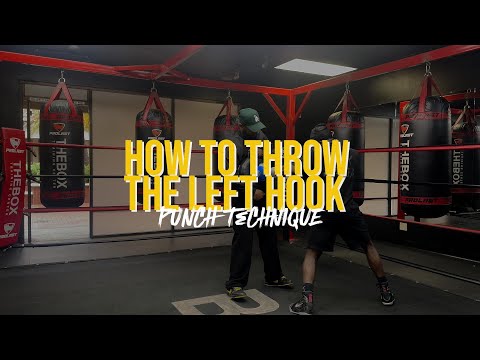
How to Throw the PERFECT Body Shot (Lead Hook to the Liver)
0
Liver Hook·ELCOACHCASEY
ELCOACHCASEY back in the ring, repping DarkGrey, with a new Gloves + Gains Method tutorial 🥊🔥 In this video, I’m teac…
Translation: liver hook
The liver hook is a left hook (from orthodox stance) specifically targeting the liver on the right side of the opponent's body, capable of causing immediate incapacitation through vagal nerve stimulation. [1] The liver's position just below the right ribcage makes it vulnerable to a properly placed hook, and the resulting pain and autonomic shutdown cannot be overcome by willpower. [1] The liver shot became a recognised tactical weapon in the 19th century prize ring, and Dempsey identified body shots to the liver region as among the most fight-ending punches. [1] The technique was perfected by body punchers like Bob Fitzsimmons, whose 'solar plexus punch' — actually a body hook targeting the liver area — won him the heavyweight championship from James J. Corbett in 1897. [2]
The liver hook targets the right side of the body where the liver sits just below the ribcage, and a clean impact produces immediate, involuntary incapacitation through vagal nerve stimulation that causes a sharp drop in blood pressure and intense pain that cannot be fought through. [1] It is considered one of the most effective body punches because even a moderately powerful shot to the liver can end a fight. [1]
The liver hook targets the right side specifically over the liver, a technique perfected by boxers like Oscar De La Hoya and Gennady Golovkin. [1]
Bas Rutten was renowned for his liver shots in both Pancrase and the UFC, finishing multiple opponents with body punches targeting the liver during his Pancrase King of Kings reign (1995-1998) and UFC Heavyweight Championship (1999). [1] Oscar De La Hoya's sixth-round liver shot knockout of Bernard Hopkins (1994) is considered one of the most perfectly placed body shots in boxing history. [2]
No images yet for this technique.
Sign in to suggest an image.
ELCOACHCASEY back in the ring, repping DarkGrey, with a new Gloves + Gains Method tutorial 🥊🔥 In this video, I’m teac…
No instructional courses yet for this technique.
Sign in to suggest a course.
Risk of injury to the person this technique is applied to
Hooks/uppercuts; generate rotational force, high KO rate (Walilko et al. 2005)
Skill level needed to execute this technique reliably
Whether this technique is allowed under major competition rule sets
Karate-Do Kyohan: The Master Text (Gichin Funakoshi, 1935)
Alias sources — [1] Championship Fighting (Dempsey, 1950) [2] Boxing (Fleischer, 1958) [3] The Sweet Science (Liebling, 1956)
Effectiveness sources — [1] Championship Fighting (Dempsey, 1950)
Standard katakana transliteration of Western martial arts terminology (外来語) — used in Japanese MMA, boxing, and BJJ communities
Alias sources — [1] Championship Fighting (Dempsey, 1950) [2] Boxing (Fleischer, 1958) [3] The Sweet Science (Liebling, 1956)
Effectiveness sources — [1] Championship Fighting (Dempsey, 1950)
hip rotation, horizontal arm acceleration, tight elbow angle
compact build for short-range hooks, strong core
obliques, hip rotators, pectorals, biceps, forearms
According to Coach Casey, the liver area is located on the right side of the body, and you can reach it either around the elbow or up the middle. The key is landing with your eyes on target to ensure you hit the correct spot.
Coach Casey advises against turning your toe over because it puts you in a vulnerable new position where a skilled opponent can counter before you finish your shot. Instead, keep your stance more stable to maintain defensive positioning.
Coach Casey emphasizes that repetition with correct intentions is essential—you need to drill the shot over and over until you can't do it wrong, even under fatigue or pressure. Additionally, strengthening your glutes, quads, and ankle rotation through conditioning helps you get into the proper position to generate maximum power.
Coach Casey instructs to leave your left hand in place after landing the shot rather than immediately retracting it, which helps maintain proper form and defensive positioning.
A left hook (from orthodox stance) specifically targeting the liver on the right side of the opponent's body, capable of causing acute pain and shutdown of motor function.
The liver hook is a left hook (from orthodox stance) specifically targeting the liver on the right side of the opponent's body, capable of causing immediate incapacitation through vagal nerve stimulation. The liver's position just below the right ribcage makes it vulnerable to a properly placed hook, and the resulting pain and autonomic shutdown cannot be overcome by willpower.
Unified MMA: legal — Legal striking technique; WBC/Boxing: legal — Legal — punches are the core technique of boxing; WKF: legal — Legal, jodan/chudan punch scores 1 point (yuko) — controlled contact required; Kyokushin: restricted — Body punches legal at full power, head punches banned; WT: restricted — Punches to trunk only (1 point), punches to head banned; ITF: legal — Legal — hand techniques to head and body both permitted; WAKO: legal — Legal in Full Contact and Low Kick formats; K: legal — 1/GLORY — Legal — full power punches to head and body; IFMA: legal — Legal
Danger rating 6/10. High — hooks/uppercuts; generate rotational force, high KO rate (Walilko et al. 2005)
The standard setup chain: Setup with Straight Punch → Pivot the Lead Foot → Arc the Arm → Follow Through.
Standard counters include: Slip — move the head off the centre line to evade the punch / Parry — deflect the incoming punch with a quick hand redirection / Counter Cross — time a straight punch over the incoming attack.
Common variants: Standard hook (horizontal-arc punch targeting the jaw or temple); Tight hook (compact, short-range hook for close-quarters fighting); Body hook (targeting the ribs or liver with a downward-angled hook); Check hook (pivoting on the lead foot while throwing the hook as a co…).
Bas Rutten was renowned for his liver shots in both Pancrase and the UFC, finishing multiple opponents with body punches targeting the liver during his Pancrase King of Kings reign (1995-1998) and UFC Heavyweight Championship (1999). Oscar De La Hoya's sixth-round liver shot knockout of Bernard Hopkins (1994) is considered one of the most perfectly placed body shots in boxing history.
Top errors to watch for: Aiming too low and hitting the hip or too high and hitting the ribs above the liver — precision is everything / Rushing the level change and diving face-first into an uppercut or knee / Not setting up the liver shot with head shots first — if you only attack the body, the opponent keeps the elbow pinne… / Hitting with a flat fist instead of digging the knuckles in at an upward angle.
The Liver Hook is also known as Ribā Fukku, Liver Shot, Liver Punch, Left Hook to the Liver.