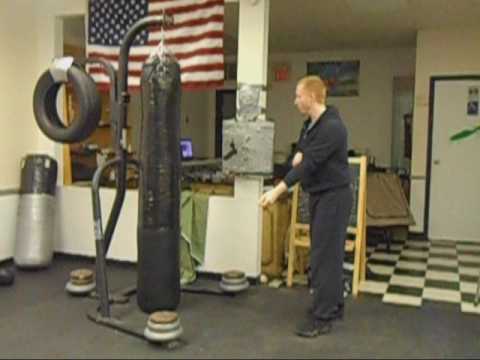
Rear hook kick tutorial for martial arts
0
Rear Hook·Nicholas Meyers (Imperatives Martial Arts)·Added by Admin
This will be the last upload for the day. I wanted to show you the difference between a common low-kick as opposed to a …
Translation: rear hook
The rear hook is thrown with the back hand in a horizontal arc, combining the power of the rear hand with the hooking trajectory. [1] Less commonly used than the lead hook due to the greater distance the rear hand must travel, the rear hook is nevertheless a potent weapon when set up correctly. [1] Dempsey described the rear hook as requiring a preliminary shift of weight to the lead foot, followed by explosive rotation back through the hips and shoulders. [1] The rear hook has been a finishing weapon for fighters with exceptional power, including George Foreman, whose rear hooks were considered among the heaviest punches in boxing history. [2]
The rear hook generates more power than the lead hook due to the greater rotational distance available from the rear hip and shoulder, but it is slower to arrive and easier to see. [1] It is most effective when preceded by a lead-hand technique that opens the opponent's guard on the opposite side. [1]
The rear hook uses the power hand for maximum force. [1]
The rear hook is a power punch used in boxing and MMA. [1]
No images yet for this technique.
Sign in to suggest an image.
This will be the last upload for the day. I wanted to show you the difference between a common low-kick as opposed to a …
No instructional courses yet for this technique.
Sign in to suggest a course.
Risk of injury to the person this technique is applied to
Hooks/uppercuts; generate rotational force, high KO rate (Walilko et al. 2005)
Skill level needed to execute this technique reliably
Whether this technique is allowed under major competition rule sets
Karate-Do Kyohan: The Master Text (Gichin Funakoshi, 1935)
Alias sources — [1] Championship Fighting (Dempsey, 1950) [2] Karate-Do Kyohan (Funakoshi, 1935) [3] Boxing (Fleischer, 1958)
Effectiveness sources — [1] Championship Fighting (Dempsey, 1950)
Standard katakana transliteration of Western martial arts terminology (外来語) — used in Japanese MMA, boxing, and BJJ communities
Alias sources — [1] Championship Fighting (Dempsey, 1950) [2] Karate-Do Kyohan (Funakoshi, 1935) [3] Boxing (Fleischer, 1958)
Effectiveness sources — [1] Championship Fighting (Dempsey, 1950)
hip rotation, horizontal arm acceleration, tight elbow angle
compact build for short-range hooks, strong core
obliques, hip rotators, pectorals, biceps, forearms
According to Nicholas Meyers, the rear low kick and hook kick are two entirely different motions. The low kick is more of a sport variety, while the hook kick offers different tactical advantages.
Nicholas Meyers emphasizes bringing your hands to your face and solidifying your body mass by bringing it all in, which allows you to be ready to punch immediately after the kick lands.
Get your foot down on the ground as quickly as possible and be ready to punch, as the rear hook kick should transition smoothly into striking combinations rather than being an isolated technique.
A hook thrown with the rear hand, requiring greater hip rotation and weight transfer to generate power through a longer arc from the rear position.
The rear hook is thrown with the back hand in a horizontal arc, combining the power of the rear hand with the hooking trajectory. Less commonly used than the lead hook due to the greater distance the rear hand must travel, the rear hook is nevertheless a potent weapon when set up correctly.
Unified MMA: legal — Legal striking technique; WBC/Boxing: legal — Legal — punches are the core technique of boxing; WKF: legal — Legal, jodan/chudan punch scores 1 point (yuko) — controlled contact required; Kyokushin: restricted — Body punches legal at full power, head punches banned; WT: restricted — Punches to trunk only (1 point), punches to head banned; ITF: legal — Legal — hand techniques to head and body both permitted; WAKO: legal — Legal in Full Contact and Low Kick formats; K: legal — 1/GLORY — Legal — full power punches to head and body; IFMA: legal — Legal
Danger rating 6/10. High — hooks/uppercuts; generate rotational force, high KO rate (Walilko et al. 2005)
The standard setup chain: Setup with Straight Punch → Pivot the Lead Foot → Arc the Arm → Follow Through.
Standard counters include: Slip — move the head off the centre line to evade the punch / Parry — deflect the incoming punch with a quick hand redirection / Counter Cross — time a straight punch over the incoming attack.
Common variants: Standard hook (horizontal-arc punch targeting the jaw or temple); Tight hook (compact, short-range hook for close-quarters fighting); Body hook (targeting the ribs or liver with a downward-angled hook); Check hook (pivoting on the lead foot while throwing the hook as a co…).
The rear hook is a power punch used in boxing and MMA.
Top errors to watch for: Over-rotating on the rear hook so you end up squared or with your back partially turned / Not setting up the rear hook with a lead-side attack first — it travels farther and is easier to see coming / Throwing it with a straight arm, which turns it into a wide, looping haymaker / Dropping the lead hand during delivery — the lead hook counter is the most dangerous reply to a rear hook.
The Rear Hook is also known as Ria Fukku, Right Hook, Rear Kagi Tsuki, Power Hook.