Strike & defenceLocksClose rangeFighting multiple people
Distance
CloseMiddleLong
Limb angle
Zero180–135°135–90°90–45°45–0°
Body target
Upper bodyMiddle bodyLower body
Overview
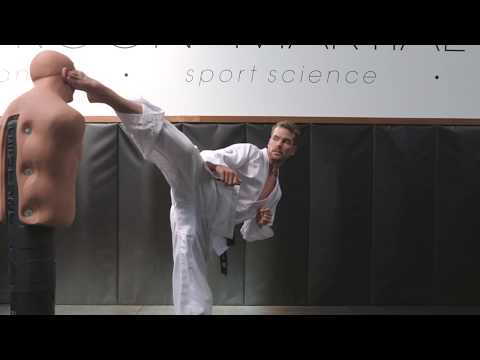
The Spinning Hook Kick is a rotational kick where the fighter spins 180 degrees or more and delivers a hooking kick to the opponent's head, striking with the heel as the leg retracts through a curved arc. [1] The spinning hook kick combines the deceptive hooking trajectory with the power of a full-body spin, creating a technique that is extremely difficult to defend because the angle and timing of impact are nearly impossible to predict. [1],[2] This technique primarily targets the jaw or temple and has produced numerous highlight-reel knockouts across combat sports. [2],[3]
Also known as
Dwi Huryeo ChagiKR[1]Ushiro Ura Mawashi GeriJP[2]Wheel Kick[3]
The spinning hook kick (dwi huryeo chagi) is one of taekwondo's most celebrated techniques and has been a competition weapon since the sport's early competitive era. [1] In MMA, the spinning hook kick (also called the spinning heel kick) produced one of the sport's most famous knockouts when Edson Barboza knocked out Terry Etim at UFC 142 in 2012. [2],[3]
Country of origin· shown in random order
🇰🇷KoreaTaekwondo
🇧🇷BrazilMMA
🇺🇸USAMMA, Kickboxing
🇯🇵Japan裏回し蹴り(Ura Mawashi-geri)Kickboxing, Karate
🇨🇳ChinaSanda
Effectiveness
The spinning hook kick generates tremendous force through full rotational momentum, with the heel striking the target (typically the temple or jaw) at the apex of a 360-degree spin. [1] The kick is difficult to see coming when well-timed, as the spin conceals the trajectory until the last moment. [1]
Lineage
The spinning hook kick is a signature technique of taekwondo, where it is known as dwi huryeo chagi, and has been part of the art's kicking repertoire since its formalisation. [1] It is also found in karate (ushiro mawashi geri) and was adopted by kickboxers and MMA fighters. [1]
Competition Record
Mirko Cro Cop used the spinning hook kick variation in PRIDE FC bouts. [1] In taekwondo Olympic competition, the spinning hook kick is one of the highest-scoring techniques, awarding additional points for its technical difficulty under World Taekwondo rules. [2]
Images
No images yet for this technique.
Sign in to suggest an image.
Biomechanical Mechanism
Primary Action — Ballistic extension of the arm — kinetic chain transfers force from the ground through the hips to the fist
4OtherJapanese Martial Arts Standard Terminology (武道用語)
Established Japanese martial arts naming convention — native Japanese term (和語/漢語)
5CitationBoxing (Dempsey, 1950)
Alias sources — [1] Kukkiwon Taekwondo Textbook (Kukkiwon, 2006) [2] Dynamic Karate (Nakayama, 1966) [3] Taekwondo: The State of the Art (Park, 1989)
6CitationChampionship Fighting (Dempsey, 1950)
Effectiveness sources — [1] Taekwondo: The State of the Art (Jun, 1989)
Community
Athletics
Requires
hip rotation power, rear foot pivot, full kinetic chain coordination
Favours
reach advantage, strong hips for power transfer
Key muscles
glutes, obliques, pectorals, triceps, deltoids
Frequently Asked Questions
How do I prevent my spinning hook kick from being telegraphed?
Stand side-on rather than frontal to avoid telegraphing the technique, and keep the kick tight and quick by practicing through what Van Roon calls the 'inverted chamber' or 'universal chamber' instead of swinging your leg wide.
What's the best way to generate power in a spinning hook kick?
The key is using your kinetic chain—engaging your entire body to generate power rather than relying only on your leg. You can strike with your heel for more damage or the ball of your foot for more reach.
When should I use the spinning hook kick in a real fight?
According to Van Roon, the spinning hook kick is most effective as a counter fighting technique, particularly as a simultaneous counter when your opponent is kicking at your head.
Should I lift my heel or spin on a flat foot when executing this kick?
Lift your heel and aim it toward the target rather than spinning on a flat foot, which creates excess friction and slows down the technique.
How does the Spinning Hook Kick work?
The Spinning Hook Kick is a rotational kick where the fighter spins 180 degrees or more and delivers a hooking kick to the opponent's head, striking with the heel as the leg retracts through a curved arc. The spinning hook kick combines the deceptive hooking trajectory with the power of a full-body spin, creating a technique that is extremely difficult to defend because the angle and timing of impact are nearly impossible to predict.
Where does the Spinning Hook Kick come from?
The spinning hook kick (dwi huryeo chagi) is one of taekwondo's most celebrated techniques and has been a competition weapon since the sport's early competitive era. In MMA, the spinning hook kick (also called the spinning heel kick) produced one of the sport's most famous knockouts when Edson Barboza knocked out Terry Etim at UFC 142 in 2012.
Is the Spinning Hook Kick legal in competition?
Unified MMA: legal — Legal striking technique; WBC/Boxing: banned — All kicks prohibited in boxing; WKF: legal — Legal, chudan (body) kick scores 2 points, jodan (head) kick scores 3 points; Kyokushin: legal — Legal at full power to body and head; WT: legal — Legal, body kick 2 points, head kick 3 points, spinning body 4 points, spinni…; WAKO: legal — Legal in Full Contact and Low Kick formats; K: legal — 1/GLORY — Legal; IFMA: legal — Legal — kicks are a core Muay Thai technique
How dangerous is the Spinning Hook Kick?
Danger rating 6/10. High — most common KO kick; generates ~1,000N force to head (Falco et al. 2009)
How do I set up the Spinning Hook Kick?
The standard setup chain: Setup with Straight Punch → Pivot the Lead Foot → Arc the Arm → Follow Through.
How do I defend against the Spinning Hook Kick?
Standard counters include: Check (Shin Block) — raise the shin to intercept the kick before it lands / Catch and Sweep — catch the kicking leg and sweep the standing leg / Step Inside — close distance inside the kick's effective range to smother it.
What are the variants of the Spinning Hook Kick?
Common variants: Standard cross (rear-hand straight punch with full hip rotation); Counter cross (pull counter) (leaning back to avoid the jab, firing the cross as a counter); Step-in cross (stepping forward with the punch for added reach and power); Body cross (targeting the solar plexus or liver with the straight rea…).
How effective is the Spinning Hook Kick in competition?
Mirko Cro Cop used the spinning hook kick variation in PRIDE FC bouts. In taekwondo Olympic competition, the spinning hook kick is one of the highest-scoring techniques, awarding additional points for its technical difficulty under World Taekwondo rules.
What are common mistakes when doing the Spinning Hook Kick?
Top errors to watch for: Not hooking the kick at the end and instead throwing a straight spinning back kick to the head — these are different … / Spinning too slowly and letting the opponent see the kick coming, giving them time to duck or lean back / Over-extending the kicking leg during the spin so the heel passes behind the target — range must be precise / Not spotting the target during the spin, resulting in a wild, inaccurate swing.
What are other names for the Spinning Hook Kick?
The Spinning Hook Kick is also known as Ura Mawashi-geri, Dwi Huryeo Chagi, Ushiro Ura Mawashi Geri, Wheel Kick.