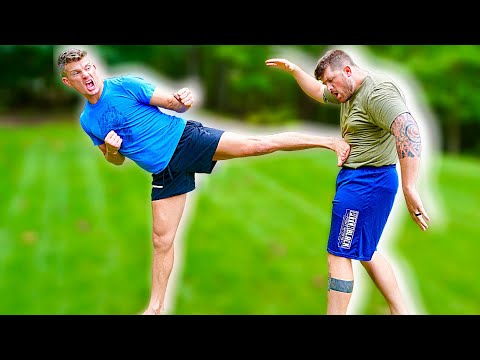
How To Throw A Spinning Back Kick | Stephen Wonderboy Thompson
0
Spinning Back Kick·Stephen Wonderboy Thompson·Added by Admin
Today i'm giving you a quick, simple tutorial on how to throw a spinning back kick! I give you some tips and tricks that…
Translation: spinning back kick
The Spinning Back Kick is a powerful spinning technique where the fighter rotates 180 degrees and delivers a linear back kick with the heel, combining the rotational momentum of the spin with the thrusting power of the back kick. [1] The spinning back kick generates enormous force due to the full-body rotation preceding the linear thrust, and it targets the midsection, solar plexus, or face with the hardest part of the foot. [1],[2] This technique requires precise distance management and timing, as the rotation creates a brief blind spot before the kicker acquires the target visually. [2],[3]
The spinning back kick is a foundational technique in taekwondo (dwi dollyo chagi) and has been a competition staple since taekwondo's competitive era began in the 1960s. [1] The technique crossed into MMA and kickboxing with devastating effect, demonstrated by fighters like Cung Le and Uriah Hall. [2],[3]
The spinning back kick rotates and thrusts the heel backward, one of the most powerful kicks in martial arts. [1]
From TKD and karate. [1]
Used in TKD and MMA; capable of generating enormous stopping power. [1]
No images yet for this technique.
Sign in to suggest an image.
Today i'm giving you a quick, simple tutorial on how to throw a spinning back kick! I give you some tips and tricks that…
No instructional courses yet for this technique.
Sign in to suggest a course.
Risk of injury to the person this technique is applied to
Most common KO kick; generates ~1,000N force to head (Falco et al. 2009)
Skill level needed to execute this technique reliably
Whether this technique is allowed under major competition rule sets
Karate-Do Kyohan: The Master Text (Gichin Funakoshi, 1935)
Alias sources — [1] Kukkiwon Taekwondo Textbook (Kukkiwon, 2006) [2] Dynamic Karate (Nakayama, 1966) [3] Taekwondo: The State of the Art (Park, 1989)
Effectiveness sources — [1] Comprehensive Asian Fighting Arts (Draeger & Smith, 1969)
Official karate technique names (和語/漢語)
Established Japanese martial arts naming convention — native Japanese term (和語/漢語)
Alias sources — [1] Kukkiwon Taekwondo Textbook (Kukkiwon, 2006) [2] Dynamic Karate (Nakayama, 1966) [3] Taekwondo: The State of the Art (Park, 1989)
Effectiveness sources — [1] Comprehensive Asian Fighting Arts (Draeger & Smith, 1969)
hip flexibility, rotational hip power, balance on support leg
long legs for reach, flexible hips for high kicks
hip flexors, glutes, quadriceps, obliques, calves
Stephen Thompson breaks it down into two steps: first, the spin where you look over your back shoulder and rotate your feet in place while turning your heel to allow your head to come around fully; second, executing the kick by driving through with your glute and delivering the kick in a straight line from the ground to the target.
Stephen Thompson emphasizes taking your foot in a straight line next to your standing leg as you execute the kick, rather than swinging it around, because swinging gives your opponent time to jam the kick. He also recommends lining your front foot up with your target before executing the spin to ensure accuracy.
Stephen Thompson identifies the glute as one of the major muscles in the spinning back kick, which is what makes it so powerful.
Stephen Thompson recommends working both sides and practicing in front of a heavy bag to develop the technique proficiently on either side.
The Spinning Back Kick is a powerful spinning technique where the fighter rotates 180 degrees and delivers a linear back kick with the heel, combining the rotational momentum of the spin with the thrusting power of the back kick. The spinning back kick generates enormous force due to the full-body rotation preceding the linear thrust, and it targets the midsection, solar plexus, or face with the hardest part of the foot.
The spinning back kick is a foundational technique in taekwondo (dwi dollyo chagi) and has been a competition staple since taekwondo's competitive era began in the 1960s. The technique crossed into MMA and kickboxing with devastating effect, demonstrated by fighters like Cung Le and Uriah Hall.
Unified MMA: legal — Legal striking technique; WBC/Boxing: banned — All kicks prohibited in boxing; WKF: legal — Legal, chudan (body) kick scores 2 points, jodan (head) kick scores 3 points; Kyokushin: legal — Legal at full power to body and head; WT: legal — Legal, body kick 2 points, head kick 3 points, spinning body 4 points, spinni…; WAKO: legal — Legal in Full Contact and Low Kick formats; K: legal — 1/GLORY — Legal; IFMA: legal — Legal — kicks are a core Muay Thai technique
Danger rating 6/10. High — most common KO kick; generates ~1,000N force to head (Falco et al. 2009)
The standard setup chain: Stance and Range → Chamber the Leg → Execute the Kick → Recover.
Standard counters include: Check (Shin Block) — raise the shin to intercept the kick before it lands / Catch and Sweep — catch the kicking leg and sweep the standing leg / Step Inside — close distance inside the kick's effective range to smother it.
Common variants: Standard back kick (spinning and thrusting the heel backward into the target); Spinning back kick (full 360° rotation for maximum power); Mule kick (short backward thrust without a full spin).
Used in TKD and MMA; capable of generating enormous stopping power.
Top errors to watch for: Turning the kick into a spinning roundhouse by swinging the leg in an arc instead of thrusting straight back / Not looking over the shoulder to spot the target — the kick is blind without the head check / Leaning forward during the spin, which takes weight off the kick and exposes the head to strikes / Spinning without purpose or setup — the spinning back kick needs a preceding attack to draw the opponent forward.
The Spinning Back Kick is also known as Ushiro Mawashi-geri, Dwi Dollyo Chagi, Ushiro Geri, Reverse Turning Kick.