How to Do Better Tornado Kicks (360 Round Kick) | Taekwondo, Karate, Martial Arts
0
Tornado Kick·Black Belt Samery
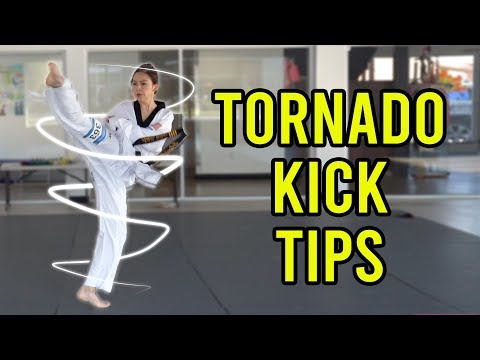
4 Tips to Have Better Tornado Kicks (360 Round House Kicks) 🔥 Join Live Martial Arts for Live workouts: https://livema…
Translation: tornado kick
The Tornado Kick is a dramatic spinning kick where the fighter uses a full 360-degree rotation with a jumping component, chambering the non-kicking leg in a sweeping motion to build rotational momentum before delivering a roundhouse kick at the apex of the spin. [1] The tornado kick combines the elements of a spin, jump, and roundhouse kick into a single explosive technique that generates exceptional power through angular momentum. [1],[2] Due to its complexity and the time required to complete the full rotation, the tornado kick is considered a high-risk, high-reward technique primarily seen in taekwondo competition and MMA highlight finishes. [2],[3]
The tornado kick originated in Korean martial arts, particularly taekwondo, where it is known as dollyo huryo chagi or 360 dollyo chagi, and has been a competition and demonstration technique since the 1970s. [1] The technique was designed to combine the momentum of a full spin with the power of a roundhouse kick, and it has produced spectacular knockouts in both taekwondo and MMA competition. [2],[3]
Anthony Pettis's 'Showtime Kick' off the cage wall at WEC 53 (2010) was a variation of the tornado kick that became one of the most replayed highlights in MMA history. [1]
No images yet for this technique.
Sign in to suggest an image.
4 Tips to Have Better Tornado Kicks (360 Round House Kicks) 🔥 Join Live Martial Arts for Live workouts: https://livema…
Instructional video on how do perform the Tornado Kick
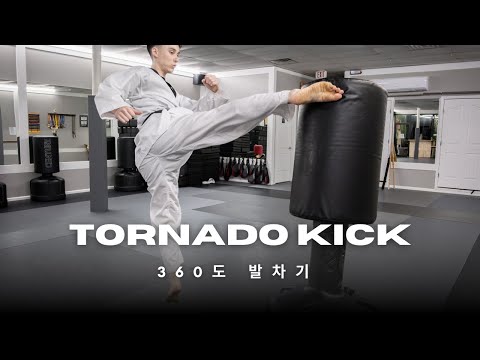
360도 발차기 / Tornado Kick Tutorial #taekwondo #taekwondotraining #taekwondoworkout #worldtaekwondo WE. MAKE. CHAMPIONS.…
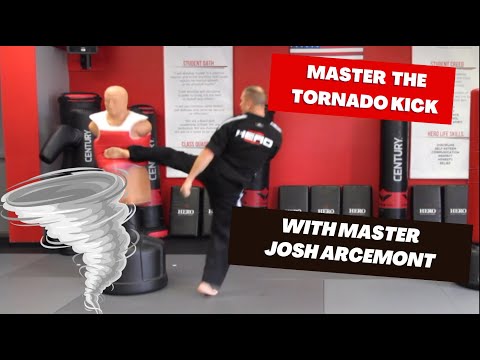
The tornado kick is a spinning roundhouse kick executed by pivoting to face away from the target, then rotating the body forward while chambering and extending the leg. HERO Martial Arts Academy emphasizes the foundational turn-step footwork, distinguishing between a grounded version (turn, step, kick) and an airborne variant (turn, step, knee-up, jump, switch, kick), and stresses keeping the arms tucked during rotation and delaying the kick extension until the knee passes center to maximize reach and power. Champions Taekwondo Academy describes an analogous progression: pivot on the balls of the feet while loading the legs and spotting the target over the shoulder, step straight through to a fighting stance, then execute a roundhouse kick; the jump version adds a high knee chamber with a leg switch before the final kick extension. Black Belt Samery identifies critical technical errors: premature lifting of the kicking leg before body rotation completion, failing to face forward before leaving the ground, insufficient push-off force, and neglecting to spot the target with the eyes immediately upon turning, which causes loss of aim and disorientation. All three instructors agree the technique is a spinning roundhouse variant applicable in sport sparring and pads work, though they differ in emphasis—HERO stresses footwork camouflage and combination potential (dragon combo: round kick, tornado kick, spinning hook kick), while Champions and Black Belt Samery focus on mechanical sequencing and common execution faults.
Synthesized from 3 instructors
No instructional courses yet for this technique.
Sign in to suggest a course.
Risk of injury to the person this technique is applied to
Most common KO kick; generates ~1,000N force to head (Falco et al. 2009)
Skill level needed to execute this technique reliably
Whether this technique is allowed under major competition rule sets
Karate-Do Kyohan: The Master Text (Gichin Funakoshi, 1935)
Alias sources — [1] Kukkiwon Textbook (2006) [2] Kukkiwon Textbook (2006)
Effectiveness sources — [1] Taekwondo: The State of the Art (Jun, 1989)
Standard katakana transliteration of Western martial arts terminology (外来語) — used in Japanese MMA, boxing, and BJJ communities
Alias sources — [1] Kukkiwon Textbook (2006) [2] Kukkiwon Textbook (2006)
Effectiveness sources — [1] Taekwondo: The State of the Art (Jun, 1989)
hip flexibility, rotational hip power, balance on support leg
long legs for reach, flexible hips for high kicks
hip flexors, glutes, quadriceps, obliques, calves
You want to make it a smooth turn with pivoting on your bottom foot rather than hopping and stepping, according to HERO Martial Arts Academy. This smooth pivot is essential to the proper execution of the technique.
Keep your arms in close whenever you spin, whether it's a spinning hook kick, spinning side kick, or tornado kick—they should always stay tight to your body, as emphasized by HERO Martial Arts Academy.
Champions Taekwondo Academy recommends swinging your leg straight through following a straight line rather than swinging it out super wide, as a wide swing will slow down your rotation and is very noticeable in sparring.
Black Belt Samery suggests breaking it down by turning your body all the way around so you can almost see where you're going, then lift your foot off the ground, jump and kick. This staged approach helps you learn the technique properly before adding speed.
The Tornado Kick is a dramatic spinning kick where the fighter uses a full 360-degree rotation with a jumping component, chambering the non-kicking leg in a sweeping motion to build rotational momentum before delivering a roundhouse kick at the apex of the spin. The tornado kick combines the elements of a spin, jump, and roundhouse kick into a single explosive technique that generates exceptional power through angular momentum.
The tornado kick originated in Korean martial arts, particularly taekwondo, where it is known as dollyo huryo chagi or 360 dollyo chagi, and has been a competition and demonstration technique since the 1970s. The technique was designed to combine the momentum of a full spin with the power of a roundhouse kick, and it has produced spectacular knockouts in both taekwondo and MMA competition.
Unified MMA: legal — Legal striking technique; WBC/Boxing: banned — All kicks prohibited in boxing; WKF: legal — Legal, chudan (body) kick scores 2 points, jodan (head) kick scores 3 points; Kyokushin: legal — Legal at full power to body and head; WT: legal — Legal, body kick 2 points, head kick 3 points, spinning body 4 points, spinni…; WAKO: legal — Legal in Full Contact and Low Kick formats; K: legal — 1/GLORY — Legal; IFMA: legal — Legal — kicks are a core Muay Thai technique
Danger rating 6/10. High — most common KO kick; generates ~1,000N force to head (Falco et al. 2009)
The standard setup chain: Stance and Range → Chamber the Leg → Execute the Kick → Recover.
Standard counters include: Check (Shin Block) — raise the shin to intercept the kick before it lands / Catch and Sweep — catch the kicking leg and sweep the standing leg / Step Inside — close distance inside the kick's effective range to smother it.
Common variants: Standard roundhouse (rear leg) (full hip rotation, shin strikes the target); Lead leg roundhouse (switch kick) (switch-step to generate power from the lead side); Low roundhouse (leg kick) (targeting the thigh to damage the opponent's base); Head kick (high roundhouse targeting the temple or jaw).
Anthony Pettis's 'Showtime Kick' off the cage wall at WEC 53 (2010) was a variation of the tornado kick that became one of the most replayed highlights in MMA history.
Top errors to watch for: Not stepping forward first, which removes the forward momentum that makes the tornado kick powerful / Spinning without spotting the target, leading to a wild, inaccurate kick that misses badly / Taking too long to complete the rotation — the entire step-spin-kick should be one explosive motion / Telegraphing by visibly crossing the rear foot forward before spinning — the step should be quick and subtle.
The Tornado Kick is also known as Torunēdo Kikku, 360 Kick, 360 Roundhouse.