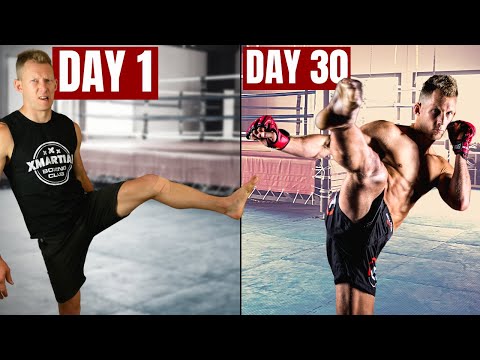
How To Get HIGHER Kicks
0
Standard High Kick·Gabriel Varga·Added by Admin
How can you get your kicks higher? In this high kick tutorial I show you the best ways to get your legs kicking up to he…
Translation: standard high kick
The Standard High Kick is the fundamental roundhouse kick delivered to head height, where the kicker rotates the hips and drives the shin or instep into the opponent's temple, jaw, or neck. [1] The technique uses the same mechanical principles as the body kick but requires the kicker to elevate the leg higher through increased hip rotation and flexibility. [1],[2] The standard high kick is the most commonly attempted head kick in Muay Thai, kickboxing, and MMA competition. [2],[3]
The head kick is one of the most powerful strikes in all of combat sports, with biomechanical studies measuring shin-to-head impacts generating forces capable of exceeding concussion thresholds by a wide margin. [1] A clean head kick to the temple or jaw produces rapid rotational acceleration of the head, frequently resulting in an immediate knockout. [1]
Mirko Cro Cop's left head kick became the most feared finishing technique in PRIDE Fighting Championship, with his famous catchphrase 'right leg hospital, left leg cemetery.' [1] Anderson Silva's front kick and high kick knockouts in the UFC made him one of the greatest strikers in MMA history, including his head kick knockout of Vitor Belfort at UFC 126 (2011). [2] In Glory Kickboxing, head kick knockouts are the most celebrated finishes. [1]
No images yet for this technique.
Sign in to suggest an image.
How can you get your kicks higher? In this high kick tutorial I show you the best ways to get your legs kicking up to he…
No instructional courses yet for this technique.
Sign in to suggest a course.
Risk of injury to the person this technique is applied to
Most common KO kick; generates ~1,000N force to head (Falco et al. 2009)
Skill level needed to execute this technique reliably
Whether this technique is allowed under major competition rule sets
Muay Thai: The Art of Fighting (Yod Ruerngsa, Khun Kao Charuad & James Cartmell, 2002)
Alias sources — [1] Dynamic Karate (Nakayama, 1966) [2] Muay Thai: The Art of Fighting (Kraitus & Kraitus, 1988) [3] Muay Thai Unleashed (Delp, 2006)
Effectiveness sources — [1] Biomechanics of Striking Arts, in Martial Arts Medicine (Kordi et al., 2009)
Standard katakana transliteration of Western martial arts terminology (外来語) — used in Japanese MMA, boxing, and BJJ communities
Alias sources — [1] Dynamic Karate (Nakayama, 1966) [2] Muay Thai: The Art of Fighting (Kraitus & Kraitus, 1988) [3] Muay Thai Unleashed (Delp, 2006)
Effectiveness sources — [1] Biomechanics of Striking Arts, in Martial Arts Medicine (Kordi et al., 2009)
hip flexibility, rotational hip power, balance on support leg
long legs for reach, flexible hips for high kicks
hip flexors, glutes, quadriceps, obliques, calves
According to Gabriel Varga, most people who struggle with height are making technique errors rather than lacking natural ability. He emphasizes that "all of you are capable of kicking up to head level it's just a matter of understanding the technique getting it down and doing the drilling at home to make sure you're strengthening and opening up your hips."
Gabriel Varga identifies a major technical error: keeping the shoulder back while throwing the leg forward and dragging the shoulder back instead of rotating the hips properly. This positioning prevents you from achieving full height even if you pivot correctly.
Gabriel Varga stresses that proper foot pivot position is essential—"if it's not you're not going to be able to open those hips up." He also recommends the windshield wiper stretch from hands and knees with a 90-degree angle at the knee, pushing hips back and swiveling side to side while extending the other leg.
Gabriel Varga suggests that following a focused daily routine can show results within 30 days. He notes that even students who have trained for years and struggled with head-level kicks can sort out their issues in just 10-15 minutes of corrective work.
The Standard High Kick is the fundamental roundhouse kick delivered to head height, where the kicker rotates the hips and drives the shin or instep into the opponent's temple, jaw, or neck. The technique uses the same mechanical principles as the body kick but requires the kicker to elevate the leg higher through increased hip rotation and flexibility.
The standard high kick has been part of Muay Thai and karate for centuries, representing the highest-value offensive technique in Thai ring scoring. In modern MMA, the high kick is one of the most common knockout techniques, responsible for numerous title-fight finishes.
Unified MMA: legal — Legal striking technique; WBC/Boxing: banned — All kicks prohibited in boxing; WKF: legal — Legal, chudan (body) kick scores 2 points, jodan (head) kick scores 3 points; Kyokushin: legal — Legal at full power to body and head; WT: legal — Legal, body kick 2 points, head kick 3 points, spinning body 4 points, spinni…; WAKO: legal — Legal in Full Contact and Low Kick formats; K: legal — 1/GLORY — Legal; IFMA: legal — Legal — kicks are a core Muay Thai technique
Danger rating 6/10. High — most common KO kick; generates ~1,000N force to head (Falco et al. 2009)
The standard setup chain: Stance and Range → Chamber the Leg → Execute the Kick → Recover.
Standard counters include: Check (Shin Block) — raise the shin to intercept the kick before it lands / Catch and Sweep — catch the kicking leg and sweep the standing leg / Step Inside — close distance inside the kick's effective range to smother it.
Common variants: Standard roundhouse (rear leg) (full hip rotation, shin strikes the target); Lead leg roundhouse (switch kick) (switch-step to generate power from the lead side); Low roundhouse (leg kick) (targeting the thigh to damage the opponent's base); Head kick (high roundhouse targeting the temple or jaw).
Mirko Cro Cop's left head kick became the most feared finishing technique in PRIDE Fighting Championship, with his famous catchphrase 'right leg hospital, left leg cemetery. ' Anderson Silva's front kick and high kick knockouts in the UFC made him one of the greatest strikers in MMA history, including his head kick knockout of Vitor Belfort at UFC 126 (2011).
Top errors to watch for: Chambering the kick like a front kick before redirecting to the head — this slows the kick and telegraphs it / Not rotating the support foot, which limits height and strains the standing knee / Leaning so far back that the kick becomes a push instead of a strike — keep the torso as upright as flexibility allows / Kicking with the toes or instep to the head — the shin is the only safe and powerful impact surface at this height.
The Standard High Kick is also known as Sutandādo Hai Kikku, Jodan Mawashi Geri, Tee Khang, High Roundhouse Kick.