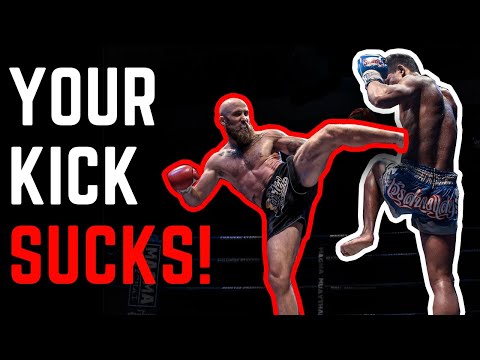
Your Switch Kick SUCKS!! (How To Switch Kick in Muay Thai)
0
Switch High Kick·Sean "Muay Thai Guy" Fagan·Added by Admin
Ready to unlock your full potential and get daily Muay Thai insights? 💥 Click the link below to join my EXCLUSIVE Nak M…
Translation: switch high kick
The Switch High Kick is a head-level roundhouse kick preceded by a rapid switch of the feet, converting the lead leg into the kicking leg with added rear-leg power and timing disruption. [1] The switch step creates an unexpected rhythm change that can catch the opponent off guard, and the momentary stance change loads the kicking hip for a more powerful strike than a standard lead-leg high kick. [1],[2] The switch high kick is particularly effective as a counter or interrupt technique, exploiting moments when the opponent is stepping forward. [2],[3]
The switch high kick uses a stance switch to target the head from the lead side. [1]
A Muay Thai technique. [1]
Used in Muay Thai and MMA. [1]
No images yet for this technique.
Sign in to suggest an image.
Ready to unlock your full potential and get daily Muay Thai insights? 💥 Click the link below to join my EXCLUSIVE Nak M…
No instructional courses yet for this technique.
Sign in to suggest a course.
Risk of injury to the person this technique is applied to
Most common KO kick; generates ~1,000N force to head (Falco et al. 2009)
Skill level needed to execute this technique reliably
Whether this technique is allowed under major competition rule sets
Karate-Do Kyohan: The Master Text (Gichin Funakoshi, 1935)
Alias sources — [1] Muay Thai: The Art of Fighting (Kraitus & Kraitus, 1988) [2] Muay Thai Unleashed (Delp, 2006) [3] Muay Thai: A Living Legacy (Vail, 2014)
Effectiveness sources — [1] Muay Thai Unleashed (Delp, 2006)
Standard katakana transliteration of Western martial arts terminology (外来語) — used in Japanese MMA, boxing, and BJJ communities
Alias sources — [1] Muay Thai: The Art of Fighting (Kraitus & Kraitus, 1988) [2] Muay Thai Unleashed (Delp, 2006) [3] Muay Thai: A Living Legacy (Vail, 2014)
Effectiveness sources — [1] Muay Thai Unleashed (Delp, 2006)
hip flexibility, rotational hip power, balance on support leg
long legs for reach, flexible hips for high kicks
hip flexors, glutes, quadriceps, obliques, calves
Sean 'Muay Thai Guy' Fagan emphasizes that your eye level should not change at all during the switch—keep your head steady and perform a quick, controlled switch in your feet.
According to Sean 'Muay Thai Guy' Fagan, your rear foot should come out to an angle slightly to the outside rather than crossing to the opposite side, which gives your hip more room to move and drive through while generating more momentum and keeping your head off the center line.
Sean 'Muay Thai Guy' Fagan stresses the importance of rotating your shoulders and upper body through the kick—your whole body needs to go through the movement so that your shoulder comes through to generate maximum power.
Sean 'Muay Thai Guy' Fagan recommends returning to the stance you feel most comfortable with, though if you train in both stances you can also come back down into the opposite stance to keep throwing combinations.
The Switch High Kick is a head-level roundhouse kick preceded by a rapid switch of the feet, converting the lead leg into the kicking leg with added rear-leg power and timing disruption. The switch step creates an unexpected rhythm change that can catch the opponent off guard, and the momentary stance change loads the kicking hip for a more powerful strike than a standard lead-leg high kick.
The switch high kick evolved alongside other switch kick variations in Muay Thai and kickboxing, where fighters developed the switch mechanism to increase lead-leg kicking power. The technique is a regular feature of modern kickboxing and MMA competition.
Unified MMA: legal — Legal striking technique; WBC/Boxing: banned — All kicks prohibited in boxing; WKF: legal — Legal, chudan (body) kick scores 2 points, jodan (head) kick scores 3 points; Kyokushin: legal — Legal at full power to body and head; WT: legal — Legal, body kick 2 points, head kick 3 points, spinning body 4 points, spinni…; WAKO: legal — Legal in Full Contact and Low Kick formats; K: legal — 1/GLORY — Legal; IFMA: legal — Legal — kicks are a core Muay Thai technique
Danger rating 6/10. High — most common KO kick; generates ~1,000N force to head (Falco et al. 2009)
The standard setup chain: Stance and Range → Chamber the Leg → Execute the Kick → Recover.
Standard counters include: Check (Shin Block) — raise the shin to intercept the kick before it lands / Catch and Sweep — catch the kicking leg and sweep the standing leg / Step Inside — close distance inside the kick's effective range to smother it.
Common variants: Standard roundhouse (rear leg) (full hip rotation, shin strikes the target); Lead leg roundhouse (switch kick) (switch-step to generate power from the lead side); Low roundhouse (leg kick) (targeting the thigh to damage the opponent's base); Head kick (high roundhouse targeting the temple or jaw).
Used in Muay Thai and MMA.
Top errors to watch for: Switching too slowly or making it two separate actions — switch then kick instead of one fluid motion / Not reaching head height because the former lead leg has less rotation than the trained rear-leg kick / Dropping the guard during the switch — the switching motion tends to open the centre line momentarily / Over-jumping on the switch and landing off-balance before the kick even fires.
The Switch High Kick is also known as Suitchi Hai Kikku, Switch Tee Sung, Switch Head Roundhouse, Lead-Leg High Kick.