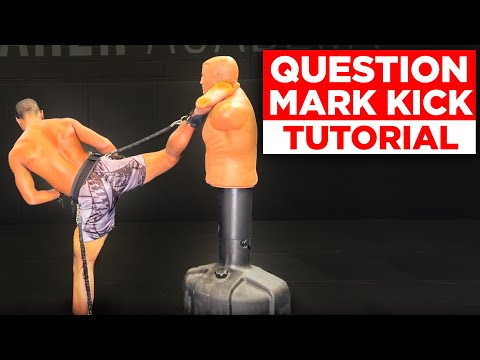
Question Mark Kick Tutorial (Step by step tutorial)
0
Question Mark Kick·Ji Martial Arts·Added by Admin
Master the Question Mark Kick | Step-by-Step Tutorial for All Levels 🔥 Want to add a deceptive and powerful technique …
Translation: question mark kick
The Question Mark Kick is a deceptive head kick that begins with the trajectory of a body kick or front kick before curving upward at the last moment to strike the opponent's jaw or temple, tracing a path resembling a question mark. [1] The initial low or mid-level trajectory causes the opponent to drop their guard to defend the body, and the sudden upward redirection catches the now-exposed head. [1],[2] The question mark kick requires exceptional hip control and the ability to change the leg's trajectory mid-flight through hip rotation and knee adjustment. [2],[3]
The question mark kick is attributed to various martial arts origins, including karate, taekwondo, and Muay Thai, with multiple practitioners claiming to have developed or popularised it. [1] The technique gained widespread recognition in MMA through fighters like Lyoto Machida and Robert Whittaker, and it became a staple of modern kickboxing through fighters like Gokhan Saki and Israel Adesanya. [2],[3]
The question mark kick is associated with Brazilian fighters who developed the technique in kyokushin karate and kickboxing gyms in Brazil, where it became known as the 'Brazilian kick.' [1] The name 'question mark kick' derives from the trajectory of the foot tracing the shape of a question mark. [1]
No images yet for this technique.
Sign in to suggest an image.
Master the Question Mark Kick | Step-by-Step Tutorial for All Levels 🔥 Want to add a deceptive and powerful technique …
No instructional courses yet for this technique.
Sign in to suggest a course.
Risk of injury to the person this technique is applied to
Most common KO kick; generates ~1,000N force to head (Falco et al. 2009)
Skill level needed to execute this technique reliably
Whether this technique is allowed under major competition rule sets
Muay Thai: The Art of Fighting (Yod Ruerngsa, Khun Kao Charuad & James Cartmell, 2002)
Alias sources — [1] Muay Thai Unleashed (Delp, 2006) [2] Muay Thai Unleashed (Delp, 2006)
Effectiveness sources — [1] Muay Thai Unleashed (Delp, 2006)
Standard katakana transliteration of Western martial arts terminology (外来語) — used in Japanese MMA, boxing, and BJJ communities
Alias sources — [1] Muay Thai Unleashed (Delp, 2006) [2] Muay Thai Unleashed (Delp, 2006)
Effectiveness sources — [1] Muay Thai Unleashed (Delp, 2006)
hip flexibility, rotational hip power, balance on support leg
long legs for reach, flexible hips for high kicks
hip flexors, glutes, quadriceps, obliques, calves
You want to make your opponent think you're throwing a front kick (tee promotion) and whip it around at the last second. According to Ji Martial Arts, a common mistake is not showing the front kick enough—people whip too early. When you become more advanced, you can literally change from a tee to a question mark kick in the final moment, making it very effective.
Power comes from three key elements: rotating your hips fully so they end up side-facing rather than front-facing, pivoting on the ball of your foot rather than staying flat-footed, and twisting your hips aggressively into the kick. Ji Martial Arts emphasizes that not rotating hips is one of the biggest power mistakes people make.
Start in a kickboxing stance with 70% weight on your back leg. Pick your back leg up with your knee as high as possible, then throw it out deep as if you're doing a front kick. Finally, whip your hips around and kick to the head as fast as possible from point A to point B. Ji Martial Arts teaches this progression to help students understand the deceptive timing.
You cannot stay flat-footed while rotating on your heel—it's dangerous and will hurt you. Pivoting on the ball of your foot enables hip rotation, allows you to throw multiple kicks, and lets you shift and change direction effectively.
The Question Mark Kick is a deceptive head kick that begins with the trajectory of a body kick or front kick before curving upward at the last moment to strike the opponent's jaw or temple, tracing a path resembling a question mark. The initial low or mid-level trajectory causes the opponent to drop their guard to defend the body, and the sudden upward redirection catches the now-exposed head.
The question mark kick is attributed to various martial arts origins, including karate, taekwondo, and Muay Thai, with multiple practitioners claiming to have developed or popularised it. The technique gained widespread recognition in MMA through fighters like Lyoto Machida and Robert Whittaker, and it became a staple of modern kickboxing through fighters like Gokhan Saki and Israel Adesanya.
Unified MMA: legal — Legal striking technique; WBC/Boxing: banned — All kicks prohibited in boxing; WKF: legal — Legal, chudan (body) kick scores 2 points, jodan (head) kick scores 3 points; Kyokushin: legal — Legal at full power to body and head; WT: legal — Legal, body kick 2 points, head kick 3 points, spinning body 4 points, spinni…; WAKO: legal — Legal in Full Contact and Low Kick formats; K: legal — 1/GLORY — Legal; IFMA: legal — Legal — kicks are a core Muay Thai technique
Danger rating 6/10. High — most common KO kick; generates ~1,000N force to head (Falco et al. 2009)
The standard setup chain: Stance and Range → Chamber the Leg → Execute the Kick → Recover.
Standard counters include: Check (Shin Block) — raise the shin to intercept the kick before it lands / Catch and Sweep — catch the kicking leg and sweep the standing leg / Step Inside — close distance inside the kick's effective range to smother it.
Common variants: Push kick (teep) (pushing the opponent away with the ball of the foot); Snap front kick (snapping the foot to the target and quickly retracting); Side teep (angled teep pushing the opponent laterally); Body teep (driving into the solar plexus or chest for maximum push-back).
Lyoto Machida used the question mark kick to knock out Randy Couture at UFC 129 (2011), which is one of the most famous uses of the technique in MMA. The technique has been used by numerous Brazilian fighters in UFC competition, including Vitor Belfort and Anderson Silva.
Top errors to watch for: Not selling the body kick feint convincingly — if the initial trajectory does not look like a real body kick, the red… / Redirecting too early, so the kick is clearly heading high from the start — the change must happen late / Losing power during the redirect because the hip rotation stalls at the transition point / Leaning too far back when redirecting upward, which reduces the force at head level.
The Question Mark Kick is also known as Kuesuchon Māku Kikku, Brazilian Kick, Fake Body High Kick.