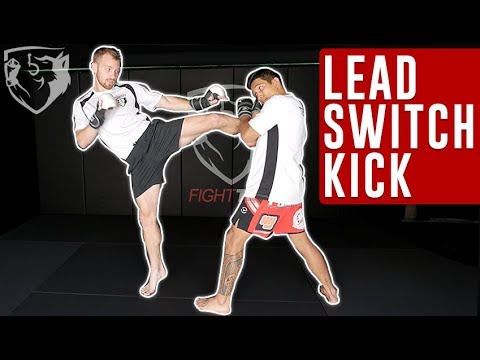
How to "Switch Kick": Lead-Leg Roundhouse Kick
0
Switch Body Kick·fightTIPS·Added by Admin
When starting Muay Thai or kickboxing classes, many people have trouble with the lead leg roundhouse kick (or "switch ki…
Translation: switch body kick
The Switch Body Kick is a body-level roundhouse kick preceded by a rapid switch of the feet, where the fighter hops and swaps the lead and rear leg positions before immediately launching the kick from what was the lead leg. [1] The switch adds power to the lead-leg kick by momentarily placing it in the rear position, engaging the full hip rotation and weight transfer typically associated with rear-leg kicks. [1],[2] The switch motion also serves as a timing disruptor, as the hop-and-swap creates an unexpected rhythm change that makes the kick harder to anticipate. [2],[3]
Switch kicks developed in Muay Thai as fighters sought to increase the power of lead-leg kicks while maintaining the speed advantage of attacking from the front side. [1] The switch mechanism became a staple of modern Muay Thai and kickboxing competition, widely taught in Thai camps and Western gyms alike. [2],[3]
The switch body kick uses a stance switch to generate power from the lead leg for a body kick. [1]
A Muay Thai technique for generating power from the lead side. [1]
Used in Muay Thai and MMA. [1]
No images yet for this technique.
Sign in to suggest an image.
When starting Muay Thai or kickboxing classes, many people have trouble with the lead leg roundhouse kick (or "switch ki…
No instructional courses yet for this technique.
Sign in to suggest a course.
Risk of injury to the person this technique is applied to
Most common KO kick; generates ~1,000N force to head (Falco et al. 2009)
Skill level needed to execute this technique reliably
Whether this technique is allowed under major competition rule sets
Karate-Do Kyohan: The Master Text (Gichin Funakoshi, 1935)
Alias sources — [1] Muay Thai: The Art of Fighting (Kraitus & Kraitus, 1988) [2] Muay Thai Unleashed (Delp, 2006) [3] Muay Thai: A Living Legacy (Vail, 2014)
Effectiveness sources — [1] Muay Thai Unleashed (Delp, 2006)
Standard katakana transliteration of Western martial arts terminology (外来語) — used in Japanese MMA, boxing, and BJJ communities
Alias sources — [1] Muay Thai: The Art of Fighting (Kraitus & Kraitus, 1988) [2] Muay Thai Unleashed (Delp, 2006) [3] Muay Thai: A Living Legacy (Vail, 2014)
Effectiveness sources — [1] Muay Thai Unleashed (Delp, 2006)
hip flexibility, rotational hip power, balance on support leg
long legs for reach, flexible hips for high kicks
hip flexors, glutes, quadriceps, obliques, calves
According to fightTIPS, people often stay flat-footed instead of pivoting on the ball of their foot, and they lean their upper body back instead of keeping it tall with the head over the support leg. Additionally, many people throw it upward like a soccer kick, which risks injuring your shin or foot on the opponent's guard.
fightTIPS emphasizes staying relatively tall and stepping your lead foot out to the side while keeping it in line, rather than stepping back. Pivot on the ball of your foot for speed and control, and keep your head directly over your support leg to maintain power and avoid dividing your energy.
fightTIPS teaches the "Dracula guard"—bringing your arms over with them slightly elevated rather than horizontal, since a horizontal arm position tends to make your kick horizontal too. This helps you maintain proper kick height and angle.
fightTIPS recommends targeting the forearms or head while hitting with the lower half of your shin. Aiming higher is both safer and allows you to generate more whip on the kick.
The Switch Body Kick is a body-level roundhouse kick preceded by a rapid switch of the feet, where the fighter hops and swaps the lead and rear leg positions before immediately launching the kick from what was the lead leg. The switch adds power to the lead-leg kick by momentarily placing it in the rear position, engaging the full hip rotation and weight transfer typically associated with rear-leg kicks.
Switch kicks developed in Muay Thai as fighters sought to increase the power of lead-leg kicks while maintaining the speed advantage of attacking from the front side. The switch mechanism became a staple of modern Muay Thai and kickboxing competition, widely taught in Thai camps and Western gyms alike.
Unified MMA: legal — Legal striking technique; WBC/Boxing: banned — All kicks prohibited in boxing; WKF: legal — Legal, chudan (body) kick scores 2 points, jodan (head) kick scores 3 points; Kyokushin: legal — Legal at full power to body and head; WT: legal — Legal, body kick 2 points, head kick 3 points, spinning body 4 points, spinni…; WAKO: legal — Legal in Full Contact and Low Kick formats; K: legal — 1/GLORY — Legal; IFMA: legal — Legal — kicks are a core Muay Thai technique
Danger rating 6/10. High — most common KO kick; generates ~1,000N force to head (Falco et al. 2009)
The standard setup chain: Stance and Range → Chamber the Leg → Execute the Kick → Recover.
Standard counters include: Check (Shin Block) — raise the shin to intercept the kick before it lands / Catch and Sweep — catch the kicking leg and sweep the standing leg / Step Inside — close distance inside the kick's effective range to smother it.
Common variants: Standard roundhouse (rear leg) (full hip rotation, shin strikes the target); Lead leg roundhouse (switch kick) (switch-step to generate power from the lead side); Low roundhouse (leg kick) (targeting the thigh to damage the opponent's base); Head kick (high roundhouse targeting the temple or jaw).
Used in Muay Thai and MMA.
Top errors to watch for: Making the switch too large and obvious — it should be a quick foot replacement, not a visible jump / Pausing after the switch before throwing the kick, giving the opponent time to react to the stance change / Losing balance during the switch because the feet cross or land unevenly / Dropping both hands during the switching motion — keep the guard up throughout.
The Switch Body Kick is also known as Suitchi Bodi Kikku, Switch Tee, Switch Roundhouse, Rear-Leg Switch Kick.