Strike & defenceLocksClose rangeFighting multiple people
Distance
CloseMiddleLong
Limb angle
Zero180–135°135–90°90–45°45–0°
Overview
The Standard Teep is the fundamental Muay Thai push kick, executed by lifting the knee to chamber position and extending the leg to push the ball or sole of the foot into the opponent's torso, driving them backward. [1] The technique uses full hip extension to deliver sustained pushing force through the target, and the arms are typically thrown back during execution to counterbalance the forward leg extension. [1],[2] The standard teep is the most commonly used teep variation and serves as Muay Thai's primary range-control weapon. [2],[3]
The standard teep is Muay Thai's most fundamental kicking technique and has been the art's primary distance-management tool for centuries. [1] Every Muay Thai camp in Thailand teaches the teep as a foundational technique from the earliest stages of training. [2],[3]
Country of origin· shown in random order
🇹🇭ThailandMuay Thai
🇧🇷BrazilMMA
🇺🇸USAMMA, Kickboxing
🇯🇵JapanKickboxing
Effectiveness
The teep is Muay Thai's primary distance-management weapon, used to control range, disrupt timing, push opponents off balance, and score points in Thai scoring systems that reward ring control. [1] Unlike a snap kick that seeks to damage, the teep's primary function is to push, making it one of the safest kicks to throw because the extended leg creates distance. [1]
Lineage
The teep is one of the oldest and most fundamental techniques in Muay Thai, taught as a core technique in every Thai boxing camp. [1] Saenchai PKSaenchaiMuayThaiGym is considered one of the modern era's greatest practitioners of the teep, using it with exceptional timing and placement. [1]
Competition Record
In Muay Thai competition at Lumpinee and Rajadamnern stadiums, the teep is heavily rewarded in scoring as a demonstration of dominance and ring control. [1] In MMA, Anderson Silva's front kick knockout of Vitor Belfort at UFC 126 (2011) — a thrust version of the teep — was one of the most spectacular finishes in UFC history. [2]
Images
No images yet for this technique.
Sign in to suggest an image.
Biomechanical Mechanism
Primary Action — Ballistic leg extension or rotation — the shin or foot impacts the target at high velocity
Joints Involved — Hip (flexion/rotation), knee (extension for front kicks, flexion-extension for roundhouse), ankle (stabilised)
Force Vector — Linear (front kick/teep — hip flexion and knee extension) or rotational (roundhouse — hip rotation with shin contact)
Kinetic Chain — Pivot foot rotation → hip turn → femur whip → shin contact — the leg acts as a heavy bat with the hip as the pivot
Position & Entry
From fighting stance (lead leg) — Chamber the knee, extend the foot forward pushing with the ball of the foot or heel, snap back
As push kick (teep) — Drive the foot into the opponent's body to maintain distance and disrupt their advance
From rear leg (power) — Step through with the rear leg, driving the hip forward for maximum pushing force
Variants
Push kick (teep) — pushing the opponent away with the ball of the foot
Snap front kick — snapping the foot to the target and quickly retracting
Side teep — angled teep pushing the opponent laterally
Body teep — driving into the solar plexus or chest for maximum push-back
1Assume Fighting Stance — begin from a balanced position with guard up
2Generate Power — use hip rotation and weight transfer for maximum force
3Execute Strike — deliver the technique to the target with correct form
4Recover to Guard — return immediately to defensive position
Sources & References
Primary Source
Muay Thai: The Art of Fighting (Yod Ruerngsa, Khun Kao Charuad & James Cartmell, 2002)
1BookMuay Thai: The Art of Fighting (Kraitus, 2002)
Alias sources — [1] Muay Thai: The Art of Fighting (Kraitus & Kraitus, 1988) [2] Muay Thai Unleashed (Delp, 2006) [3] WBC Muay Thai Rules (2014)
2BookKarate-Do Kyohan (Funakoshi, 1935)
Effectiveness sources — [1] Muay Thai: The Art of Fighting (Kraitus & Kraitus, 1988)
3OtherJapanese Combat Sports Katakana Convention
Standard katakana transliteration of Western martial arts terminology (外来語) — used in Japanese MMA, boxing, and BJJ communities
4CitationMuay Thai: The Art of Fighting (Kraitus, 2002)
Alias sources — [1] Muay Thai: The Art of Fighting (Kraitus & Kraitus, 1988) [2] Muay Thai Unleashed (Delp, 2006) [3] WBC Muay Thai Rules (2014)
5CitationKarate-Do Kyohan (Funakoshi, 1935)
Effectiveness sources — [1] Muay Thai: The Art of Fighting (Kraitus & Kraitus, 1988)
Community
Athletics
Requires
hip flexion power, knee extension speed, balance
Favours
long legs for range, hip flexibility
Key muscles
hip flexors, quadriceps, tibialis anterior, core
Frequently Asked Questions
Where should I strike with my foot when throwing a teep?
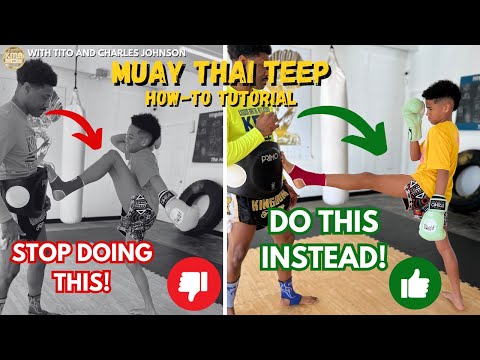
You should strike with the balls of your feet—the pad on the sole—not the whole foot or your toes. Kingdom Martial Arts Academy emphasizes that your toes should be pulled back to avoid injury if you hit an elbow or get blocked, and hitting with the balls of your feet keeps the power connected to the ground.
How should my base leg be positioned for power in the teep?
Your base leg should remain straight and flat on the ground—don't bend the knee or come up on the balls of your foot. Kingdom Martial Arts Academy teaches that the power comes from the ground, so staying flat gives you maximum drive and stability.
What's the proper hand position when throwing a teep?
Keep your hands up in a guard position. Kingdom Martial Arts Academy recommends keeping one hand high and bringing the other down slightly as you execute the teep to protect your chin and maintain balance—avoid dropping both hands.
Why does the bag spin when I use my teep?
The bag spins when you use your whole foot instead of just the balls of your feet. Kingdom Martial Arts Academy advises hitting the same spot every time with only the ball of the foot to keep the bag stable and develop consistent technique.
How does the Standard Teep work?
The Standard Teep is the fundamental Muay Thai push kick, executed by lifting the knee to chamber position and extending the leg to push the ball or sole of the foot into the opponent's torso, driving them backward. The technique uses full hip extension to deliver sustained pushing force through the target, and the arms are typically thrown back during execution to counterbalance the forward leg extension.
Where does the Standard Teep come from?
The standard teep is Muay Thai's most fundamental kicking technique and has been the art's primary distance-management tool for centuries. Every Muay Thai camp in Thailand teaches the teep as a foundational technique from the earliest stages of training.
Is the Standard Teep legal in competition?
Unified MMA: legal — Legal striking technique; WBC/Boxing: banned — All kicks prohibited in boxing; WKF: legal — Legal, chudan (body) kick scores 2 points, jodan (head) kick scores 3 points; Kyokushin: legal — Legal at full power to body and head; WT: legal — Legal, body kick 2 points, head kick 3 points, spinning body 4 points, spinni…; WAKO: legal — Legal in Full Contact and Low Kick formats; K: legal — 1/GLORY — Legal; IFMA: legal — Legal — kicks are a core Muay Thai technique
The standard setup chain: Assume Fighting Stance → Generate Power → Execute Strike → Recover to Guard.
How do I defend against the Standard Teep?
Standard counters include: Check (Shin Block) — raise the shin to intercept the kick before it lands / Catch and Sweep — catch the kicking leg and sweep the standing leg / Step Inside — close distance inside the kick's effective range to smother it.
What are the variants of the Standard Teep?
Common variants: Push kick (teep) (pushing the opponent away with the ball of the foot); Snap front kick (snapping the foot to the target and quickly retracting); Side teep (angled teep pushing the opponent laterally); Body teep (driving into the solar plexus or chest for maximum push-back).
How effective is the Standard Teep in competition?
In Muay Thai competition at Lumpinee and Rajadamnern stadiums, the teep is heavily rewarded in scoring as a demonstration of dominance and ring control. In MMA, Anderson Silva's front kick knockout of Vitor Belfort at UFC 126 (2011) — a thrust version of the teep — was one of the most spectacular finishes in UFC history.
What are common mistakes when doing the Standard Teep?
Top errors to watch for: Pushing with the toes instead of the ball or sole of the foot — the toes jam and break on impact / Not chambering and instead lifting the foot from the floor directly to the target — no power or snap / Leaning the upper body back excessively, making the teep weak and leaving you off-balance / Extending the knee before driving the hip, which turns the kick into a leg push with no force.
What are other names for the Standard Teep?
The Standard Teep is also known as Tīpu (Kihon-gata), Teep Trong, Push Kick, Front Teep.