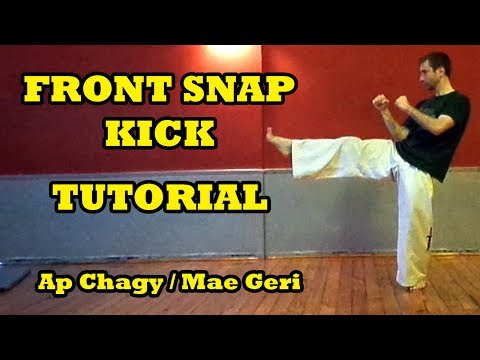
Front kick (Snap)Best In depth tutorial - Mae Geri - Ap Chagy
0
Snap Teep·Liquidcadmus·Added by Admin
Press CC for English subtitles. This is a simple tutorial for the most basic kick, the Front Snap Kick. Keep in mind t…
Translation: snap teep
The Snap Teep is a push kick variation that emphasises speed and retraction over push-through force, delivered with a quick snapping motion that contacts the target and retracts immediately. [1] Unlike the standard teep, which follows through to shove the opponent, the snap teep strikes and returns, making it harder to catch and providing a faster return to guard position. [1],[2] The snap teep targets the face, solar plexus, or body with a stinging impact rather than a sustained push. [2],[3]
The snap teep is a nuanced variation within Muay Thai's teep family, developed by Thai fighters who recognised the value of a faster, less committal push kick that could be used without the risk of having the foot caught. [1] The technique blends the speed principles of karate's snap kick with the teep's pushing mechanics. [2],[3]
The snap teep is a quick, snapping front kick for distance management. [1]
A Muay Thai technique. [1]
Used in Muay Thai competition. [1]
No images yet for this technique.
Sign in to suggest an image.
Press CC for English subtitles. This is a simple tutorial for the most basic kick, the Front Snap Kick. Keep in mind t…
No instructional courses yet for this technique.
Sign in to suggest a course.
Risk of injury to the person this technique is applied to
Teep/push kick; primarily distance management, liver shot potential
Skill level needed to execute this technique reliably
Whether this technique is allowed under major competition rule sets
Karate-Do Kyohan: The Master Text (Gichin Funakoshi, 1935)
Alias sources — [1] Muay Thai: The Art of Fighting (Kraitus & Kraitus, 1988) [2] Muay Thai Unleashed (Delp, 2006) [3] Muay Thai: A Living Legacy (Vail, 2014)
Effectiveness sources — [1] Muay Thai Unleashed (Delp, 2006)
Standard katakana transliteration of Western martial arts terminology (外来語) — used in Japanese MMA, boxing, and BJJ communities
Alias sources — [1] Muay Thai: The Art of Fighting (Kraitus & Kraitus, 1988) [2] Muay Thai Unleashed (Delp, 2006) [3] Muay Thai: A Living Legacy (Vail, 2014)
Effectiveness sources — [1] Muay Thai Unleashed (Delp, 2006)
hip flexion power, knee extension speed, balance
long legs for range, hip flexibility
hip flexors, quadriceps, tibialis anterior, core
You should kick with the ball of the foot, not the toes or instep, as kicking with those areas risks injury. To practice proper contact, gently kick a wall or floor to get used to pulling your toes back and making contact with the ball of your foot.
Raise your knee slightly above the target's height while keeping your leg bent. A high chamber gives you sufficient range of motion to execute the kick properly and helps maintain balance throughout the technique.
Slouching is a common problem that will cause you to lose balance and make the kick go off-line or bounce off the target. Keep your back upright, chest out, and shoulders straight as you kick.
Turning your base foot and hip allows you to apply hip power into the kick; without this rotation, you cannot generate proper force. Practice raising your knee in a chambered position for a couple of seconds while turning your base foot and maintaining balance until you can do this consistently.
The Snap Teep is a push kick variation that emphasises speed and retraction over push-through force, delivered with a quick snapping motion that contacts the target and retracts immediately. Unlike the standard teep, which follows through to shove the opponent, the snap teep strikes and returns, making it harder to catch and providing a faster return to guard position.
The snap teep is a nuanced variation within Muay Thai's teep family, developed by Thai fighters who recognised the value of a faster, less committal push kick that could be used without the risk of having the foot caught. The technique blends the speed principles of karate's snap kick with the teep's pushing mechanics.
Unified MMA: legal — Legal striking technique; WBC/Boxing: banned — All kicks prohibited in boxing; WKF: legal — Legal, chudan (body) kick scores 2 points, jodan (head) kick scores 3 points; Kyokushin: legal — Legal at full power to body and head; WT: legal — Legal, body kick 2 points, head kick 3 points, spinning body 4 points, spinni…; WAKO: legal — Legal in Full Contact and Low Kick formats; K: legal — 1/GLORY — Legal; IFMA: legal — Legal — kicks are a core Muay Thai technique
Danger rating 5/10. High — teep/push kick; primarily distance management, liver shot potential
The standard setup chain: Assume Fighting Stance → Generate Power → Execute Strike → Recover to Guard.
Standard counters include: Check (Shin Block) — raise the shin to intercept the kick before it lands / Catch and Sweep — catch the kicking leg and sweep the standing leg / Step Inside — close distance inside the kick's effective range to smother it.
Common variants: Push kick (teep) (pushing the opponent away with the ball of the foot); Snap front kick (snapping the foot to the target and quickly retracting); Side teep (angled teep pushing the opponent laterally); Body teep (driving into the solar plexus or chest for maximum push-back).
Used in Muay Thai competition.
Top errors to watch for: Pushing through the target instead of snapping back — this makes it a standard teep, not a snap teep / Not retracting fast enough, which allows the opponent to catch the foot / Using so little force that the snap teep has no effect and the opponent walks through it / Snapping at the foot level only without hip involvement — the hip must still drive the technique even in the fast ver….
The Snap Teep is also known as Sunappu Tīpu, Quick Teep, Snapping Push Kick, Flicking Teep.