Do you REALLY know how to elbow ?
0
Elbow Strike·Superbon - ซุปเปอร์บอน
SUPERBON FIGHT GEAR : https://superbonstore.com SUPERBON TRAINING PROGRAM : https://superbonstore.com/product/superbon-…
Translation: elbow strike
The Elbow Strike group comprises all striking techniques delivered with the proximal end of the ulna — the hard, bony point of the elbow — making it one of the most devastating close-range weapons in unarmed combat. [1] Biomechanical analysis has demonstrated that elbow strikes generate significant force relative to their short range, because the compact lever arm concentrates kinetic energy into a small, dense impact surface, greatly increasing pressure per unit area compared to a gloved fist. [1],[2] In Muay Thai, elbow strikes (sok) are classified into at least nine distinct trajectories — horizontal, uppercut, downward, spinning, reverse, diagonal, double, and chopping variations — forming one of the eight weapons (mae mai) of the art. [2],[3] Elbow strikes are prized for their ability to produce lacerations due to the sharp bone edge contacting soft facial tissue, and they account for a significant proportion of cuts and stoppages in Muay Thai and MMA competition. [3],[4] Effective elbow technique requires close distance entry, often from the clinch, and relies on hip rotation and shoulder torque rather than arm extension for power generation. [4],[5] The group is organised by trajectory: downward elbows, horizontal elbows, reverse elbows, spinning elbows, and uppercut elbows, each presenting different angles of attack and tactical use cases. [5]
Elbow strikes have been central to Southeast Asian martial arts for centuries, with Muay Thai and Muay Boran codifying elaborate elbow techniques (sok) as core offensive weapons well before the modern ring era. [1] Ancient Thai military manuals describe elbow strikes as battlefield weapons used when fighters closed to grappling distance and lost or broke their primary weapons. [1],[2] In Lethwei (Burmese bare-knuckle boxing), elbows are equally emphasised, and the art's rules specifically encourage their use. [2],[3] Elbow strikes were historically prohibited or restricted in many Western and East Asian combat sports — boxing forbids them entirely, and early karate competition did not include them — but they gained global prominence through Muay Thai's international expansion beginning in the 1970s and 1980s. [3],[4] The inclusion of elbow strikes in MMA under the Unified Rules (with the notable exception of downward twelve-to-six elbows) further elevated their tactical importance and led to systematic training methodologies blending Thai, Filipino (panantukan), and silat elbow systems. [4],[5]
Elbow strikes are legal in MMA and Muay Thai competition; they are one of the most common causes of cuts in MMA. [1]
No images yet for this technique.
Sign in to suggest an image.
SUPERBON FIGHT GEAR : https://superbonstore.com SUPERBON TRAINING PROGRAM : https://superbonstore.com/product/superbon-…
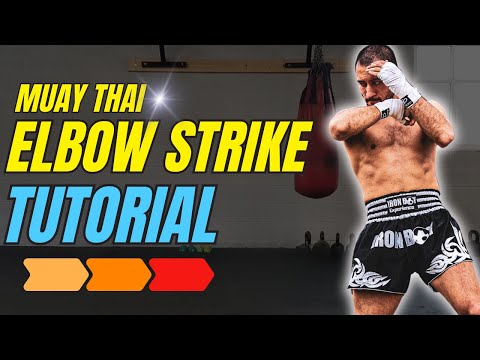
Basic Muay Thai ELBOW STRIKE Technique TUTORIAL JOIN Channel & Access SUPER FAN perks: https://www.youtube.com/channel/…
No instructional courses yet for this technique.
Sign in to suggest a course.
Risk of injury to the person this technique is applied to
Elbow is hardest striking surface; high laceration and KO risk
Skill level needed to execute this technique reliably
Whether this technique is allowed under major competition rule sets
Muay Thai: The Art of Fighting (Yod Ruerngsa, Khun Kao Charuad & James Cartmell, 2002)
Alias sources — [1] Muay Thai: The Art of Fighting (Kraitus & Kraitus, 1988) [2] Dynamic Karate (Nakayama, 1966) [3] Muay Thai Unleashed (Delp, 2006)
Effectiveness sources — [1] Muay Thai Unleashed (Delp, 2006) [2] Muay Thai: The Art of Fighting (Kraitus & Rennehan, 2002)
Official karate technique names (和語/漢語)
Established Japanese martial arts naming convention — native Japanese term (和語/漢語)
Alias sources — [1] Muay Thai: The Art of Fighting (Kraitus & Kraitus, 1988) [2] Dynamic Karate (Nakayama, 1966) [3] Muay Thai Unleashed (Delp, 2006)
Effectiveness sources — [1] Muay Thai Unleashed (Delp, 2006) [2] Muay Thai: The Art of Fighting (Kraitus & Rennehan, 2002)
leg drive, upward hip thrust, tight vertical alignment
shorter reach fighters effective at inside range
quadriceps, glutes, deltoids, biceps, core
Every move, in any martial art, shares a few universal traits. Mix and match below to pinpoint the right tool — or compare equivalents across styles.
The Downward Elbow family groups all elbow strikes delivered on a downward trajectory, where the elbow travels from a raised position above the target and descends vertically or at a steep diagonal angle. [1] These techniques use gravity to augment the force generated by the shoulder and trunk, creating particularly heavy impacts suited to striking the crown of the head, the back of the neck, or the collarbone of a bent-over opponent. [1,2] Downward elbows are among the most situationally devastating strikes in Muay Thai and MMA, often delivered when an opponent shoots for a takedown, dips their head in the clinch, or is stunned and leaning forward. [2,3] The family includes chopping elbows (diagonal downward), smashing elbows (powerful vertical drops), and twelve-six elbows (strictly vertical), each differing in angle and application. [3]
The Elbow Strike family encompasses elbow techniques that do not fit neatly into the specific trajectory-based families (Horizontal, Downward, Uppercut, Spinning, Reverse) but are practiced as general-purpose elbow strikes across multiple martial arts. [1] In karate, the generic elbow strike (hiji uchi or empi uchi) is taught as a foundational close-range weapon before students specialize in specific trajectories. [1] The family includes elbow techniques from karate, kung fu, and other arts that classify elbows by target or context rather than by trajectory — such as the short elbow to the body from clinch range, or the elbow strike used in self-defense escapes. [2] The elbow is the hardest striking surface on the human body, and its use as a weapon appears in virtually every close-range combat system worldwide. [1,2]
The Fundamental Elbow Strike family covers elbow-striking techniques across all martial arts traditions — the most devastating close-range weapon in combat sports, using the sharp point and hard bone of the elbow to deliver cutting, concussive blows. [1] The elbow is the hardest striking surface on the human body, and elbow strikes generate enormous force over a small contact area, making them exceptionally effective at causing cuts (which can stop fights via doctor stoppage), knockouts, and structural damage. [1,2] While Muay Thai has the most sophisticated elbow system (sok), elbows are also used extensively in MMA, karate (hiji ate), Krav Maga, Wing Chun, and various Southeast Asian martial arts. [2,3] In MMA, elbow strikes from the ground (ground-and-pound elbows from guard, mount, or side control) have become one of the most common fight-finishing techniques. [3]
The Horizontal Elbow family encompasses all elbow strikes delivered along a horizontal or near-horizontal plane, swinging the elbow laterally across the body in a motion analogous to a hook punch but at much closer range. [1] The horizontal elbow is the most commonly used elbow strike in Muay Thai competition, because it targets the opponent's temple, jaw, and cheekbone with a sweeping arc that is difficult to see coming in the clinch. [1,2] Biomechanically, the technique relies on rapid hip rotation and shoulder torque to whip the bent arm in a horizontal arc, with the point of the elbow making contact at the apex of the swing. [2,3] The family includes the standard horizontal elbow and the slashing elbow, which differ primarily in the angle and speed of execution. [3]
The Mae Mai (แม่ไม้, 'mother techniques') of Muay Thai elbow strikes represent the foundational elbow techniques from which all advanced Muay Thai elbow work is derived — the core curriculum of Thailand's 'Art of Eight Limbs' elbow system. [1] The Mae Mai elbows comprise the fundamental striking angles that cover every direction of attack: horizontal (sok tat), diagonal (sok chieng), uppercut (sok ngad), downward (sok sab), and reverse/spinning (sok klap). [1,2] These techniques are considered sacred in Thai boxing tradition — they are the 'mother' from which all 'child' techniques (luk mai) are born, and their mastery is what separates Thai stadium fighters from casual practitioners. [2,3] The Mae Mai elbow system is unique to Muay Thai and represents the most systematised elbow-striking curriculum in any martial art. [3]
The Reverse Elbow family covers elbow strikes directed rearward, where the striker drives the elbow backward into an opponent positioned behind or to the side. [1] The reverse elbow is a close-quarters defensive technique used when an opponent attacks from behind, secures a rear clinch, or attempts a back take, allowing the striker to deliver a sharp blow to the face, solar plexus, or ribs without needing to turn and face the attacker. [1,2] Biomechanically, the reverse elbow relies on trunk rotation and shoulder retraction to generate force, and while it produces less power than forward-facing elbows, its surprise value and unorthodox angle make it effective. [2,3]
The Spinning Elbow family comprises elbow strikes delivered with a full rotational turn of the body, where the striker pivots 180 to 360 degrees to build centripetal force before impacting the target with the elbow point. [1] Spinning elbows are among the most powerful striking techniques in combat sports, as the full-body rotation adds substantial angular momentum to the already dense impact surface of the elbow. [1,2] The technique requires precise timing and distance management, because the rotation temporarily turns the striker's back to the opponent, creating vulnerability if the strike misses. [2,3] Despite this risk, well-executed spinning elbows are extremely difficult to defend against because the rotational path obscures the angle of attack until the moment of impact. [3]
The Uppercut Elbow family groups all elbow strikes delivered on an upward trajectory, where the elbow rises vertically or diagonally from below to strike the opponent's chin, jaw, or body. [1] These techniques mirror the motion of an uppercut punch but deliver force through the harder and smaller surface of the elbow point, concentrating impact into a much smaller area. [1,2] Uppercut elbows are highly effective in the clinch, where the close distance makes them difficult to see and defend, and the upward trajectory targets the vulnerable underside of the chin, which is biomechanically linked to knockout susceptibility. [2,3] The family includes rising elbows and the Muay Thai-specific Sok Ngat, each emphasising slightly different angles of ascent. [3]
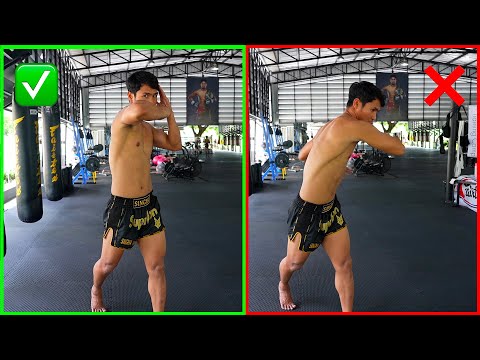
Turn your body so your shoulder is in the middle of your body, not flaring out to the side, to maintain balance and power. Superbon emphasizes that proper body rotation is essential—you step and turn your body together, protecting yourself while attacking at the same time.
Keep your palm facing down and toward your chest, not inward. Ironboy Experience explains that turning your palm outward makes your elbow pointy and sharp, while keeping your other hand up to cover your face for defense.
Pick up your back heel to release your hip and shoulder, allowing you to turn fully through the strike. Ironboy Experience notes that this also keeps your head between your legs so you don't lose balance while getting maximum rotation.
Always follow through completely with your elbow strikes, cutting all the way through rather than just tapping. Ironboy Experience stresses that you want to use your torso all the way through and pop that shoulder forward without leaving it behind.
The Elbow Strike group comprises all striking techniques delivered with the proximal end of the ulna — the hard, bony point of the elbow — making it one of the most devastating close-range weapons in unarmed combat. Biomechanical analysis has demonstrated that elbow strikes generate significant force relative to their short range, because the compact lever arm concentrates kinetic energy into a small, dense impact surface, greatly increasing pressure per unit area compared to a gloved fist.
Elbow strikes have been central to Southeast Asian martial arts for centuries, with Muay Thai and Muay Boran codifying elaborate elbow techniques (sok) as core offensive weapons well before the modern ring era. Ancient Thai military manuals describe elbow strikes as battlefield weapons used when fighters closed to grappling distance and lost or broke their primary weapons.
Unified MMA: legal — Legal — all elbow strikes permitted; WBC/Boxing: banned — All elbow strikes prohibited in boxing; WKF: banned — Elbow strikes not a legal technique in sport karate; Kyokushin: banned — Elbow strikes prohibited; WT: banned — Prohibited; ITF: banned — Prohibited; WAKO: banned — Prohibited in all kickboxing formats; K: banned — 1/GLORY — Prohibited — key difference from Muay Thai; IFMA: legal — Legal — elbows are a core Muay Thai weapon (art of eight limbs)
Danger rating 7/10. Very High — elbow is hardest striking surface; high laceration and KO risk
The standard setup chain: Close Distance → Hip Rotation → Strike with Elbow Point.
Standard counters include: Lean Back — pull the head out of elbow range to avoid the short-range strike / Clinch Tie-Up — close to body-to-body range to smother elbow strikes / Push Kick (Teep) — maintain distance to prevent elbow range from being established.
Common variants: Standard uppercut (rising punch from below targeting the chin); Short uppercut (compact version for clinch range); Body uppercut (targeting the solar plexus with the rising punch); Lead uppercut (using the lead hand for a faster, less-telegraphed rising…).
Elbow strikes are legal in MMA and Muay Thai competition; they are one of the most common causes of cuts in MMA.
Top errors to watch for: Throwing elbows from too far away — you miss and over-rotate, exposing your back / Swinging the arm wide like a hook instead of driving the elbow tip in a tight arc / Neglecting the return — the elbow must snap back to guard just like a punch / Forgetting to rotate the hips, turning it into an arm-only slap with the forearm.
The Elbow Strike is also known as Hiji-uchi, Sok, Empi Uchi, Elbow.