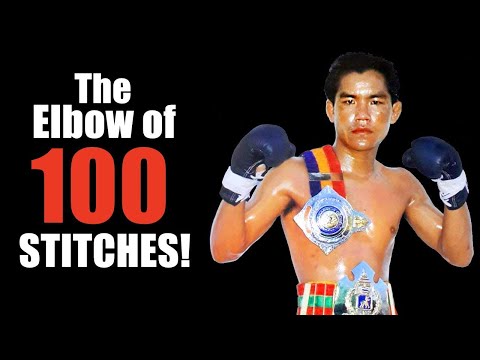
The Elbow Hunter of 100 Stitches Explained - Yodkhunpon Technique Breakdown
0
Reverse Elbow·The Modern Martial Artist
Few fighters inspired fear in his competitors and elation in the crowd like Yodkhunpon, the Great Elbow Hunter of 100 st…
Translation: reverse elbow
The Reverse Elbow family covers elbow strikes directed rearward, where the striker drives the elbow backward into an opponent positioned behind or to the side. [1] The reverse elbow is a close-quarters defensive technique used when an opponent attacks from behind, secures a rear clinch, or attempts a back take, allowing the striker to deliver a sharp blow to the face, solar plexus, or ribs without needing to turn and face the attacker. [1],[2] Biomechanically, the reverse elbow relies on trunk rotation and shoulder retraction to generate force, and while it produces less power than forward-facing elbows, its surprise value and unorthodox angle make it effective. [2],[3]
Reverse elbow techniques appear in multiple martial arts traditions, including Muay Thai, wing chun, and various self-defence systems such as Krav Maga. [1] In Southeast Asian fighting arts, the reverse elbow was used as a defensive reaction when grabbed or clinched from behind, a common scenario in battlefield combat. [2],[3]
The reverse elbow strikes backward at an opponent behind or to the side. [1]
Reverse elbows appear in Muay Thai and various martial arts. [1]
Used in MMA and Muay Thai. [1]
No images yet for this technique.
Sign in to suggest an image.
Few fighters inspired fear in his competitors and elation in the crowd like Yodkhunpon, the Great Elbow Hunter of 100 st…
No instructional courses yet for this technique.
Sign in to suggest a course.
Risk of injury to the person this technique is applied to
Backward elbow strike; close-range surprise weapon
Skill level needed to execute this technique reliably
Whether this technique is allowed under major competition rule sets
Muay Thai: The Art of Fighting (Yod Ruerngsa, Khun Kao Charuad & James Cartmell, 2002)
Alias sources — [1] Muay Thai: The Art of Fighting (Kraitus & Kraitus, 1988) [2] Muay Thai: The Art of Fighting (Kraitus & Kraitus, 1988) [3] Dynamic Karate (Nakayama, 1966)
Effectiveness sources — [1] Muay Thai Unleashed (Delp, 2006)
Official karate technique names (和語/漢語)
Established Japanese martial arts naming convention — native Japanese term (和語/漢語)
Alias sources — [1] Muay Thai: The Art of Fighting (Kraitus & Kraitus, 1988) [2] Muay Thai: The Art of Fighting (Kraitus & Kraitus, 1988) [3] Dynamic Karate (Nakayama, 1966)
Effectiveness sources — [1] Muay Thai Unleashed (Delp, 2006)
close-range proficiency, hip rotation, sharp elbow point
dense bone structure at the olecranon, strong rotational core
core rotators, deltoids, trapezius, biceps
Every move, in any martial art, shares a few universal traits. Mix and match below to pinpoint the right tool — or compare equivalents across styles.
According to The Modern Martial Artist's breakdown of Yodkhunpon technique, the reverse elbow works best when integrated with knees—Yod Kumpan's knees and elbows loaded each other, allowing him to land multiple shots in combination while keeping opponents trapped at close range.
The Modern Martial Artist emphasizes that feints are as important as the actual strikes; Yod Kumpan would consistently feint off-rhythm while chambering his legs as he moved in, allowing him to get inside an opponent's rhythm while breaking his own so they couldn't time a counter.
Masters defend against their own attacks by parrying or catching to the inside or outside, since opponents facing you have access to the same range and techniques you do.
The Reverse Elbow family covers elbow strikes directed rearward, where the striker drives the elbow backward into an opponent positioned behind or to the side. The reverse elbow is a close-quarters defensive technique used when an opponent attacks from behind, secures a rear clinch, or attempts a back take, allowing the striker to deliver a sharp blow to the face, solar plexus, or ribs without needing to turn and face the attacker.
Reverse elbow techniques appear in multiple martial arts traditions, including Muay Thai, wing chun, and various self-defence systems such as Krav Maga. In Southeast Asian fighting arts, the reverse elbow was used as a defensive reaction when grabbed or clinched from behind, a common scenario in battlefield combat.
Unified MMA: legal — Legal — all elbow strikes permitted; WBC/Boxing: banned — All elbow strikes prohibited in boxing; WKF: banned — Elbow strikes not a legal technique in sport karate; Kyokushin: banned — Elbow strikes prohibited; WT: banned — Prohibited; ITF: banned — Prohibited; WAKO: banned — Prohibited in all kickboxing formats; K: banned — 1/GLORY — Prohibited — key difference from Muay Thai; IFMA: legal — Legal — elbows are a core Muay Thai weapon (art of eight limbs)
Danger rating 7/10. Very High — backward elbow strike; close-range surprise weapon
The standard setup chain: Close Distance → Hip Rotation → Strike with Elbow Point.
Standard counters include: Lean Back — pull the head out of elbow range to avoid the short-range strike / Clinch Tie-Up — close to body-to-body range to smother elbow strikes / Push Kick (Teep) — maintain distance to prevent elbow range from being established.
Common variants: Horizontal elbow (swinging the elbow horizontally at head level); Uppercut elbow (rising elbow from below targeting the chin); Downward elbow (chopping the elbow straight down (Muay Thai sok tat)); Spinning elbow (full rotation before driving the elbow into the target).
Used in MMA and Muay Thai.
Top errors to watch for: Reaching too far behind and losing the structural integrity of the strike — keep the arm tight to the body / Not rotating the hip into the strike, using arm-only motion / Looking away from the target behind you — turn the head to track the opponent / Over-committing and spinning past the intended target.
The Reverse Elbow is also known as Ura Hiji-uchi, Back Elbow, Rear Elbow, Ushiro Empi.