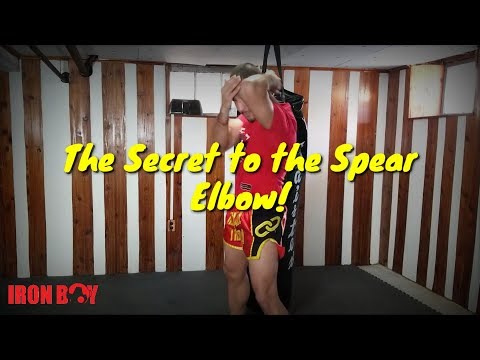
THE SECRET TO THE SPEAR ELBOW
0
Downward Elbow·Ironboy Experience
Elbows! These weapons along with the clinch really separate muay thai from every other fight sport. Elbows can create na…
Translation: downward elbow
The Downward Elbow family groups all elbow strikes delivered on a downward trajectory, where the elbow travels from a raised position above the target and descends vertically or at a steep diagonal angle. [1] These techniques use gravity to augment the force generated by the shoulder and trunk, creating particularly heavy impacts suited to striking the crown of the head, the back of the neck, or the collarbone of a bent-over opponent. [1],[2] Downward elbows are among the most situationally devastating strikes in Muay Thai and MMA, often delivered when an opponent shoots for a takedown, dips their head in the clinch, or is stunned and leaning forward. [2],[3] The family includes chopping elbows (diagonal downward), smashing elbows (powerful vertical drops), and twelve-six elbows (strictly vertical), each differing in angle and application. [3]
Downward elbow strikes appear in traditional Muay Boran techniques where they were used against opponents who lowered their heads, either in clinch fighting or after being off-balanced. [1] In Muay Thai competition, downward elbows became a common counter to clinch entries and body-level attacks, with Thai fighters developing precise timing to drop the elbow onto an advancing opponent's skull. [1],[2] The twelve-to-six variant gained notoriety in MMA discourse when it was specifically banned under the Unified Rules of Mixed Martial Arts adopted in 2001, based on concerns about the concentrated force delivered along a straight vertical axis. [2],[3]
Downward elbows strike from above using gravity to increase impact force. [1]
Downward elbows are part of Muay Thai's sok arsenal. [1]
Downward elbows are legal in MMA (except the twelve-six variant in some rulesets). [1]
No images yet for this technique.
Sign in to suggest an image.
Elbows! These weapons along with the clinch really separate muay thai from every other fight sport. Elbows can create na…
No instructional courses yet for this technique.
Sign in to suggest a course.
Risk of injury to the person this technique is applied to
12-6 elbow; extremely dangerous downward strike
Skill level needed to execute this technique reliably
Whether this technique is allowed under major competition rule sets
Muay Thai: The Art of Fighting (Yod Ruerngsa, Khun Kao Charuad & James Cartmell, 2002)
Alias sources — [1] Muay Thai: The Art of Fighting (Kraitus & Kraitus, 1988) [2] Muay Thai: The Art of Fighting (Kraitus & Kraitus, 1988) [3] Dynamic Karate (Nakayama, 1966)
Effectiveness sources — [1] Muay Thai Unleashed (Delp, 2006)
Official karate technique names (和語/漢語)
Established Japanese martial arts naming convention — native Japanese term (和語/漢語)
Alias sources — [1] Muay Thai: The Art of Fighting (Kraitus & Kraitus, 1988) [2] Muay Thai: The Art of Fighting (Kraitus & Kraitus, 1988) [3] Dynamic Karate (Nakayama, 1966)
Effectiveness sources — [1] Muay Thai Unleashed (Delp, 2006)
hip flexion power, knee extension speed, balance
long legs for range, hip flexibility
hip flexors, quadriceps, tibialis anterior, core
Every move, in any martial art, shares a few universal traits. Mix and match below to pinpoint the right tool — or compare equivalents across styles.
The Chopping Elbow subfamily covers downward elbow strikes delivered on a steep diagonal angle, resembling the motion of a hatchet or cleaver cutting downward and across. [1] Unlike a straight vertical drop, the chopping elbow follows a path roughly 45 degrees from vertical, allowing the striker to target the opponent's temple, orbital ridge, or the bridge of the nose with the sharp point of the elbow. [1,2] The technique requires the striker to raise the elbow high, rotate the shoulder forward, and drive the elbow diagonally through the target using core rotation and gravity. [2,3]
Hiji Oroshi Uchi is a descending elbow strike delivered vertically downward onto the opponent, using gravity and body weight to amplify the impact. [1] The attacker raises the elbow above the target and drives it straight down, targeting the crown of the head, back of the neck, spine, or collarbone. [1] This is the karate equivalent of the 12-to-6 elbow in MMA — one of the most powerful short-range striking techniques due to the combination of gravity, body weight, and the hardness of the elbow bone. [1]
The Smashing Elbow subfamily encompasses powerful downward elbow strikes characterised by maximal force generation, where the striker drops their full bodyweight behind the elbow to deliver a heavy, concussive blow. [1] The smashing elbow differs from the chopping elbow in its emphasis on blunt-force impact rather than cutting action, targeting the top of the skull, the back of the neck, or the shoulders with a hammering motion. [1,2] Effective execution typically involves a slight jump or rise onto the toes before dropping the elbow, adding gravitational acceleration to the hip-driven torque. [2,3]
The Twelve-Six Elbow subfamily refers to a specific downward elbow strike that travels in a strictly vertical line, likened to the motion of a clock hand moving from the twelve o'clock position straight down to six o'clock. [1] This technique delivers force along the most direct gravitational path, concentrating the full weight of the arm and upper body into a narrow point of contact on the elbow tip. [1,2] The twelve-to-six elbow is notable in MMA discourse because it is explicitly banned under the Unified Rules of Mixed Martial Arts, the only specific elbow trajectory to be prohibited, on the grounds that its direct vertical force vector poses excessive risk of injury. [2,3]
The secret to the downward elbow is learning how to pop your front shoulder forward as you step in. According to Ironboy Experience, this shoulder movement is one of the most important parts—you need to practice popping the shoulder forward and back repeatedly until you develop the feel for hitting solid instead of scraping.
Practice the shoulder pop in the mirror until you get the feeling right. Ironboy Experience explains that once you start doing it over and over on a heavy bag, you'll feel the difference between hitting solidly and just scraping—you want your elbow to drive right into the target, not glance off it.
Yes—Ironboy Experience compares the hip drive mechanics to a knee strike: if you don't drive your hip forward, your knee goes up; when you do drive it forward, the knee goes toward your opponent. The same principle applies to the elbow—the shoulder pop creates directional force instead of a vertical movement.
Use it when your opponent is coming in with punches—you can shield up and then throw the elbow from there. Ironboy Experience notes the downward elbow is effective for creating cuts on the face or forehead, and you should also maintain defense against incoming strikes.
The Downward Elbow family groups all elbow strikes delivered on a downward trajectory, where the elbow travels from a raised position above the target and descends vertically or at a steep diagonal angle. These techniques use gravity to augment the force generated by the shoulder and trunk, creating particularly heavy impacts suited to striking the crown of the head, the back of the neck, or the collarbone of a bent-over opponent.
Downward elbow strikes appear in traditional Muay Boran techniques where they were used against opponents who lowered their heads, either in clinch fighting or after being off-balanced. In Muay Thai competition, downward elbows became a common counter to clinch entries and body-level attacks, with Thai fighters developing precise timing to drop the elbow onto an advancing opponent's skull.
Unified MMA: legal — Legal — all elbow strikes permitted; WBC/Boxing: banned — All elbow strikes prohibited in boxing; WKF: banned — Elbow strikes not a legal technique in sport karate; Kyokushin: banned — Elbow strikes prohibited; WT: banned — Prohibited; ITF: banned — Prohibited; WAKO: banned — Prohibited in all kickboxing formats; K: banned — 1/GLORY — Prohibited — key difference from Muay Thai; IFMA: legal — Legal — elbows are a core Muay Thai weapon (art of eight limbs)
Danger rating 8/10. Very High — 12-6 elbow; extremely dangerous downward strike
The standard setup chain: Close Distance → Hip Rotation → Strike with Elbow Point.
Standard counters include: Lean Back — pull the head out of elbow range to avoid the short-range strike / Clinch Tie-Up — close to body-to-body range to smother elbow strikes / Push Kick (Teep) — maintain distance to prevent elbow range from being established.
Common variants: Push kick (teep) (pushing the opponent away with the ball of the foot); Snap front kick (snapping the foot to the target and quickly retracting); Side teep (angled teep pushing the opponent laterally); Body teep (driving into the solar plexus or chest for maximum push-back).
Downward elbows are legal in MMA (except the twelve-six variant in some rulesets).
Top errors to watch for: Hitting with the forearm instead of the point of the elbow — the olecranon must be the contact surface / Not raising the elbow high enough before chopping down — insufficient height means insufficient force / Attempting the downward elbow against an upright opponent — it is only effective when they are bent forward / Losing balance by over-committing the downward motion and falling forward.
The Downward Elbow is also known as Shitamuki Hiji-uchi, Sok Sap, Dropping Elbow, Otoshi Empi.