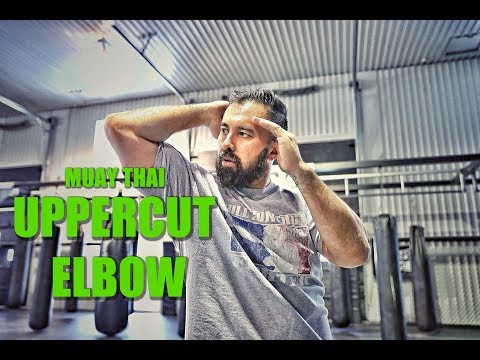
Muay Thai Elbows Ep. 3 | The Uppercut Elbow
0
Uppercut Elbow·Danny Fung
#muaythai #muaythaielbows #uppercutelbow In this third installment of our Muay Thai Elbows Series, we take an in-depth l…
Translation: uppercut elbow
The Uppercut Elbow family groups all elbow strikes delivered on an upward trajectory, where the elbow rises vertically or diagonally from below to strike the opponent's chin, jaw, or body. [1] These techniques mirror the motion of an uppercut punch but deliver force through the harder and smaller surface of the elbow point, concentrating impact into a much smaller area. [1],[2] Uppercut elbows are highly effective in the clinch, where the close distance makes them difficult to see and defend, and the upward trajectory targets the vulnerable underside of the chin, which is biomechanically linked to knockout susceptibility. [2],[3] The family includes rising elbows and the Muay Thai-specific Sok Ngat, each emphasising slightly different angles of ascent. [3]
Uppercut elbows are a core component of Muay Thai's close-range arsenal, where the rising elbow from the clinch is considered one of the art's most effective weapons. [1] The technique appears in classical Muay Boran postures and has been part of formal Thai boxing instruction since the sport's earliest codification. [1],[2] In MMA, uppercut elbows gained tactical importance as fighters recognised their effectiveness in the clinch against the cage, where opponents often lower their heads to defend against knees. [2],[3]
The uppercut elbow strikes upward in an arc similar to a punch uppercut. [1]
From Muay Thai sok techniques. [1]
Used in Muay Thai and MMA. [1]
No images yet for this technique.
Sign in to suggest an image.
#muaythai #muaythaielbows #uppercutelbow In this third installment of our Muay Thai Elbows Series, we take an in-depth l…
No instructional courses yet for this technique.
Sign in to suggest a course.
Risk of injury to the person this technique is applied to
Rising elbow; targets chin from below
Skill level needed to execute this technique reliably
Whether this technique is allowed under major competition rule sets
Muay Thai: The Art of Fighting (Yod Ruerngsa, Khun Kao Charuad & James Cartmell, 2002)
Alias sources — [1] Muay Thai: The Art of Fighting (Kraitus & Kraitus, 1988) [2] Muay Thai: The Art of Fighting (Kraitus & Kraitus, 1988) [3] Muay Thai: The Art of Fighting (Kraitus & Kraitus, 1988)
Effectiveness sources — [1] Muay Thai Unleashed (Delp, 2006)
Standard katakana transliteration of Western martial arts terminology (外来語) — used in Japanese MMA, boxing, and BJJ communities
Alias sources — [1] Muay Thai: The Art of Fighting (Kraitus & Kraitus, 1988) [2] Muay Thai: The Art of Fighting (Kraitus & Kraitus, 1988) [3] Muay Thai: The Art of Fighting (Kraitus & Kraitus, 1988)
Effectiveness sources — [1] Muay Thai Unleashed (Delp, 2006)
leg drive, upward hip thrust, tight vertical alignment
shorter reach fighters effective at inside range
quadriceps, glutes, deltoids, biceps, core
Every move, in any martial art, shares a few universal traits. Mix and match below to pinpoint the right tool — or compare equivalents across styles.
The Rising Elbow subfamily covers uppercut-trajectory elbow strikes that travel upward from a low starting position to target the chin, jaw, or underside of the opponent's face. [1] The rising elbow is driven by an explosive upward thrust of the hips and legs combined with shoulder elevation, launching the elbow point vertically into the target. [1,2] This technique is particularly dangerous because it attacks the chin from below, an angle associated with high knockout rates due to the rotational acceleration imparted to the head and the resulting shearing forces on the brainstem. [2,3]
Sok Ngat is the Thai classification for the uppercut elbow, a rising elbow strike that drives upward into the opponent's chin from directly below. [1] The technique is distinguished by its steep vertical trajectory and its origin from a low, concealed position, often thrown from the natural arm hang during clinch exchanges. [1,2] Sok Ngat is considered one of the most effective knockout elbows in Muay Thai because the upward angle perfectly targets the vulnerable mandible and chin, areas where impact most efficiently produces concussive force. [2,3]
The uppercut elbow is effective as a counter when your opponent tries to clinch you by grabbing your shoulders or neck, or when they're entering to work inside the clinch. Danny Fung emphasizes it's particularly useful to intercept an opponent's entrance as they step in wide.
Catch your opponent's overhand right and counter immediately with the uppercut elbow in one fluid motion, as Danny Fung demonstrates with the one-two timing.
Unlike boxing gloves which protect the hands and forearms, the elbow has no protective covering on the bone itself, making it a much more powerful striking weapon. This is one of the key advantages of Muay Thai over boxing.
You can throw the uppercut elbow with one hand at a time or with both arms simultaneously, depending on the situation and your positioning relative to your opponent.
The Uppercut Elbow family groups all elbow strikes delivered on an upward trajectory, where the elbow rises vertically or diagonally from below to strike the opponent's chin, jaw, or body. These techniques mirror the motion of an uppercut punch but deliver force through the harder and smaller surface of the elbow point, concentrating impact into a much smaller area.
Uppercut elbows are a core component of Muay Thai's close-range arsenal, where the rising elbow from the clinch is considered one of the art's most effective weapons. The technique appears in classical Muay Boran postures and has been part of formal Thai boxing instruction since the sport's earliest codification.
Unified MMA: legal — Legal — all elbow strikes permitted; WBC/Boxing: banned — All elbow strikes prohibited in boxing; WKF: banned — Elbow strikes not a legal technique in sport karate; Kyokushin: banned — Elbow strikes prohibited; WT: banned — Prohibited; ITF: banned — Prohibited; WAKO: banned — Prohibited in all kickboxing formats; K: banned — 1/GLORY — Prohibited — key difference from Muay Thai; IFMA: legal — Legal — elbows are a core Muay Thai weapon (art of eight limbs)
Danger rating 7/10. Very High — rising elbow; targets chin from below
The standard setup chain: Close Distance → Hip Rotation → Strike with Elbow Point.
Standard counters include: Lean Back — pull the head out of elbow range to avoid the short-range strike / Clinch Tie-Up — close to body-to-body range to smother elbow strikes / Push Kick (Teep) — maintain distance to prevent elbow range from being established.
Common variants: Standard uppercut (rising punch from below targeting the chin); Short uppercut (compact version for clinch range); Body uppercut (targeting the solar plexus with the rising punch); Lead uppercut (using the lead hand for a faster, less-telegraphed rising…).
Used in Muay Thai and MMA.
Top errors to watch for: Scooping the elbow in a wide arc instead of driving straight up — the uppercut elbow is a vertical thrust / Not driving from the legs — the power comes from standing up explosively, not from arm lifting / Hitting with the forearm instead of the elbow point / Throwing the uppercut elbow from too far away where a punch uppercut would be more appropriate.
The Uppercut Elbow is also known as Appākatto Erubō, Sok Ngat, Rising Elbow, Upward Elbow.