HOW TO ATTACK THE TURTLE - Front Headlock System
0
Front Headlock Turtle·Fargo BJJ Academy
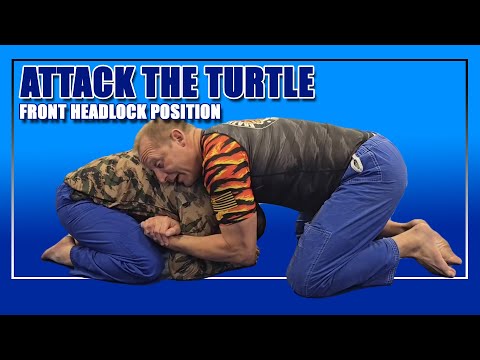
HOW TO ATTACK THE TURTLE - Front Headlock System High percentage choke options from the front headlock position you can…
Translation: front headlock turtle
The Front Headlock Turtle subfamily covers the attacking position where the top fighter controls the turtled opponent from the head side, using a front headlock (head-and-arm control) to break down the turtle and set up submissions or back takes. [1] The front headlock provides powerful head control that can be used for guillotines, d'arce chokes, anaconda chokes, and snap-downs to break the turtle. [1],[2] It is one of the most versatile attacking positions against the turtle. [2],[3]
The front headlock against turtle developed from wrestling's front headlock series and was expanded in BJJ and MMA to include a comprehensive submission curriculum including guillotines, d'arce chokes, and anaconda chokes. [1] It is one of the primary turtle-attacking positions in modern grappling. [2],[3]
The front headlock on turtle is a fundamental wrestling and BJJ technique. [1]
Front headlock turtle control is used in wrestling, BJJ, and MMA competition. [1]
No images yet for this technique.
Sign in to suggest an image.
HOW TO ATTACK THE TURTLE - Front Headlock System High percentage choke options from the front headlock position you can…
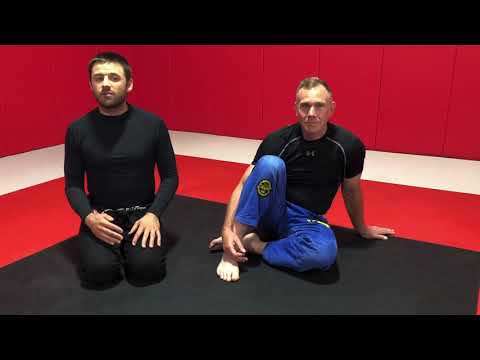
This week Greg shows a spin to the back from a front headlock
No instructional courses yet for this technique.
Sign in to suggest a course.
Risk of injury to the person this technique is applied to
Turtle is a defensive shell position; vulnerable to back takes and chokes
Skill level needed to execute this technique reliably
Whether this technique is allowed under major competition rule sets
Brazilian Jiu-Jitsu: Theory and Technique (Renzo Gracie & Royler Gracie, 2001)
Alias sources — [1] Mastering Jujitsu (Gracie & Danaher, 2003) [2] UWW Wrestling Rules [3] UWW Wrestling Rules
Effectiveness sources — [1] Wrestling Physical Conditioning Encyclopedia (Petrov, 1977) [2] Mastering Jujitsu (Gracie & Danaher, 2003)
Official Kodokan ground technique classification system
Mixed Japanese-Western terminology — combines traditional Japanese terms with katakana loanwords
Alias sources — [1] Mastering Jujitsu (Gracie & Danaher, 2003) [2] UWW Wrestling Rules [3] UWW Wrestling Rules
Effectiveness sources — [1] Wrestling Physical Conditioning Encyclopedia (Petrov, 1977) [2] Mastering Jujitsu (Gracie & Danaher, 2003)
hook control, seatbelt grip endurance, hip connection
long legs for deep hooks, strong grip for seatbelt
hip adductors, biceps, forearms, core
Every move, in any martial art, shares a few universal traits. Mix and match below to pinpoint the right tool — or compare equivalents across styles.
The front headlock position commonly occurs when someone has a failed takedown attempt and you crawl under or counter, or when your opponent is escaping side control and comes up to a single leg. According to Lincoln Brazilian Jiu-Jitsu Center, it's an important transitional position that occurs frequently in the stand-up game.
Spinning to the back is the most basic and important attack from front headlock turtle, with attacking the guillotine as a complementary move. Lincoln Brazilian Jiu-Jitsu Center emphasizes that the guillotine is not the most basic option, and spinning and guillotine attacks work together—as your opponent defends one, they open themselves to the other.
According to Fargo BJJ Academy, you should be right on top of your opponent, not to the side, with one arm under the head and the other arm outside. Keep one palm down and one palm up, and maintain your butt and knees back while using paddle feet to stay mobile if your opponent is actively driving for a takedown.
Fargo BJJ Academy teaches that you want your opponent's arm across their body rather than up high, and it's critical to keep your elbow and knee connected tightly so the grip cannot be pulled apart. When executing, you pinch and pull them across rather than up, then straighten your leg and fall to your side.
The Front Headlock Turtle subfamily covers the attacking position where the top fighter controls the turtled opponent from the head side, using a front headlock (head-and-arm control) to break down the turtle and set up submissions or back takes. The front headlock provides powerful head control that can be used for guillotines, d'arce chokes, anaconda chokes, and snap-downs to break the turtle.
The front headlock against turtle developed from wrestling's front headlock series and was expanded in BJJ and MMA to include a comprehensive submission curriculum including guillotines, d'arce chokes, and anaconda chokes. It is one of the primary turtle-attacking positions in modern grappling.
IBJJF: legal — Legal — common transitional position; IJF: restricted — Legal position but extended turtle without attacking penalized for non-combat…; ADCC: legal — Legal; Unified MMA: legal — Legal; UWW: legal — Legal — bottom position, opponent works to turn/pin; FIAS Sport Sambo: legal — Legal
Danger rating 3/10. Moderate — turtle is a defensive shell position; vulnerable to back takes and chokes
The standard setup chain: Achieve Position → Stabilize → Maintain → Attack.
Standard counters include: Hand Fight — grip-fight the choking hand to prevent the rear naked choke / Shoulder Walk — walk shoulders to the mat to escape back control / Turn into Guard — rotate to face the attacker and recover guard position.
Common variants: Back control with hooks (both feet hooked inside the opponent's thighs); Body triangle back control (legs locked in a figure-four around the torso); Rear mount (mounted on the back with both hooks, opponent face-down); Chair sit back control (sitting behind the opponent with hooks, upright position).
Front headlock turtle control is used in wrestling, BJJ, and MMA competition.
Top errors to watch for: Wrapping the head without controlling the near arm — the arm must be included for choke setups or controlled separately / Not maintaining pressure on the opponent's head — the head must be driven down to prevent them from posturing / Attempting chokes without proper neck positioning — the chin must be trapped in the elbow crease / Standing too high over the turtled opponent — stay low with hips forward for pressure and control.
The Front Headlock Turtle is also known as Furonto Heddorokku Kame, Front Headlock, Front Head Position, Snap Down Position.