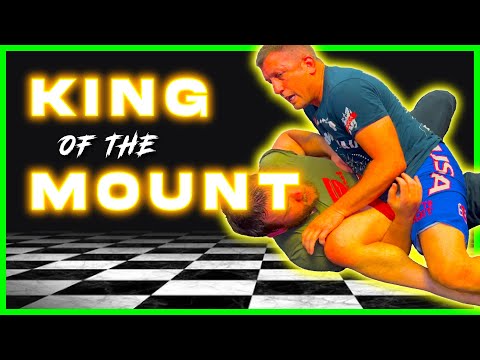
Mount CONTROL Tips!
0
Mount·TeachMeGrappling Coach Brian
This video I'm helping a couple of my guys with controlling from the mount position and I show 3 ways to crossface your …
Translation: mount
The Mount family covers the dominant ground position where the top fighter sits on the bottom fighter's torso, with legs straddling the body. [1] The mount is one of the most dominant positions in the grappling hierarchy — the top fighter can use bodyweight, gravity, and the ability to post with the hands to maintain control while attacking with strikes and submissions. [1],[2] This family covers full mount (standard straddling position), high mount (hips near the chest/shoulders), low mount (hips near the waist), S-mount (modified mount for armbar attacks), and mounted crucifix (both arms trapped). [2],[3]
The mount has been recognised as a dominant position since the earliest grappling traditions, depicted in ancient Egyptian and Greek wrestling art. [1] BJJ formalised the mount as one of the premier positions in its hierarchy, worth four points in IBJJF competition — tied with back control for the highest positional score. [2],[3]
The mount is one of the two highest-scoring positions in BJJ (four points), reflecting its tactical superiority — the top fighter can generate maximum downward pressure while the bottom fighter has severely limited defensive options. [1] In MMA, the mount is one of the most dangerous positions because it enables devastating ground-and-pound with full bodyweight behind the strikes. [2] Ribeiro describes the mount as the position where the top fighter can most effectively combine pressure with submission attacks. [3]
The mount has been recognised as dominant since the earliest grappling traditions. [1] Judo formalised the mount through tate-shiho-gatame (vertical four-corner hold). [2] The Gracie family elevated mount attacks, with Roger Gracie's cross-collar choke from mount becoming the most feared submission combination in IBJJF history. [3]
No images yet for this technique.
Sign in to suggest an image.
This video I'm helping a couple of my guys with controlling from the mount position and I show 3 ways to crossface your …
No instructional courses yet for this technique.
Sign in to suggest a course.
Risk of injury to the person this technique is applied to
Top positions enable pressure and striking; rib compression risk under heavy pressure
Skill level needed to execute this technique reliably
Whether this technique is allowed under major competition rule sets
Mastering Jujitsu (Renzo Gracie & John Danaher, 2003)
Alias sources — [1] IBJJF Rules and Regulations [2] Kodokan Judo (Kano, 1986) [3] IBJJF Rules and Regulations
Effectiveness sources — [1] IBJJF Rules and Regulations [2] UFC official statistics (ufcstats.com) [3] Jiu-Jitsu University (Ribeiro, 2008)
Standard Japanese martial arts terminology (kanji/hiragana)
Established Japanese martial arts naming convention — native Japanese term (和語/漢語)
Alias sources — [1] IBJJF Rules and Regulations [2] Kodokan Judo (Kano, 1986) [3] IBJJF Rules and Regulations
Effectiveness sources — [1] IBJJF Rules and Regulations [2] UFC official statistics (ufcstats.com) [3] Jiu-Jitsu University (Ribeiro, 2008)
base stability, heavy hips, ride ability
heavier build with strong hips for pressure
hip adductors, core, glutes, quadriceps
Every move, in any martial art, shares a few universal traits. Mix and match below to pinpoint the right tool — or compare equivalents across styles.
The Full Mount subfamily covers the standard mount position where the top fighter sits with the hips on the opponent's torso, legs straddling the body, and full bodyweight applied. [1] Full mount provides a stable platform for ground-and-pound in MMA and submission attacks in grappling, with the bottom fighter's options limited to bridging, framing, and escape attempts. [1,2] Full mount variants include the standard mount (neutral hip position), grapevine mount (legs hooking inside the opponent's legs), and gift wrap mount (controlling both arms with one arm). [2,3]
The High Mount subfamily covers the mount variation where the top fighter slides the hips up toward the opponent's chest or shoulders, creating a higher mounting position that increases submission access. [1] The high mount provides better armbar, triangle, and mounted cross-choke angles because the top fighter's hips are closer to the opponent's head and shoulders. [1,2] The trade-off is slightly less base stability compared to full mount, as the higher position makes the mount easier to bridge. [2,3]
The Low Mount subfamily covers the mount variation where the top fighter's hips are positioned low on the opponent's waist or hips, providing a more stable but less submission-oriented mounting position. [1] The low mount is typically used for control and ground-and-pound rather than submission attacks, as the lower hip position provides better base against bridging. [1,2] The low mount is common in MMA where maintaining the mount for striking is the priority. [2,3]
The Mounted Crucifix subfamily covers the mount variation where the top fighter has trapped both of the opponent's arms — one under a leg and the other controlled by the hands — while mounted, completely immobilising the bottom fighter. [1] The mounted crucifix combines the dominance of the mount with the arm control of the crucifix, creating one of the most controlling positions in grappling. [1,2] It allows completely undefended strikes in MMA and a wide range of submission attacks in grappling. [2,3]
The S-Mount subfamily covers the modified mount position where the top fighter swings one leg up alongside the opponent's head while keeping the other knee by the hip, creating an S-shaped body configuration that provides ideal armbar positioning. [1] The S-mount is specifically designed as a submission platform for the armbar — the leg by the head is in position to clamp over the face, and the hip positioning provides the correct angle for armbar execution. [1,2] The S-mount represents one of the highest-percentage armbar set-up positions in grappling. [2,3]
The mount is the most dominant position in ground fighting. In early UFC events, Royce Gracie consistently achieved mount and finished opponents from there. In IBJJF, mount scores 4 points — the highest positional score. (IBJJF Rules v6.0; Ribeiro, Jiu-Jitsu University)
Coach Brian emphasizes monitoring your opponent's attempt to dip their foot and point their knee toward the mat to scoop your ankle—hide that foot with yours to prevent the escape while maintaining upper body control.
Coach Brian advises using a cross face to control their head and prevent the escape; if they continue turning, you can jump to technical mount or drop back to the mat and cross your ankles to prevent them from lifting you.
Coach Brian recommends closing off the open side by applying a cross face with your forearm tight against their face, then jumping down to catch the position so your shoulder can control them if they try to bridge or turn.
The Mount family covers the dominant ground position where the top fighter sits on the bottom fighter's torso, with legs straddling the body. The mount is one of the most dominant positions in the grappling hierarchy — the top fighter can use bodyweight, gravity, and the ability to post with the hands to maintain control while attacking with strikes and submissions.
The mount has been recognised as a dominant position since the earliest grappling traditions, depicted in ancient Egyptian and Greek wrestling art. BJJ formalised the mount as one of the premier positions in its hierarchy, worth four points in IBJJF competition — tied with back control for the highest positional score.
IBJJF: legal — Legal, mount scores 4 points — highest-scoring position; IJF: legal — Legal, osaekomi (pin) — 10-19 seconds scores waza-ari, 20 seconds scores ippon; ADCC: legal — Legal, mount scores 2 points; Unified MMA: legal — Legal dominant position; UWW: legal — Legal, back exposure scores points, pin ends match by fall; FIAS Sport Sambo: legal — Legal, pin scores points
Danger rating 3/10. Moderate — top positions enable pressure and striking; rib compression risk under heavy pressure
The standard setup chain: Pass the Guard → Settle Weight → Control Arms → Threaten Submissions.
Standard counters include: Bridge (Upa) — explosive hip elevation to off-balance the top player / Elbow-Knee Escape (Shrimp) — create space by driving elbow to knee and hip-escaping / Frame — establish forearm frames to prevent the top player from settling weight.
Common variants: Low mount (hips heavy on the opponent's belly, grapevines in for sta…); High mount (knees under the armpits, arms isolated for submissions); S-mount (one knee high under the armpit, other leg across for arm …); Technical mount (one leg hooked, one knee posted, modified for back-take t…).
Roger Gracie's mount-based attack system produced 10 IBJJF World Championship gold medals, with the majority of his submissions coming from mount via cross-collar choke. In UFC, the mount has been used for ground-and-pound finishes in hundreds of fights.
Top errors to watch for: Sitting too high on the opponent — low mount with the hips down is more stable and harder to escape / Not using grapevine hooks — the hooks prevent the opponent from bridging and rolling / Crossing the ankles under the opponent — crossed ankles can be caught in an ankle lock; grapevine instead / Posting with the hands on the mat — maintain head-and-arm control; hands on the mat invite the upa escape.
The Mount is also known as Kijōi, Mounted Position, Tate Shiho Gatame, Full Mount.