Does Top Position Matter In Jiu Jitsu / Submission Grappling?
0
Top Position·Sub Spectrum BJJ
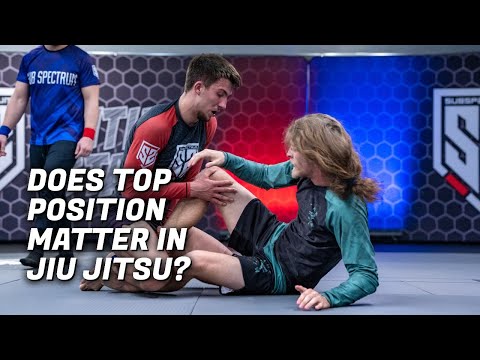
Logan Straub of No Illusions Martial Arts takes on Jordan Mills of Cedar Valley Jiu Jitsu in the group stage of the inau…
Translation: top position
The Top Position group encompasses all dominant ground positions where the fighter on top has passed the opponent's guard and achieved a controlling position. [1] Top positions represent the upper half of grappling's positional hierarchy — they provide the controlling fighter with the ability to apply pins, generate striking force (in MMA), and attack with submissions while the bottom fighter's options are limited. [1],[2] This group covers side control, mount (full, high, low, S-mount, mounted crucifix), knee-on-belly (standard, reverse, knee-on-chest), and north-south positions. [2],[3]
Top positions have been the dominant positions in wrestling and grappling since antiquity, with pinning an opponent being the primary winning condition in most wrestling traditions. [1] Judo formalised top position through its osaekomi-waza (pinning techniques), and BJJ built upon this foundation by adding a comprehensive submission attack system from each top position. [2],[3]
Top positions provide the controlling fighter with gravity advantage, the ability to generate downward pressure, and access to strikes (in MMA), making them the dominant positions in the grappling hierarchy. [1] Ribeiro identifies the top position progression (side control to mount to back) as the fundamental strategic pathway in BJJ. [2]
Top position encompasses all dominant ground positions in grappling, emphasised across BJJ, judo, and wrestling. [1]
Top position control time is a tracked statistic in MMA and is the dominant strategy in wrestling and BJJ. [1]
No images yet for this technique.
Sign in to suggest an image.
Logan Straub of No Illusions Martial Arts takes on Jordan Mills of Cedar Valley Jiu Jitsu in the group stage of the inau…
As a beginner you NEED THIS TECHNIQUE in order to be successful with any takedown!! Watch this video to find out more: …
No instructional courses yet for this technique.
Sign in to suggest a course.
Risk of injury to the person this technique is applied to
Top positions enable pressure and striking; rib compression risk under heavy pressure
Skill level needed to execute this technique reliably
Whether this technique is allowed under major competition rule sets
Jiu-Jitsu University (Saulo Ribeiro, 2008)
Alias sources — [1] Jiu-Jitsu University (Ribeiro, 2008) [2] Kodokan Judo (Kano, 1986) [3] Mastering Jujitsu (Gracie & Danaher, 2003)
Effectiveness sources — [1] Mastering Jujitsu (Gracie & Danaher, 2003) [2] Jiu-Jitsu University (Ribeiro, 2008)
Standard Japanese martial arts terminology (kanji/hiragana)
Established Japanese martial arts naming convention — native Japanese term (和語/漢語)
Alias sources — [1] Jiu-Jitsu University (Ribeiro, 2008) [2] Kodokan Judo (Kano, 1986) [3] Mastering Jujitsu (Gracie & Danaher, 2003)
Effectiveness sources — [1] Mastering Jujitsu (Gracie & Danaher, 2003) [2] Jiu-Jitsu University (Ribeiro, 2008)
hip flexibility, active legs, grip management
long legs for distance control and guard retention
hip flexors, adductors, quadriceps, core, grip
Every move, in any martial art, shares a few universal traits. Mix and match below to pinpoint the right tool — or compare equivalents across styles.
The Knee On Belly family covers the top position where the controlling fighter places one knee on the bottom fighter's torso while the other foot is posted on the mat for base, creating a mobile and aggressive pinning position. [1] Knee-on-belly is one of the most versatile top positions because it provides excellent mobility for transitioning to other positions, generates significant pressure on the bottom fighter, and allows a wide variety of submissions. [1,2] In IBJJF competition, achieving knee-on-belly scores two points, reflecting its recognition as a dominant position. [2,3]
The Mount family covers the dominant ground position where the top fighter sits on the bottom fighter's torso, with legs straddling the body. [1] The mount is one of the most dominant positions in the grappling hierarchy — the top fighter can use bodyweight, gravity, and the ability to post with the hands to maintain control while attacking with strikes and submissions. [1,2] This family covers full mount (standard straddling position), high mount (hips near the chest/shoulders), low mount (hips near the waist), S-mount (modified mount for armbar attacks), and mounted crucifix (both arms trapped). [2,3]
The North-South family covers the top control position where the controlling fighter lies chest-to-chest with the opponent but in opposite direction — head-to-feet — creating a 180-degree orientation. [1] North-south provides strong pinning pressure and is frequently used as a transitional position between side control and other positions, as well as a platform for kimura and north-south choke attacks. [1,2] The position's chest-to-chest compression makes it very difficult for the bottom fighter to create space or bridge effectively. [2,3]
The Side Control family covers the dominant top position where the controlling fighter lies perpendicular to the bottom fighter, chest-to-chest, having passed the guard to achieve a lateral pin. [1] Side control is one of the most important positions in grappling because it is the most commonly achieved dominant position after passing the guard, and it provides a stable platform for attacks while the bottom fighter has limited options. [1,2] This family covers standard side control, kesa gatame (scarf hold), and twister side control, each offering different control mechanics and submission opportunities. [2,3]
Top positions — mount, side control, knee-on-belly, north-south — are the dominant ground positions. In IBJJF, mount and back control score 4 points (maximum), guard pass scores 3, knee-on-belly scores 2. Mount appears in 3,445 passages across our corpus. (200+ books; IBJJF Rules v6.0; Ribeiro, Jiu-Jitsu University)
Starting in top position lets you immediately begin accumulating ride time from when the timer starts, which not only earns you points but can decide the match if there's a tie.
After a successful takedown, establish a strong top control position like scarf hold or judo side control, and make sure to pull on the arm and control the head to prevent your opponent from escaping or reversing the position.
Change your angle 90 degrees, keep your head high, and drive forward rather than making a left angle; additionally, know complementary takedown techniques so you have a follow-up plan if your initial attempt fails.
Practicing proper break falls—landing with your butt next to your feet while slapping out your arms—is essential before practicing takedowns, as it prevents injuries that could sideline you for weeks.
The Top Position group encompasses all dominant ground positions where the fighter on top has passed the opponent's guard and achieved a controlling position. Top positions represent the upper half of grappling's positional hierarchy — they provide the controlling fighter with the ability to apply pins, generate striking force (in MMA), and attack with submissions while the bottom fighter's options are limited.
Top positions have been the dominant positions in wrestling and grappling since antiquity, with pinning an opponent being the primary winning condition in most wrestling traditions. Judo formalised top position through its osaekomi-waza (pinning techniques), and BJJ built upon this foundation by adding a comprehensive submission attack system from each top position.
IBJJF: legal — Legal, mount scores 4 points — highest-scoring position; IJF: legal — Legal, osaekomi (pin) — 10-19 seconds scores waza-ari, 20 seconds scores ippon; ADCC: legal — Legal, mount scores 2 points; Unified MMA: legal — Legal dominant position; UWW: legal — Legal, back exposure scores points, pin ends match by fall; FIAS Sport Sambo: legal — Legal, pin scores points
Danger rating 3/10. Moderate — top positions enable pressure and striking; rib compression risk under heavy pressure
The standard setup chain: Achieve Guard Contact → Control Grips → Manage Distance → Threaten Submissions/Sweeps.
Standard counters include: Guard Pass — systematically work to clear the legs and establish a dominant position / Leg Pin — control one or both legs to neutralize guard retention / Pressure Passing — use heavy chest pressure to flatten and immobilize the guard player.
Common variants: Standard half guard (one leg trapped between both legs with an underhook); Deep half guard (fully under the opponent with the leg fully entangled); Lockdown half guard (figure-four leg lock on the trapped leg (10th Planet)); Z-guard (knee shield) (knee across the opponent's chest creating a frame).
Top position control time is a tracked statistic in MMA and is the dominant strategy in wrestling and BJJ.
Top errors to watch for: Being too high (not enough weight on the opponent) — sink your weight down and spread it across the opponent / Not using the crossface from side control — the crossface controls the opponent's head and prevents escapes / Staying in one top position without transitioning — advance from side control to mount to back as opportunities arise / Using only arms for control — top control comes from hips, chest, and weight distribution, not arm strength.
The Top Position is also known as Ue Taisei, Top Control, Pinning Position, Dominant Position.