Jiu-Jitsu Techniques | 10 Answers for Ground Vs Standing
0
Standard Standing Guard Position·Knight Jiu-Jitsu·Added by Admin
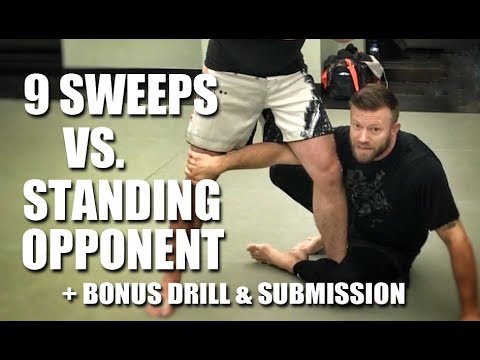
So much more at Patreon.com/KnightJiuJitsu This video has some solid answers for dealing with a standing opponent when …
Translation: standard standing guard position
The Standard Standing Guard Position establishes the fundamental standing-versus-seated dynamic with one fighter standing and the other seated or on their back, using feet on hips, hooks, or grip-and-foot combinations to maintain guard. [1] From this configuration, the standing fighter attempts to pass by going around, over, or through the guard player's legs, while the seated fighter works to sweep, submit, or maintain guard control. [1],[2] This positional dynamic is the defining interaction of modern BJJ competition. [2],[3]
The standard standing guard is the baseline fighting stance. [1]
Derived from boxing and martial arts stance traditions. [1]
Fundamental to all combat sports competition. [1]
No images yet for this technique.
Sign in to suggest an image.
So much more at Patreon.com/KnightJiuJitsu This video has some solid answers for dealing with a standing opponent when …
No instructional courses yet for this technique.
Sign in to suggest a course.
Risk of injury to the person this technique is applied to
Standing positions are pre-engagement stances; minimal direct risk
Skill level needed to execute this technique reliably
Whether this technique is allowed under major competition rule sets
Jiu-Jitsu University (Saulo Ribeiro, 2008)
Alias sources — [1] Mastering Jujitsu (Gracie & Danaher, 2003) [2] Championship Fighting (Dempsey, 1950) [3] Championship Fighting (Dempsey, 1950)
Effectiveness sources — [1] Boxing: The Complete Guide to Training and Fitness (Hatmaker, 2004)
Mixed Japanese-Western terminology — combines traditional Japanese terms with katakana loanwords
Alias sources — [1] Mastering Jujitsu (Gracie & Danaher, 2003) [2] Championship Fighting (Dempsey, 1950) [3] Championship Fighting (Dempsey, 1950)
Effectiveness sources — [1] Boxing: The Complete Guide to Training and Fitness (Hatmaker, 2004)
hip flexibility, active legs, grip management
long legs for distance control and guard retention
hip flexors, adductors, quadriceps, core, grip
Rock up and aim for your opponent's knees as you get to your feet, placing both your feet behind their ankles and pushing and pulling to drive back up. Knight Jiu-Jitsu emphasizes this approach is simple and very effective.
If both your feet end up on the same side after your opponent pushes out, you've lost leverage for the sweep. Instead, switch your foot placement and reposition to regain control and execute the sweep from a different angle.
Grab your opponent's elbows (rather than wrists), drop your feet into their hips, pull over your hand, and wind up in mount position. Knight Jiu-Jitsu notes this approach works better when your opponent is anchored to you and resisting a push.
The Standard Standing Guard Position establishes the fundamental standing-versus-seated dynamic with one fighter standing and the other seated or on their back, using feet on hips, hooks, or grip-and-foot combinations to maintain guard. From this configuration, the standing fighter attempts to pass by going around, over, or through the guard player's legs, while the seated fighter works to sweep, submit, or maintain guard control.
The standard standing guard position is the most commonly occurring positional dynamic in modern BJJ competition, representing the fundamental guard-passing-versus-guard-playing interaction. It has been the centrepiece of competitive BJJ strategy for decades.
IBJJF: legal — Legal — guard is fundamental to BJJ, sweeps from guard score 2 points; IJF: restricted — Guard pulling penalized as non-combativity — groundwork from guard permitted …; ADCC: legal — Legal, guard pull penalized -1 point in points portion; Unified MMA: legal — Legal — no penalty for playing guard; FIAS Sport Sambo: legal — Legal
Danger rating 2/10. Low — standing positions are pre-engagement stances; minimal direct risk
The standard setup chain: Achieve Guard Contact → Control Grips → Manage Distance → Threaten Submissions/Sweeps.
Standard counters include: Guard Pass — systematically work to clear the legs and establish a dominant position / Leg Pin — control one or both legs to neutralize guard retention / Pressure Passing — use heavy chest pressure to flatten and immobilize the guard player.
Common variants: Standard guard (primary leg and grip configuration for control and attack…); Offensive guard (configured for sweeps and submissions); Defensive guard (prioritising distance management and preventing passes); Transition guard (moving between guard types to adjust to the opponent's pa…).
Fundamental to all combat sports competition.
Top errors to watch for: Bending at the waist instead of the knees — bend the knees with a straight back for proper base / Gripping too high on the legs — control at the knees or ankles for maximum manipulation / Letting the opponent grab both sleeves or collar — strip grips before they establish their guard system / Standing with feet too close together — shoulder-width stance provides balance and mobility.
The Standard Standing Guard Position is also known as Sutandādo Tachi Gādo Pojishon, Fighting Guard, Ready Position, Standard On-Guard Stance.