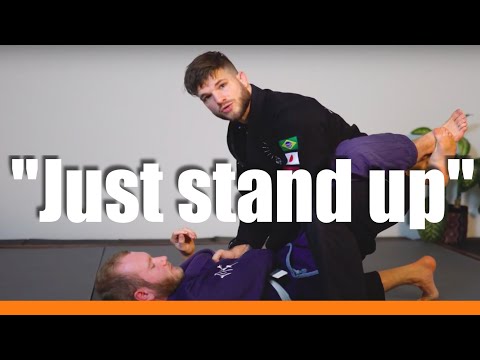
Standing up guard pass
0
Standard Standing Guard·Energia Martial Arts
Standing up guard pass Rumor has is it that I, because of my love for leglocks, don't know or refuse to pass guard... Th…
Translation: standard standing guard
The Standard Standing Guard subfamily covers the basic configuration where one fighter is on the ground in an open guard position while the other fighter is standing, creating the classic guard-passer-versus-guard-player dynamic. [1] This is one of the most common positional configurations in BJJ competition, occurring after guard pulls, incomplete takedowns, and standing passes. [1],[2] The standing fighter has the advantage of mobility and passing options, while the seated fighter has access to sweeps, leg attacks, and guard retention techniques. [2],[3]
The standard standing guard is the baseline standing position. [1]
Drawn from multiple martial arts traditions. [1]
Used in all combat sports. [1]
No images yet for this technique.
Sign in to suggest an image.
Standing up guard pass Rumor has is it that I, because of my love for leglocks, don't know or refuse to pass guard... Th…
No instructional courses yet for this technique.
Sign in to suggest a course.
Risk of injury to the person this technique is applied to
Standing positions are pre-engagement stances; minimal direct risk
Skill level needed to execute this technique reliably
Whether this technique is allowed under major competition rule sets
Jiu-Jitsu University (Saulo Ribeiro, 2008)
Alias sources — [1] IBJJF Rules (2024) [2] Championship Fighting (Dempsey, 1950)
Effectiveness sources — [1] Boxing: The Complete Guide to Training and Fitness (Hatmaker, 2004)
Mixed Japanese-Western terminology — combines traditional Japanese terms with katakana loanwords
Alias sources — [1] IBJJF Rules (2024) [2] Championship Fighting (Dempsey, 1950)
Effectiveness sources — [1] Boxing: The Complete Guide to Training and Fitness (Hatmaker, 2004)
hip flexibility, active legs, grip management
long legs for distance control and guard retention
hip flexors, adductors, quadriceps, core, grip
Every move, in any martial art, shares a few universal traits. Mix and match below to pinpoint the right tool — or compare equivalents across styles.
Keeping your upper body away from your opponent prevents them from controlling you and makes the pass more effective. Energia Martial Arts emphasizes maintaining good posture and distance as a key principle of the standing guard pass.
Controlling the sleeve on the outside is actually the hardest part of the whole pass. Once you secure this control, the rest of the technique becomes much more manageable.
Don't put your second foot close to your opponent's free hand, as this will still leave you vulnerable to a sweep. Proper foot placement away from their free hand is critical to completing the pass safely.
The Standard Standing Guard subfamily covers the basic configuration where one fighter is on the ground in an open guard position while the other fighter is standing, creating the classic guard-passer-versus-guard-player dynamic. This is one of the most common positional configurations in BJJ competition, occurring after guard pulls, incomplete takedowns, and standing passes.
The standard standing guard dynamic became the most common starting configuration in modern BJJ competition as guard pulling became prevalent. The standing-versus-seated guard exchange is now central to competitive BJJ strategy.
IBJJF: legal — Legal — guard is fundamental to BJJ, sweeps from guard score 2 points; IJF: restricted — Guard pulling penalized as non-combativity — groundwork from guard permitted …; ADCC: legal — Legal, guard pull penalized -1 point in points portion; Unified MMA: legal — Legal — no penalty for playing guard; FIAS Sport Sambo: legal — Legal
Danger rating 2/10. Low — standing positions are pre-engagement stances; minimal direct risk
The standard setup chain: Achieve Guard Contact → Control Grips → Manage Distance → Threaten Submissions/Sweeps.
Standard counters include: Guard Pass — systematically work to clear the legs and establish a dominant position / Leg Pin — control one or both legs to neutralize guard retention / Pressure Passing — use heavy chest pressure to flatten and immobilize the guard player.
Common variants: Spider guard (gripping both sleeves with feet on the biceps for distanc…); De la Riva guard (one hook behind the opponent's lead leg with opposite foo…); Lasso guard (lasso grip wrapping the leg around the opponent's arm); Collar-sleeve guard (controlling collar with one hand and sleeve with the othe…).
Used in all combat sports.
Top errors to watch for: Standing in one spot without moving — footwork is essential to avoid guard entries and create passing angles / Reaching down with both hands simultaneously — one hand controls while the other strips grips / Not varying the passing direction — predictable passing allows the guard player to set up their game / Standing too tall without any forward pressure — some forward engagement is needed to initiate passes.
The Standard Standing Guard is also known as Sutandādo Tachi Gādo, Basic Standing Guard, Standard On-Guard.