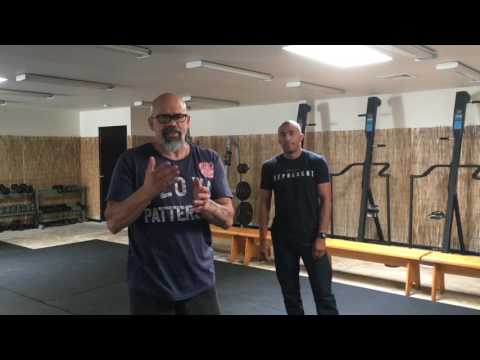
How A Striker Can Keep The Fight Standing
0
Standing Position·THE PIT Online Dojo
The Pit Online Dojo... One of the most important factors in any fight is keeping the fight standing. There are a few ba…
Translation: standing position
The Standing Position group encompasses all positions that occur while both fighters are on their feet, including stances, distance management frameworks, and standing guard positions. [1] Standing positions are the starting point of virtually all combat exchanges — the stance determines the fighter's balance, power generation, and defensive posture, while distance management determines which techniques are available at any given moment. [1],[2] This group covers fighting stances (orthodox, southpaw, square, wrestling), distance management zones (close, mid, long range), and standing guard positions used in grappling. [2],[3]
Standing fighting positions have been studied and refined since the earliest martial arts traditions, with each combat system developing optimal stances for its specific techniques. [1] Boxing codified the orthodox and southpaw stances, wrestling developed the staggered stance, and MMA synthesised elements from multiple traditions into a versatile standing fighting framework. [2],[3]
Standing position is the starting point of all combat, with stance, distance management, and footwork determining which fighter can initiate attacks and control range. [1] Proper stance provides balance, defensive structure, and the ability to generate power in strikes and explosiveness in takedowns. [2]
Standing positions encompass all upright fighting stances across combat sports disciplines. [1]
Standing position is the starting position in all combat sports competitions. [1]
No images yet for this technique.
Sign in to suggest an image.
The Pit Online Dojo... One of the most important factors in any fight is keeping the fight standing. There are a few ba…
No instructional courses yet for this technique.
Sign in to suggest a course.
Risk of injury to the person this technique is applied to
Standing positions are pre-engagement stances; minimal direct risk
Skill level needed to execute this technique reliably
Whether this technique is allowed under major competition rule sets
Jiu-Jitsu University (Saulo Ribeiro, 2008)
Alias sources — [1] Championship Fighting (Dempsey, 1950) [2] Championship Fighting (Dempsey, 1950) [3] Boxing Mastery (Hatmaker, 2004) [4] Championship Fighting (Dempsey, 1950)
Effectiveness sources — [1] Mastering Jujitsu (Gracie & Danaher, 2003) [2] Kodokan Judo (Kano, 1986)
Standard Japanese martial arts terminology (kanji/hiragana)
Established Japanese martial arts naming convention — native Japanese term (和語/漢語)
Alias sources — [1] Championship Fighting (Dempsey, 1950) [2] Championship Fighting (Dempsey, 1950) [3] Boxing Mastery (Hatmaker, 2004) [4] Championship Fighting (Dempsey, 1950)
Effectiveness sources — [1] Mastering Jujitsu (Gracie & Danaher, 2003) [2] Kodokan Judo (Kano, 1986)
hip flexibility, active legs, grip management
long legs for distance control and guard retention
hip flexors, adductors, quadriceps, core, grip
Every move, in any martial art, shares a few universal traits. Mix and match below to pinpoint the right tool — or compare equivalents across styles.
The Distance Management family covers the spatial zones between fighters and the tactical implications of each distance. [1] Distance management is one of the most fundamental concepts in all combat sports — controlling the distance determines which techniques are available, which fighter has the advantage, and how exchanges unfold. [1,2] The three primary zones — long range (kicking and reaching distance), mid range (punching and clinch entry distance), and close range (clinch and takedown distance) — each favour different techniques and fighting styles. [2,3]
The Guard Position Standing family covers the standing guard positions used in grappling, where one fighter controls the standing opponent's posture or distance while seated or positioned on the ground. [1] Standing guard positions are transitional configurations that occur during guard pulls, sit-out exchanges, and standing-to-ground transitions. [1,2] These positions bridge the gap between standing combat and ground fighting. [2,3]
The Stance family covers the fundamental standing positions from which fighters launch attacks, defend, and move. [1] A fighter's stance determines their balance, power generation capability, defensive coverage, and available techniques at any moment. [1,2] This family covers the primary fighting stances: orthodox (left foot forward), southpaw (right foot forward), square (feet even), and the staggered wrestling stance (low, wide base), each optimised for different combat objectives. [2,3]
Standing position — stance, footwork, and distance management — determines the starting point for all striking and grappling exchanges. Stance appears in 8,608 passages across our corpus — the single most referenced concept. Every martial art begins with stance training. (200+ books; universal across all martial arts texts)
According to THE PIT Online Dojo, you need three things: control distance by using strikes and lateral movement as barriers to keep him from closing in, protect your hips at all costs since a grappler who controls your hips can take you down, and maintain a lower stance than you would against another striker to defend against takedowns effectively.
THE PIT Online Dojo emphasizes that distance is number one—he who controls the distance will control the fight. As a striker, you want to maintain striking range where you can punch safely, while your opponent (if a grappler) wants to close the distance completely to take you down.
THE PIT Online Dojo recommends throwing a multitude of straight punches combined with lateral movement; straight punches create a barrier that deters opponents from walking in, while lateral movement prevents them from setting up their shots since they can never plant their feet.
According to THE PIT Online Dojo, you need to find a balance: low enough to defend takedowns effectively, but not so low that you can't strike well, and not so high that you're easily taken down. Your level must be adjusted based on whether you're purely striking or facing a grappler.
The Standing Position group encompasses all positions that occur while both fighters are on their feet, including stances, distance management frameworks, and standing guard positions. Standing positions are the starting point of virtually all combat exchanges — the stance determines the fighter's balance, power generation, and defensive posture, while distance management determines which techniques are available at any given moment.
Standing fighting positions have been studied and refined since the earliest martial arts traditions, with each combat system developing optimal stances for its specific techniques. Boxing codified the orthodox and southpaw stances, wrestling developed the staggered stance, and MMA synthesised elements from multiple traditions into a versatile standing fighting framework.
Unified MMA: legal — Legal; IBJJF: legal — Legal; IJF: legal — Legal; WBC/Boxing: legal — Legal — stance and footwork are fundamental; WKF: legal — Legal; UWW: legal — Legal
Danger rating 2/10. Low — standing positions are pre-engagement stances; minimal direct risk
The standard setup chain: Achieve Guard Contact → Control Grips → Manage Distance → Threaten Submissions/Sweeps.
Standard counters include: Guard Pass — systematically work to clear the legs and establish a dominant position / Leg Pin — control one or both legs to neutralize guard retention / Pressure Passing — use heavy chest pressure to flatten and immobilize the guard player.
Common variants: Standard guard (primary leg and grip configuration for control and attack…); Offensive guard (configured for sweeps and submissions); Defensive guard (prioritising distance management and preventing passes); Transition guard (moving between guard types to adjust to the opponent's pa…).
Standing position is the starting position in all combat sports competitions.
Top errors to watch for: Standing square to the opponent — a staggered stance provides better mobility and power generation / Flat-footed stance — stay on the balls of the feet for quick movement / Standing too close or too far — each fighter has an optimal distance; find and maintain it / Not moving the feet — static fighters are easy to hit and easy to take down.
The Standing Position is also known as Tachi Taisei, Stance, Standing Game, Footwork Position, Upright Position.