Introduction to Open Guard Sweeps
When grounded against a standing opponent, the practitioner should prioritize sweeping to establish a positional advantage before standing. By timing a sweep correctly, the athlete prevents the opponent from resetting distance and forces them to recover from a disadvantaged position.
Double Ankle Sweep Fundamentals
The double ankle sweep is executed when the opponent approaches with feet positioned square. The practitioner grasps both ankles, drives the knees together into the opponent's waist, and transitions to mount position by curving the legs and securing the back of the neck.
Double Ankle Sweep Against Anchored Opponent
When the opponent secures a grip before the sweep can be initiated, the practitioner should abandon the pushing motion and instead grab the opponent's elbows. The practitioner then places their feet at the opponent's hips and pulls over their hands to reach mount position.
Hook Sweep from Staggered Stance
When the opponent adopts a staggered stance, the double ankle grip becomes unavailable. The practitioner secures the nearest ankle with their hand while hooking their foot behind the opponent's calf or knee, then synchronizes a push-pull motion to sweep while transitioning to knee-on-belly.
Foot Hook Sweep Variations
If the opponent extends their stance too far, the practitioner can reposition their legs to place their ankle against the opponent's ankle from behind. This adjustment allows the sweep to be executed in the opposite direction while maintaining control and flow to standing position.
Transitioning Between Hook and Tripod Sweeps
When the opponent escapes the initial hook sweep by extracting their leg, the practitioner switches to the opposite side and re-establishes the foot hook at the hip. This dynamic transition creates a drilling opportunity, allowing the practitioner to flow between variations based on opponent resistance.
Inside Thigh Hook and Triangle Setup
When the opponent pushes the foot out from the hip, the practitioner immediately transitions to an inside thigh hook. By pushing the opponent's leg to widen their base, sitting up, and securing the wrist, the practitioner can then step into the hip and lock the triangle choke.
Dummy Sweep from Disengaged Guard
The dummy sweep is the most direct option when the opponent maintains a square stance while disengaged. The practitioner sits up, aims both hands at the opponent's knees while simultaneously hooking both ankles, then executes a synchronized push-pull motion to regain standing position.
Jiu-Jitsu Techniques | 10 Answers for Ground Vs Standing
Key Takeaways
- •Introduction to Open Guard Sweeps
- •Double Ankle Sweep Fundamentals
- •Double Ankle Sweep Against Anchored Opponent
- •Hook Sweep from Staggered Stance
So much more at Patreon.com/KnightJiuJitsu This video has some solid answers for dealing with a standing opponent when you are on the ground. These are what I feel are high-percentage, helpful techniques for getting to a better position. The main focus is on sweeps in order to create opportunity to get back to standing, but I also include a couple of submissions. These are applicable with minor modifications and considerations to sport, self-defense and MMA. I hope you find some usefulness in them. Thank you for watching, sharing and subscribing! Instagram: @knight_jiu_jitsu Keep watching for great things out of Aperture Fight Focused on Facebook and on YouTube
Frequently Asked Questions
What does this video teach about standard standing guard position?
This video covers introduction to open guard sweeps, double ankle sweep fundamentals, double ankle sweep against anchored opponent. It provides detailed instruction from Knight Jiu-Jitsu.
How long does it take to learn standard standing guard position?
The basic mechanics can be understood in a single session, but developing reliable execution requires consistent drilling over weeks of practice. This 8-part breakdown helps structure your training by isolating each phase of the technique.
What are the key details for finishing standard standing guard position?
When the opponent pushes the foot out from the hip, the practitioner immediately transitions to an inside thigh hook. By pushing the opponent's leg to widen their base, sitting up, and securing the wrist, the practitioner can then step into the hip and lock the triangle choke.
Related videos
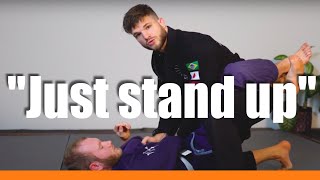
Standing up guard pass
Energia Martial Arts
Boxing Stance | Learn Long Range vs Short Range Fighting
FightCamp
5 Tips For Fighting At Long Range
Warrior Martial Arts
Be A Master Of DISTANCE MANAGEMENT: The Most Important Part Of Fighting | BAZOOKATRAINING.COM
Bazooka Joe Valtellini

Beterbiev vs. Bivol 2 | Master of Distance Management | FILM STUDY
Surgical Boxing