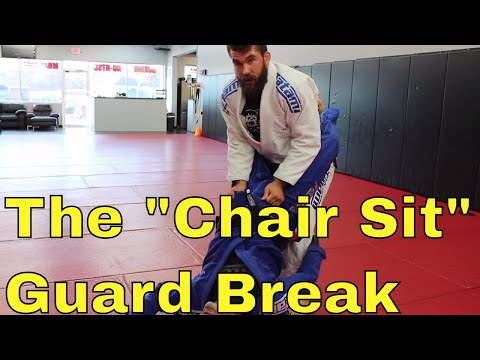
Crack Open a Strong Full Guard with this Standing Break in BJJ
0
Guard Position Standing·Chewjitsu
Being able to break the Guard in BJJ is an essential skill. But it's a task that is not always the easiest, depending on…
Translation: guard position standing
The Guard Position Standing family covers the standing guard positions used in grappling, where one fighter controls the standing opponent's posture or distance while seated or positioned on the ground. [1] Standing guard positions are transitional configurations that occur during guard pulls, sit-out exchanges, and standing-to-ground transitions. [1],[2] These positions bridge the gap between standing combat and ground fighting. [2],[3]
Standing guard positions draw from boxing stances, martial arts kamae, and wrestling positioning. [1]
Stance selection is a tactical consideration in all combat sports competition. [1]
No images yet for this technique.
Sign in to suggest an image.
Being able to break the Guard in BJJ is an essential skill. But it's a task that is not always the easiest, depending on…
No instructional courses yet for this technique.
Sign in to suggest a course.
Risk of injury to the person this technique is applied to
Standing positions are pre-engagement stances; minimal direct risk
Skill level needed to execute this technique reliably
Whether this technique is allowed under major competition rule sets
Jiu-Jitsu University (Saulo Ribeiro, 2008)
Alias sources — [1] Jiu-Jitsu University (Ribeiro, 2008) [2] Jiu-Jitsu University (Ribeiro, 2008) [3] Jiu-Jitsu University (Ribeiro, 2008)
Effectiveness sources — [1] Mastering Jujitsu (Gracie & Danaher, 2003) [2] Boxing: The Complete Guide to Training and Fitness (Hatmaker, 2004)
Mixed Japanese-Western terminology — combines traditional Japanese terms with katakana loanwords
Alias sources — [1] Jiu-Jitsu University (Ribeiro, 2008) [2] Jiu-Jitsu University (Ribeiro, 2008) [3] Jiu-Jitsu University (Ribeiro, 2008)
Effectiveness sources — [1] Mastering Jujitsu (Gracie & Danaher, 2003) [2] Boxing: The Complete Guide to Training and Fitness (Hatmaker, 2004)
hip flexibility, active legs, grip management
long legs for distance control and guard retention
hip flexors, adductors, quadriceps, core, grip
Every move, in any martial art, shares a few universal traits. Mix and match below to pinpoint the right tool — or compare equivalents across styles.
The standing guard position — feet placement, weight distribution, hand position — is the first thing taught in every striking art. In boxing, the guard protects the chin with both hands. In Muay Thai, the guard is higher and the stance more square to check kicks. (Universal across striking texts in corpus)
Bring both of your knees in to the hips, positioning them directly behind the opponent's hips while maintaining control of their elbows. This placement is crucial for applying effective pressure to open the guard.
Maintain good posture by sitting back as much as possible. Once you have control, spread your knees out to put pressure on the guard while sitting back into a chair-like position, which arches up the opponent's hips and breaks their guard.
The Guard Position Standing family covers the standing guard positions used in grappling, where one fighter controls the standing opponent's posture or distance while seated or positioned on the ground. Standing guard positions are transitional configurations that occur during guard pulls, sit-out exchanges, and standing-to-ground transitions.
Standing guard positions developed in BJJ with the increasing use of guard pulls in competition, where fighters transition directly from standing to guard without a takedown. They represent the transitional phase between standing and ground grappling.
IBJJF: legal — Legal — guard is fundamental to BJJ, sweeps from guard score 2 points; IJF: restricted — Guard pulling penalized as non-combativity — groundwork from guard permitted …; ADCC: legal — Legal, guard pull penalized -1 point in points portion; Unified MMA: legal — Legal — no penalty for playing guard; FIAS Sport Sambo: legal — Legal
Danger rating 2/10. Low — standing positions are pre-engagement stances; minimal direct risk
The standard setup chain: Achieve Guard Contact → Control Grips → Manage Distance → Threaten Submissions/Sweeps.
Standard counters include: Guard Pass — systematically work to clear the legs and establish a dominant position / Leg Pin — control one or both legs to neutralize guard retention / Pressure Passing — use heavy chest pressure to flatten and immobilize the guard player.
Common variants: Standard guard (primary leg and grip configuration for control and attack…); Offensive guard (configured for sweeps and submissions); Defensive guard (prioritising distance management and preventing passes); Transition guard (moving between guard types to adjust to the opponent's pa…).
Stance selection is a tactical consideration in all combat sports competition.
Top errors to watch for: Kneeling into the guard without a plan — standing provides more options; don't give up the advantage without reason / Allowing the guard player to establish grips without resistance — strip grips immediately and continuously / Bending forward at the waist — maintain an upright posture with hips back for balance / Standing too close to the guard player — maintain distance that prevents their hooks from reaching.
The Guard Position Standing is also known as Tachi Gādo Pojishon, Standing In Guard, Guard Top Standing, Combat Base Standing.