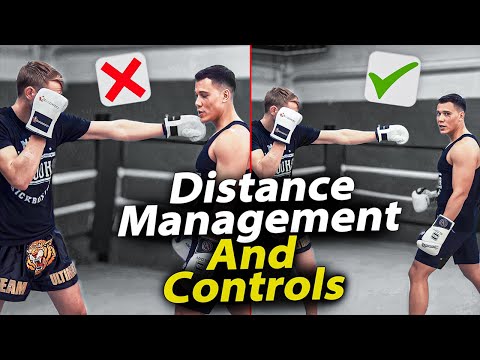
Strike & defenceLocksClose rangeFighting multiple people
Distance
CloseMiddleLong
Overview
The Distance Management family covers the spatial zones between fighters and the tactical implications of each distance. [1] Distance management is one of the most fundamental concepts in all combat sports — controlling the distance determines which techniques are available, which fighter has the advantage, and how exchanges unfold. [1],[2] The three primary zones — long range (kicking and reaching distance), mid range (punching and clinch entry distance), and close range (clinch and takedown distance) — each favour different techniques and fighting styles. [2],[3]
Also known as
Range Control[1]Fighting Distance[2]Measure[3]Ma-ai[4]
Distance management theory has been central to fighting since antiquity, with fencing developing the most systematic early framework through its concepts of measure and tempo. [1] Boxing, kickboxing, and MMA refined distance management into a comprehensive tactical framework that governs modern striking strategy. [2],[3]
Country of origin· shown in random order
🇬🇧EnglandBoxing
🇬🇷GreeceBoxing
🇹🇭ThailandMuay Thai
🇧🇷BrazilMMA
🇺🇸USAMMA, Kickboxing
🇯🇵Japan距離管理(Kyori Kanri)Karate, Kickboxing
🇰🇷KoreaTaekwondo
🇫🇷FranceFencing, Savate
🇮🇹ItalyFencing
🇨🇳China— Japanese name read in ChineseSanda
Effectiveness
Distance management is the fundamental skill of controlling the range between fighters, determining which techniques are available and when. [1],[2]
Lineage
Distance management concepts are found in all striking arts, from boxing's range theory to fencing's measure system. [1],[2]
Competition Record
Distance management is a key analytical metric in MMA, with dominant fighters consistently controlling range. [1]
Images
No images yet for this technique.
Sign in to suggest an image.
Biomechanical Mechanism
Primary Action — Establishing and maintaining a controlling position relative to the opponent
Joints Involved — Body positioning determines which joints and limbs are available for control and attack
Force Vector — Varies by position — gravity, frames, hooks, and pressure dictate control dynamics
Positional Mechanic — Hierarchy of positions — each position offers different offensive and defensive capabilities
Position & Entry
From neutral position — Assume the fighting stance by placing feet at shoulder width, bending knees slightly, and establishing guard position
Before engagement — Establish the proper stance as the starting position before initiating or receiving attacks
✓Distance management is the art of controlling the space between fighters — it determines which techniques are available and who holds the tactical advantage (Dempsey, Championship Fighting, 1950)
✓Three primary ranges exist: long range (kicking/jabbing distance), mid range (punching/combination distance), and close range (clinch/takedown distance)
✓The fighter who controls distance controls the fight — forcing the opponent to fight at an uncomfortable range is a winning strategy
✓Distance management uses footwork, feints, and frames to maintain the desired range
✓In MMA, distance management is the most important skill: it integrates striking, wrestling, and clinch seamlessly
✓Distance management is both offensive (closing distance to attack) and defensive (creating distance to avoid attacks)
✓Study distance masters: Anderson Silva, Lyoto Machida, Israel Adesanya — all control fights through superior distance management
Common Mistakes
!Standing at a fixed distance without adjusting — distance must be constantly managed based on the opponent's movement
!Not understanding your optimal range — each fighter has a range where their best weapons are available; find and maintain it
!Moving only forward and backward — lateral movement and angles are essential for distance management
!Ignoring the opponent's distance preferences — force them to fight at YOUR optimal range, not theirs
!Not using feints to manage distance — feints provoke reactions that create distance opportunities
!Closing distance without a plan — entering the opponent's range must be purposeful, not accidental
!Retreating in a straight line — angled retreats maintain distance while creating offensive angles
Distance management — controlling the space between fighters — is the fundamental strategic concept in all striking arts. In boxing, 'fighting at your range' determines who lands and who gets hit. In MMA, the striker wants distance while the wrestler wants to close it. (Boxing and MMA manuals across corpus)
Frequently Asked Questions
Why is distance management considered the most important part of fighting?
Distance management is crucial both offensively and defensively because it allows you to hit your opponent without getting hit yourself. Bazooka Joe Valtellini emphasizes that controlling the distance between you and your opponent is fundamental to combat fighting.
How do I know what distance to fight at?
Different distances work better for different fighters and situations. Bazooka Joe notes that in MMA you might use double distance to avoid takedowns, while in kickboxing he prefers one-and-a-half distance. You learn which distance suits your style best through training and experience.
How should I throw strikes to maintain proper distance?
Each strike needs to be used at its maximum range and length—your jab requires full extension, your cross needs full range. Bazooka Joe explains that using techniques at their longest, most powerful range is essential to distance management.
What footwork techniques help me manage distance?
Learning different types of footwork for closing distance and evading is important. Bazooka Joe teaches single, one-and-a-half, and double distance footwork, and emphasizes using angles and stepping out to maintain range safely rather than moving straight in.
How does the Distance Management work?
The Distance Management family covers the spatial zones between fighters and the tactical implications of each distance. Distance management is one of the most fundamental concepts in all combat sports — controlling the distance determines which techniques are available, which fighter has the advantage, and how exchanges unfold.
Where does the Distance Management come from?
Distance management theory has been central to fighting since antiquity, with fencing developing the most systematic early framework through its concepts of measure and tempo. Boxing, kickboxing, and MMA refined distance management into a comprehensive tactical framework that governs modern striking strategy.
Danger rating 2/10. Low — standing positions are pre-engagement stances; minimal direct risk
How do I set up the Distance Management?
The standard setup chain: Achieve Position → Stabilize → Maintain → Attack.
How do I defend against the Distance Management?
Standard counters include: Posture Control — maintain strong posture to limit the opponent's offensive options / Escape to Neutral — work back to standing or a neutral position.
What are the variants of the Distance Management?
Common variants: Standard variation (primary positioning for control and attack); Offensive variation (configured for submission or striking opportunities); Transitional variation (positioned for quick movement to the next position); Defensive variation (prioritising stability and control over attack).
How effective is the Distance Management in competition?
Distance management is a key analytical metric in MMA, with dominant fighters consistently controlling range.
What are common mistakes when doing the Distance Management?
Top errors to watch for: Standing at a fixed distance without adjusting — distance must be constantly managed based on the opponent's movement / Not understanding your optimal range — each fighter has a range where their best weapons are available; find and main… / Moving only forward and backward — lateral movement and angles are essential for distance management / Ignoring the opponent's distance preferences — force them to fight at YOUR optimal range, not theirs.
What are other names for the Distance Management?
The Distance Management is also known as Kyori Kanri, Range Control, Fighting Distance, Measure, Ma-ai.