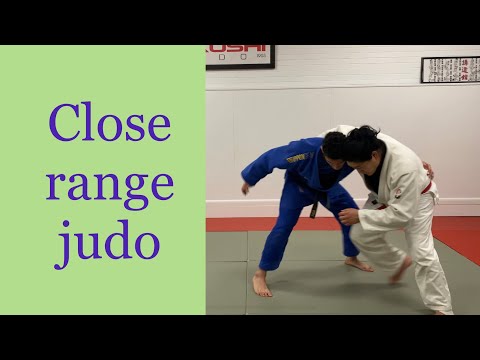
Close range Judo
0
Close Range·Shintaro Higashi
Close range judo. When? Why? RvL RvL (Kenka Yotsu) Short range judo involves a lot more unpredictability because of …
Translation: close range
The Close Range subfamily covers the fighting distance where fighters are within arm's reach and clinch engagement is imminent or active. [1] Close range is the distance where hooks, uppercuts, elbows, knees, and clinch techniques are most effective, and where takedown attempts are most commonly initiated. [1],[2] Fighting at close range favours fighters with strong clinch work, dirty boxing skills, and takedown ability. [2],[3]
Close-range fighting has been studied in boxing (inside fighting), Muay Thai (clinch), and wrestling. [1]
Close-range exchanges are critical in MMA and Muay Thai competition. [1]
No images yet for this technique.
Sign in to suggest an image.
Close range judo. When? Why? RvL RvL (Kenka Yotsu) Short range judo involves a lot more unpredictability because of …
No instructional courses yet for this technique.
Sign in to suggest a course.
Risk of injury to the person this technique is applied to
Standing positions are pre-engagement stances; minimal direct risk
Skill level needed to execute this technique reliably
Whether this technique is allowed under major competition rule sets
Karate-Do Kyohan: The Master Text (Gichin Funakoshi, 1935)
Alias sources — [1] Mastering Jujitsu (Gracie & Danaher, 2003) [2] Championship Fighting (Dempsey, 1950) [3] Championship Fighting (Dempsey, 1950)
Effectiveness sources — [1] Boxing: The Complete Guide to Training and Fitness (Hatmaker, 2004) [2] Muay Thai Unleashed (Delp, 2006)
Standard Japanese martial arts terminology (kanji/hiragana)
Established Japanese martial arts naming convention — native Japanese term (和語/漢語)
Alias sources — [1] Mastering Jujitsu (Gracie & Danaher, 2003) [2] Championship Fighting (Dempsey, 1950) [3] Championship Fighting (Dempsey, 1950)
Effectiveness sources — [1] Boxing: The Complete Guide to Training and Fitness (Hatmaker, 2004) [2] Muay Thai Unleashed (Delp, 2006)
balance, lower body stability, quick directional change
well-proportioned build with strong base
calves, quadriceps, core, hip stabilisers
Every move, in any martial art, shares a few universal traits. Mix and match below to pinpoint the right tool — or compare equivalents across styles.
According to Shintaro Higashi, fighting for shoulder control is essential at close range because once you secure the shoulder with a sleeve or lapel grip, you gain significant control over your opponent. Maintaining proper shoulder position also prevents your opponent from executing techniques like turn throws or leg attacks effectively.
Shintaro Higashi recommends pointing your toes outward to prevent leg attacks like Osodogari. If you point your toes inward instead, you bend your knee inward and make yourself vulnerable to your opponent hooking and sweeping you over.
Shintaro Higashi emphasizes keeping your posture upright and fighting for an underhook rather than climbing on the opponent's hip, as this prevents them from executing turn throws. An underhook also makes it very difficult for your opponent to hop and turn effectively.
Shintaro Higashi states that overhooks are not always better at close range. If you develop strong underhook technique, you can control your opponent very effectively from that position.
The Close Range subfamily covers the fighting distance where fighters are within arm's reach and clinch engagement is imminent or active. Close range is the distance where hooks, uppercuts, elbows, knees, and clinch techniques are most effective, and where takedown attempts are most commonly initiated.
Close range fighting has been a core distance in boxing since the sport's bare-knuckle era, with inside fighting and infighting being essential boxing skills. MMA expanded close range fighting to include the full spectrum of clinch, takedown, and short-range striking techniques.
Unified MMA: legal — Legal; IBJJF: legal — Legal; IJF: legal — Legal; WBC/Boxing: legal — Legal — stance and footwork are fundamental; WKF: legal — Legal; UWW: legal — Legal
Danger rating 2/10. Low — standing positions are pre-engagement stances; minimal direct risk
The standard setup chain: Achieve Position → Stabilize → Maintain → Attack.
Standard counters include: Posture Control — maintain strong posture to limit the opponent's offensive options / Escape to Neutral — work back to standing or a neutral position.
Common variants: Standard variation (primary positioning for control and attack); Offensive variation (configured for submission or striking opportunities); Transitional variation (positioned for quick movement to the next position); Defensive variation (prioritising stability and control over attack).
Close-range exchanges are critical in MMA and Muay Thai competition.
Top errors to watch for: Entering close range without hand fighting — the hands must be active to control ties and prevent the opponent's grips / Standing tall at close range — lower the level for takedown threats and to reduce the opponent's striking angles / Not using frames to manage the clinch entry — frames prevent the opponent from achieving dominant clinch position / Fighting at close range without clinch skills — close range without grappling knowledge is dangerous.
The Close Range is also known as Kinkyori, Infighting Range, Close Quarters, Short Range.