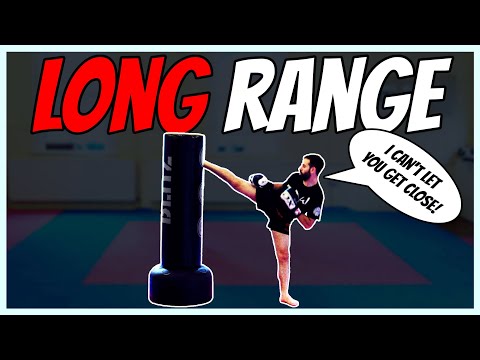
5 Tips For Fighting At Long Range
0
Long Range·Warrior Martial Arts
Website - https://www.warrior-martial-arts.com Instagram - https://www.instagram.com/warrior.martial.arts Facebook - htt…
Translation: long range
The Long Range subfamily covers the fighting distance where fighters are beyond punching range, requiring kicks, long jabs, or forward movement to close distance. [1] Long range is the distance where the longest-reaching techniques — front kicks, side kicks, teep, and jabbing while stepping — are the primary offensive tools. [1],[2] Fighting at long range favours fighters with reach advantages, kicking skills, and superior footwork who can maintain distance and control the pace. [2],[3]
Long-range fighting is emphasised in karate, taekwondo, and kickboxing traditions. [1]
Long-range fighters in MMA include strikers like Israel Adesanya and Jon Jones. [1]
No images yet for this technique.
Sign in to suggest an image.
Website - https://www.warrior-martial-arts.com Instagram - https://www.instagram.com/warrior.martial.arts Facebook - htt…
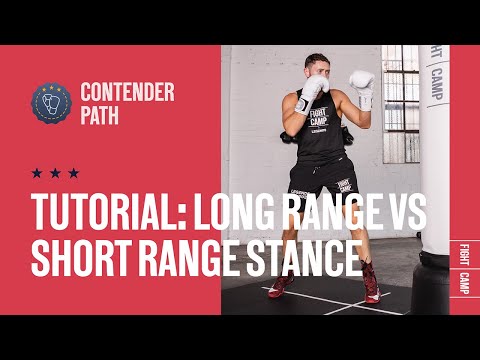
What is the difference between a long-range stance and a short-range stance? Well, FightCamp Co-Founder & Trainer Tommy …
No instructional courses yet for this technique.
Sign in to suggest a course.
Risk of injury to the person this technique is applied to
Standing positions are pre-engagement stances; minimal direct risk
Skill level needed to execute this technique reliably
Whether this technique is allowed under major competition rule sets
Brazilian Jiu-Jitsu: Theory and Technique (Renzo Gracie & Royler Gracie, 2001)
Alias sources — [1] Mastering Jujitsu (Gracie & Danaher, 2003) [2] Championship Fighting (Dempsey, 1950) [3] Championship Fighting (Dempsey, 1950)
Effectiveness sources — [1] Mastering Jujitsu (Gracie & Danaher, 2003) [2] Muay Thai Unleashed (Delp, 2006)
Standard Japanese martial arts terminology (kanji/hiragana)
Established Japanese martial arts naming convention — native Japanese term (和語/漢語)
Alias sources — [1] Mastering Jujitsu (Gracie & Danaher, 2003) [2] Championship Fighting (Dempsey, 1950) [3] Championship Fighting (Dempsey, 1950)
Effectiveness sources — [1] Mastering Jujitsu (Gracie & Danaher, 2003) [2] Muay Thai Unleashed (Delp, 2006)
balance, lower body stability, quick directional change
well-proportioned build with strong base
calves, quadriceps, core, hip stabilisers
Every move, in any martial art, shares a few universal traits. Mix and match below to pinpoint the right tool — or compare equivalents across styles.
In a long range stance, you cheat your weight back onto your rear leg and extend your hands out slightly, especially your lead hand, to stay in position for counter punching. Short range fighting, by contrast, uses a peekaboo guard with elbows glued to the body, which makes it easier to land power punches but also easier to get hit.
To land hooks and uppercuts from long range, you need to close the distance by stepping forward with your lead foot before throwing these punches, since they require you to be closer than your jab and cross.
The jab (one) and cross (two) are your primary long range punches—they help keep your opponent away from you and allow you to maintain distance while controlling the fight.
Yes, even if you're not naturally tall, it's beneficial to develop the ability to fight at distance as well as get in close, as you may eventually face opponents your own height and need versatility in your game.
The Long Range subfamily covers the fighting distance where fighters are beyond punching range, requiring kicks, long jabs, or forward movement to close distance. Long range is the distance where the longest-reaching techniques — front kicks, side kicks, teep, and jabbing while stepping — are the primary offensive tools.
Long range fighting has been emphasised in kicking-based arts like Taekwondo, Karate, and Savate, where maintaining distance and using kicks as the primary weapon is central to strategy. MMA's integration of kicking at range expanded the tactical importance of long range management.
Unified MMA: legal — Legal; IBJJF: legal — Legal; IJF: legal — Legal; WBC/Boxing: legal — Legal — stance and footwork are fundamental; WKF: legal — Legal; UWW: legal — Legal
Danger rating 2/10. Low — standing positions are pre-engagement stances; minimal direct risk
The standard setup chain: Achieve Position → Stabilize → Maintain → Attack.
Standard counters include: Posture Control — maintain strong posture to limit the opponent's offensive options / Escape to Neutral — work back to standing or a neutral position.
Common variants: Standard variation (primary positioning for control and attack); Offensive variation (configured for submission or striking opportunities); Transitional variation (positioned for quick movement to the next position); Defensive variation (prioritising stability and control over attack).
Long-range fighters in MMA include strikers like Israel Adesanya and Jon Jones.
Top errors to watch for: Standing at long range without using the jab — the jab is the primary tool for maintaining long range / Moving only backward to maintain distance — lateral movement and angles are more effective than straight retreats / Not using the front kick to manage distance — the teep is the longest-range tool available / Allowing the opponent to close distance without consequence — punish every attempt to close range.
The Long Range is also known as Enkyori, Out-Fighting Range, Kicking Distance, Long Distance.