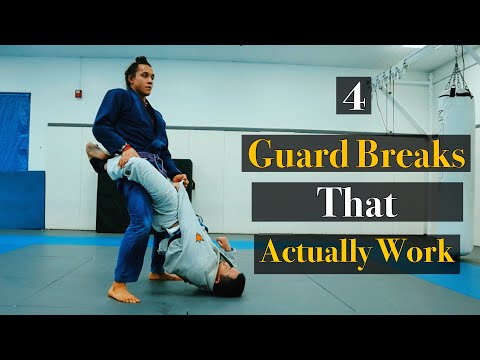
4 Best Closed Guard Breaks
0
Closed Guard·Jedi Does Jiujitsu
In today’s video we cover the 4 most effective Closed Guard breaks for bjj. Given that breaking closed guard is not the …
Translation: closed guard
Closed guard is the most fundamental guard position in Brazilian Jiu-Jitsu, where the bottom player wraps their legs around the opponent's torso and locks their ankles behind the opponent's back, creating a controlling clamp that prevents the top player from disengaging or advancing. [1] It was the guard that launched BJJ into global prominence — Royce Gracie fought almost exclusively from closed guard at UFC 1–4, submitting opponents with armbars, triangles, and guillotines from this position. [1],[2] The closed guard offers the strongest positional control of any guard variation because the locked ankles prevent the top player from standing or backing away, while the guard player's hips can generate powerful off-balancing forces for sweeps and create tight angles for submissions. [2],[3] Despite the proliferation of open guard systems in modern competition, closed guard remains the highest-percentage submission guard and the first guard taught to every BJJ beginner. [3]
Closed guard is the original guard position of Brazilian Jiu-Jitsu, developed by Hélio Gracie as a defensive platform from which a smaller fighter could control and submit a larger opponent. [1] Royce Gracie's UFC victories (1993–1994) were fought almost entirely from closed guard, demonstrating its effectiveness to the world. [1],[2] The closed guard was the dominant guard in BJJ competition until the late 1990s–2000s, when open guard innovations began to diversify the guard game; however, it remains the most fundamental and most-taught guard position. [2],[3]
Closed guard is the highest-percentage submission guard in BJJ — more submissions are finished from closed guard than from any other single position, with armbar, triangle, and cross-collar choke being the three most common finishes. [1] Roger Gracie's competition career demonstrated closed guard's effectiveness at the highest level — he won multiple World Championships using almost exclusively closed guard attacks. [2] In MMA, a strong closed guard neutralises the top fighter's ground-and-pound and creates submission threats, as demonstrated by fighters like Demian Maia and Fabricio Werdum. [3]
No images yet for this technique.
Sign in to suggest an image.
In today’s video we cover the 4 most effective Closed Guard breaks for bjj. Given that breaking closed guard is not the …
No instructional courses yet for this technique.
Sign in to suggest a course.
Risk of injury to the person this technique is applied to
Closed guard is one of the safest positions in grappling; the guard player controls distance and can prevent strikes; the primary risk is being stacked (opponent drives forward compressing the guard player's neck) or slammed in rulesets that permit it
Skill level needed to execute this technique reliably
Whether this technique is allowed under major competition rule sets
Jiu-Jitsu University (Saulo Ribeiro, 2008)
Description sources — [1] Jiu-Jitsu University (Ribeiro, 2008) on closed guard fundamentals [2] Mastering Jujitsu (Gracie & Danaher, 2003) on Gracie guard philosophy [3] The Guard (Beneville & Moreira, 2003)
History sources — [1] The Gracie Way (Kid Peligro, 2003) [2] UFC 1-4 historical records [3] BJJ competition evolution
Description sources — [1] Jiu-Jitsu University (Ribeiro, 2008) on closed guard fundamentals [2] Mastering Jujitsu (Gracie & Danaher, 2003) on Gracie guard philosophy [3] The Guard (Beneville & Moreira, 2003)
History sources — [1] The Gracie Way (Kid Peligro, 2003) [2] UFC 1-4 historical records [3] BJJ competition evolution
hip mobility (creating angles for attacks), grip strength (breaking and controlling posture), core strength (hip bumps and sit-ups)
long legs (easier to lock around larger opponents), flexible hips, strong grip
adductors (squeezing the guard closed), hip flexors (posture breaking and angle creation), core (sit-ups for sweeps), forearms (grip)
Every move, in any martial art, shares a few universal traits. Mix and match below to pinpoint the right tool — or compare equivalents across styles.
A Damn Good Guard is BJ Penn's term for an active closed guard that immediately threatens with submissions while preventing the top player from posturing up or passing. [1] The guard player maintains constant offensive pressure through grip fighting, angle creation, and submission attempts. [1]
The Goes Guard is a specific open guard configuration from MMA grappling where the bottom player hooks one leg behind the opponent's knee while controlling the same-side sleeve or wrist, creating a dynamic platform for sweeps, stand-ups, and transitions to the De La Riva guard. [1] Named after Roberto Goes, a Brazilian competitor and BJ Penn training partner, the Goes Guard was developed specifically for MMA's unique ground-fighting environment where the bottom player must not only sweep but also be able to stand up quickly to avoid ground-and-pound. [1] The guard combines elements of the De La Riva hook (the leg hooks behind the opponent's knee, controlling their base) with an open guard's hand positioning (controlling the wrist or sleeve for distance management and sweep setup). [1] BJ Penn documented the Goes Guard in The Book of Knowledge (2007) as an MMA-specific guard variant entered from the De La Riva position, presenting two signature sweeps: the Goes Guard Push Sweep (pushing the opponent backward over the hooked leg) and the Goes Guard Switch Sweep (redirecting the sweep mid-attempt when the opponent resists). [1] The tactical value in MMA is the DUAL-PURPOSE nature: the guard provides offensive sweeping capability while maintaining the ability to disengage to standing at any moment — the bottom player is never committed to staying on the ground, which is a critical consideration in MMA where being on the bottom means absorbing strikes. [1]
The closed guard is the most fundamental guard in BJJ and was the position from which Royce Gracie defeated multiple opponents in early UFC events. Helio Gracie developed the guard system to allow a smaller fighter to control a larger opponent from the bottom. (Ribeiro, Jiu-Jitsu University; Gracie & Danaher, Mastering Jujitsu)
Solid posture is one of the most important concepts for shutting down your opponent's attacks from the closed guard. If you allow your opponent to break down your posture, their options for attacks are virtually endless.
Never have one hand on your partner and one hand on the ground, as this offers an easy triangle attack. If you find yourself in this situation, immediately get both hands in the same place and push away.
Keep your elbow on your straight arm locked firmly in place when controlling your opponent's core. Any give at all will make it super easy for your opponent to break your grip and break down your posture.
Before you go for any guard breaks, it's important to first establish good posture and address any offensive grips your opponent has established.
Closed guard is the most fundamental guard position in Brazilian Jiu-Jitsu, where the bottom player wraps their legs around the opponent's torso and locks their ankles behind the opponent's back, creating a controlling clamp that prevents the top player from disengaging or advancing. It was the guard that launched BJJ into global prominence — Royce Gracie fought almost exclusively from closed guard at UFC 1–4, submitting opponents with armbars, triangles, and guillotines from this position.
Closed guard is the original guard position of Brazilian Jiu-Jitsu, developed by Hélio Gracie as a defensive platform from which a smaller fighter could control and submit a larger opponent. Royce Gracie's UFC victories (1993–1994) were fought almost entirely from closed guard, demonstrating its effectiveness to the world.
IBJJF: legal — Legal — guard is fundamental to BJJ, sweeps from guard score 2 points; IJF: restricted — Guard pulling penalized as non-combativity — groundwork from guard permitted …; ADCC: legal — Legal, guard pull penalized -1 point in points portion; Unified MMA: legal — Legal — no penalty for playing guard; FIAS Sport Sambo: legal — Legal
Danger rating 2/10. Low — closed guard is one of the safest positions in grappling; the guard player controls distance and can prevent strikes; the primary risk is being stacked (opponent drives forward compressing the guard player's neck) or slammed in rulesets that permit it
The standard setup chain: Establish Closed Guard → Break Posture → Control Arms → Attack → Chain Attacks → Maintain Guard.
Standard counters include: Guard Break (standing) — standing up inside closed guard breaks the ankle lock with hip extension / Guard Break (kneeling) — inserting a knee through the middle and prying the guard open / Posture — maintaining upright posture with hands on hips prevents the guard player from attacking / Stack Pass — driving the guard player's legs over their head to compress and pass.
Common variants: Standard closed guard (ankles crossed behind the opponent's back, controlling po…); High guard (legs climbed high on the opponent's back, hips angled; se…); Rubber guard (10th Planet system; using flexibility to overhook the opp…); Williams guard (trapping one of the opponent's arms between the legs in a…); Body triangle guard (locking a figure-four (triangle) with the legs around the…).
Closed guard submissions (armbar, triangle, cross-collar choke) account for the highest percentage of submission finishes at black belt level in IBJJF competition. Roger Gracie won 10 World Championship gold medals using predominantly closed guard attacks.
Top errors to watch for: Lying flat on the back — effective closed guard requires being on one hip, angled toward the attacking side; flat gua… / Ankles crossed too low on the opponent's back — the ankles should be high (near the shoulder blades) for maximum cont… / Holding closed guard passively without attacking — a static closed guard gets opened and passed; constant attacking k… / Not breaking posture before attacking — attempting an armbar or triangle while the opponent has full posture results ….
The Closed Guard is also known as Kurōzudo Gādo, Closed Guard, Full Guard, Guard Position.