Introduction and Context
Eli Knight of Knight Jiu-Jitsu collaborates with Jared Jessup at IQ Jiu-Jitsu to systematize deep half guard entries, sweeps, and positioning. This instructional focuses on the complete system from initial setup through multiple offensive options.
Knee Shield Foundation
The deep half guard entry commonly originates from knee shield position. The bottom leg hooks the opponent's leg while the top leg creates pressure toward the chest. Foot stacking (rather than ankle crossing) provides the structural base necessary for effective entries.
Frame Structure and Weight Distribution
Proper framing on the shoulder and arm (between elbow and wrist) prevents the opponent from flattening the position. The practitioner monitors the opponent's energy to determine which frame point requires reinforcement.
Entry Mechanics and Crossface Prevention
To avoid crossface while shooting deep, the practitioner kicks the opponent's torso toward the armpit to force a post on the opposite side. This occupies the opponent's hand and creates a clear path for the deep half insertion.
Basic Roll Sweep (Hand Control)
When hand control is maintained on the opponent during the entry, a simple across-body roll completes the sweep. The structural integrity of the leg position prevents the opponent from rolling over or under through the frame.
Deep Half Guard Position and Leg Scissor Mechanics
If the opponent posts to prevent the initial roll, the practitioner transitions to deep half guard with elevated legs. Scissoring the femurs combined with an uppercut to the posted hand dislodges the post and enables the sweep.
Foot Control and Leverage Optimization
Stepping on the opponent's foot creates superior push-pull leverage compared to using only the femur. This foot control drops the opponent's weight onto the practitioner, allowing an effortless roll rather than muscled movement.
Corrected Posture Response and Ankle Control
When the opponent corrects posture after the initial entry, the practitioner secures the arm underneath their own leg and establishes ankle contact. This touch point allows the practitioner to accelerate the opponent's natural postural correction.
Perpendicular Hip Switch and Leg Leverage Sweep
The practitioner shifts their tailbone perpendicular to the opponent, transitioning to hamstring-to-hamstring contact. Pulling the ankle while driving the foot outward creates mechanical leverage that rolls the opponent over cleanly.
Guard Pass and Back Take Options
From the sweep position, the practitioner may stand and kick out to achieve a clean pass, or alternatively step and hook the opponent's inside leg. Driving the far leg across and pushing exposes the opponent's back for a back take.
Jiu-Jitsu Mini-Seminar on Deep Half Guard Techniques
Key Takeaways
- •Introduction and Context
- •Knee Shield Foundation
- •Frame Structure and Weight Distribution
- •Entry Mechanics and Crossface Prevention
Deep Half Guard is a powerful position, especially for use against heavier aggressive opponents. This video is an exploration into the entry, sweeps and back takes from deep half. Professor Jared Jessup and I outline lots of details here. I hope you enjoy it, and that it helps your game! • Make sure to subscribe and turn on notifications to be told when I go live on this channel and when I upload new videos. I appreciate you watching as always. • Get the Jiu-Jitsu Deep Dive Digital Seminar with over 180 videos and 5 hours of content here: https://www.martialartsdigitalseminars.com/Jiu-Jitsu-Deep-Dive • Check out Patreon for more in-depth classroom instruction: Patreon.com/KnightJiuJitsu • Jared Jessup: @iqjiujitsu on FB and IG • Knight Jiu-Jitsu T-Shirts available here: https://tinyurl.com/wzu6ufb • Knight Jiu-Jitsu on Instagram @knight_jiu_jitsu_ • Follow me on DTube: https://d.tube/#!/c/knightbjj • Follow me on Steemit: https://steempeak.com/@knightbjj
Related Techniques
Frequently Asked Questions
What does this video teach about standard deep half?
This video covers introduction and context, knee shield foundation, frame structure and weight distribution. It provides detailed instruction from Knight Jiu-Jitsu.
How long does it take to learn standard deep half?
The basic mechanics can be understood in a single session, but developing reliable execution requires consistent drilling over weeks of practice. This 10-part breakdown helps structure your training by isolating each phase of the technique.
What are the key details for finishing standard deep half?
The practitioner shifts their tailbone perpendicular to the opponent, transitioning to hamstring-to-hamstring contact. Pulling the ankle while driving the foot outward creates mechanical leverage that rolls the opponent over cleanly.
Related videos
DEEP Half Guard — Beginner's Guide
James Clingerman
(HOW TO) Waiter Sweep from Deep Half Guard
Brandon Mccaghren
Back Takes from the Waiter Sweep Position (Deep Half Guard)
Tarik BJJ
This Guard is Ridiculously Strong - Waiter Guard Back Attack - BJJ Guards
Dubious Dom
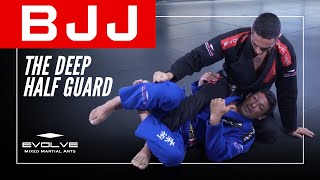
BJJ | An Introduction To The Deep Half Guard
Evolve Mixed Martial Arts